  |
|
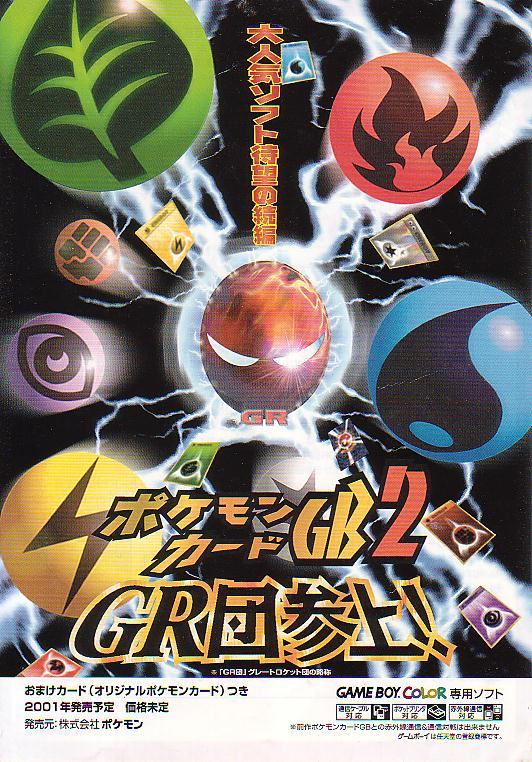
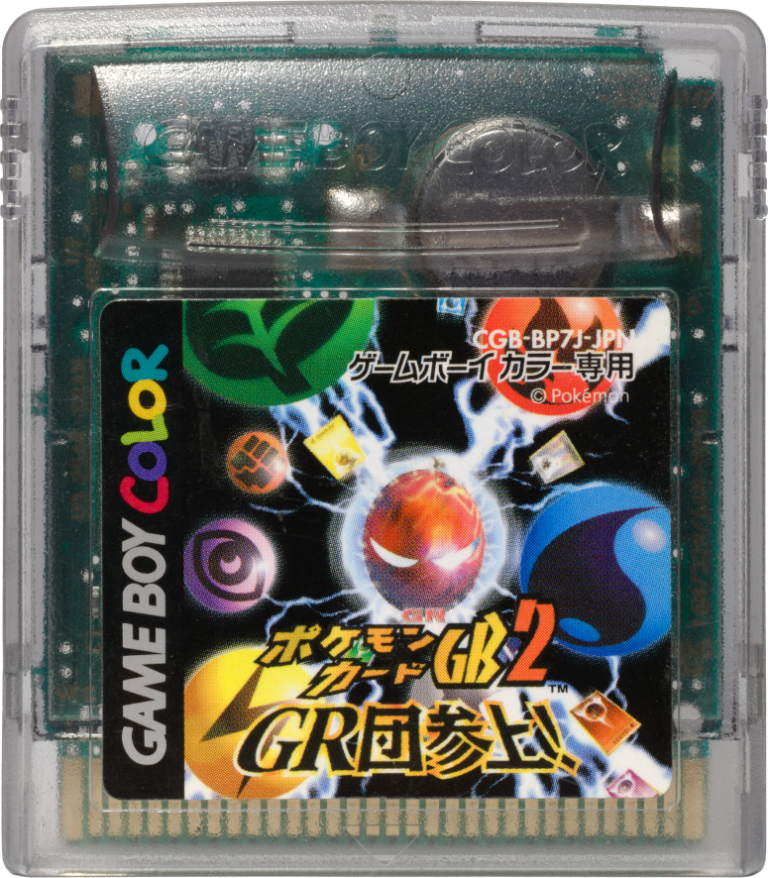
| Titles | Pokémon Card GB2: Here Comes Team GR! ポケモンカードGB2 GR団参上! (Pokémon Kādo Jī Bī Tsū: Jī Āru-dan Sanjō!) |
| Platform | Game Boy Color (Game Boy Color only; infrared port and Game Link Cable) |
| Developer | Hudson Soft, with Creatures Inc. |
| Publisher | The Pokémon Company (its first published game) |
| Director | Koji Arai |
| Producers | Tsunekazu Ishihara · Shinichi Nakamoto · Takahiro Harada |
| Music | Ichiro Shimakura |
| Players | 1–2 |
| Genre | Card battle role-playing game |
| Cards | 441 usable cards in eight booster packs, plus promos |
| Released | 28 March 2001 (Japan only) |
| Re-releases | None – not on Virtual Console or Nintendo Switch Online (October 2026) |
| Predecessor | Pokémon Trading Card Game (Game Boy Color, 1998) |
| Sales | About 890,000 in Japan |
Overview
 Published by The Pokémon Company on the Game Boy Color, Pokémon Card GB2: Here Comes Team GR! is the sequel to Pokémon Trading Card Game on Game Boy, and another Pokémon game to be released only in Japan.
The sequel inherited most of the previous game’s mechanics, with the addition of new features, like a whole new island the player can explore, many new cards and the option to play as a female character. Pokémon Card GB2 also has a more elaborate story, focusing mainly on the villainous Team Great Rocket.
The game includes nearly every card from the Base, Jungle, Fossil and Team Rocket sets of the real Pokémon Trading Card Game, along with most of the Japanese Vending cards and the Intro Pack cards – 441 cards in all.
The sequel to Pokémon Card GB. To win back the cards stolen by the mysterious organisation Team GR, the hero, Mark, sets off once again on a journey of card battles. With the ‘Team Rocket’ and ‘Expansion Sheet’ series and the ‘Intro Pack’ newly added, there are now 441 different cards in the game, twice as many as before!
The easy-to-follow guide feature that lets even first-timers start playing straight away is still here, and now you can rebuild your deck to suit your opponent, so you can enjoy more advanced battles. Experience the deep world of Pokémon cards!
- Have your deck rated on how complete it is
- There are also battles that limit which cards you can use
— Official description (The Pokémon Company, pokemon.co.jp; translated from the Japanese by Pokémon Dungeon)
Quick Answers
The questions people ask about Pokémon Card GB2, answered first and explained further down the page.
Was Pokémon Card GB2 ever released in English?
No. It came out only in Japan, on 28 March 2001. IGN previewed it in January 2001 as Pokémon Trading Card Game 2: Return of Team Rocket and expected a Western release, but none followed. English-speaking players have relied on an unofficial fan translation, which first appeared as a complete patch in 2012. More →
Is Pokémon Card GB2 on Nintendo Switch Online or the 3DS Virtual Console?
No. As of October 2026 the sequel has never been re-released. Only the first Pokémon Trading Card Game made the jump: it reached the 3DS Virtual Console in 2014 and the Nintendo Switch Online Game Boy library on 8 August 2023. GB2 is still playable only on an original Japanese cartridge. More →
How many cards are in Pokémon Card GB2?
441 cards can be used. That covers every card from the first game plus the Team Rocket expansion, most of the Japanese Vending (Expansion Sheet) cards, the 15 Intro Pack cards and 13 game-exclusive cards. They are split across eight booster packs, from Beginning Pokémon to We Are Team Rocket, plus promos. More →
How do you get Lugia and Here Comes Team Rocket! in Pokémon Card GB2?
Both are Phantom Cards that only Card Pop! can produce. Two players with copies of GB2 link via infrared and each receives a random card, which can occasionally be a Phantom Card. The other two Phantom Cards, Venusaur and Mew, can also be bought for 2,000 coins at GR Island’s Game Center. More →
Can Pokémon Card GB2 link with the first Pokémon Trading Card Game?
No. The two games cannot trade cards, duel or perform Card Pop! with each other; GB2 only talks to another copy of GB2. Trying to Card Pop between the two can cause glitches and even wipe save data, so it is best avoided entirely on original hardware. More →
How do you reach and beat Biruritchi, the final boss?
Clear the six GR forts and the Colorless Altar on GR Island, then head to the GR Castle. There Kanzaki will only duel you if your deck holds all four Legendary Cards, and Rui must also be beaten. Biruritchi plays a best-of-three match with one of four random Dark Pokémon decks. More →
Story
The game starts out on TCG Island, where the player has already become the Pokémon Trading Card Champion and won the legendary cards guarded by the Grand Masters, who can only be challenged after defeating the eight Club Masters of the region. To their surprise, Team Great Rocket appears and steals the player’s cards, taking over several clubs and kidnapping many people along the way – including two of the Club Masters and all four Grand Masters.
The player then visits Dr. Mason’s Lab, where they meet their old rival Ronald, who decides to infiltrate Team Great Rocket to get some intel on the organisation. Dr. Mason then talks to the player and gives them some new cards to replace the stolen ones, and asks them to help Ronald save the Club Masters from their kidnappers and recover the stolen cards.

The player then starts out on their journey, first visiting the Club Masters of the region (or the Team Great Rocket members who have taken over their clubs) and battling them. Six of the Club Masters hand over an Event Coin when they are defeated, each named after a Pokémon, and beating four Team GR members on TCG Island gathers the four pieces of the GR Coin. The player then heads to GR Island, where they fight seven Team Great Rocket Fort Leaders, along with their members, in six forts and the Colorless Altar.
Many of the Fort Leaders and the members guarding them force the player to follow special rules in order to duel them. Like the Club Masters, each Fort Leader gives the player a coin, named after a Pokémon. Beating the forts also frees the kidnapped Club Masters and Grand Masters, so the player wins back the legendary cards, which are needed in order to reach Team Great Rocket’s boss.
With the legendary cards back in hand, the player heads to the Team GR Castle on GR Island, where they face Team Great Rocket’s two Big Bosses, Rui and Kanzaki, and finally the king himself, Biruritchi, in a best-of-three match. Once Biruritchi is defeated, the player receives the GR King Coin and Team GR’s Mewtwo card, and the credits roll. Beating him a second time opens the Sealed Fort for more duels after the story.
Characters
The game is filled with characters the player will encounter throughout the story:
Playable characters

Mark
The male playable character and the protagonist of the previous game.

Mint
The female counterpart of Mark, added in Pokémon Card GB2. She only appears in this game, and as the game was only released in Japan, she has never appeared in an official English release.
Club Masters
There are eight Club Masters spread out across TCG Island. Unlike the previous game, they give the player Coins instead of Medals – six of them, at least, as Rick and Mitch are kidnapped by Team Great Rocket and hand over promo cards instead once they are rescued.

 Rock Club: Gene
Deck: Even 3 Years on a Rock Deck
The Rock Club’s master awards the Kabuto Coin at his club. His deck name plays on the Japanese proverb about perseverance; in the first game he used Rock Crusher.

Fighting Club: Mitch
Deck: Raging Billow of Fists Deck
The second kidnapped Club Master. Rescuing him from the GR Fighting Fort earns the Cool Porygon promo rather than a coin; his first-game deck was First-Strike.

 Grass Club: Nikki
Deck: MAX Energy Deck
Hands over her Oddish Coin at Mr. Ishihara’s House rather than inside her own club. Her first-game deck was the Flower Power Deck, replaced here by a new list.

 Fire Club: Ken
Deck: Go Arcanine! Deck
His club falls under Team GR’s control early on; once it is freed he awards the Charmander Coin. His first-game deck was the Fire Charge Deck.

 Lightning Club: Isaac
Deck: Sky Spark Deck; Electric Selfdestruct Deck
Uses two different decks in the sequel. His Electric Selfdestruct Deck echoes the Zapping Selfdestruct Deck he used in the first game, and he awards the Pikachu Coin.

 Water Club: Amy
Deck: Rain Dance Confusion Deck
Another Club Master whose club is overrun by Team GR on TCG Island. Rescued, she gives the Starmie Coin; in the first game she used the Rain Dancer Deck.

Science Club: Rick
Deck: Dark Science Deck
Kidnapped by Team Great Rocket at the start of the adventure. Freeing him from the GR Grass Fort earns the Hungry Snorlax promo instead of an Event Coin.

 Psychic Club: Murray
Deck: Psychic Elite Deck; Handed Over GR Deck
Has two decks in GB2, one called the Handed Over GR Deck. Beating him at the Psychic Club earns the Alakazam Coin; his first-game deck was Strange Psyshock.
Grand Masters
The four Grand Masters, their legendary cards and their type specialisms. All four are kidnapped by Team Great Rocket and have to be freed from the GR forts.

Pokémon Dome: Courtney
Deck: Grand Fire Deck
Abducted by Team GR and freed from the GR Fire Fort, where she gives an Arcanine promo. Her first-game deck was the Legendary Moltres Deck.

Pokémon Dome: Steve
Deck: Legendary Fossil Deck
Swaps his first-game Legendary Zapdos Deck for a fossil-themed list. Freeing him from the GR Lightning Fort earns an Electabuzz promo card.

Pokémon Dome: Jack
Deck: Water Legend Deck
The ice specialist is rescued from the GR Water Fort and rewards the player with a Magikarp promo. His first-game deck was the Legendary Articuno Deck.

Pokémon Dome: Rod
Deck: Great Dragon Deck
The strongest Grand Master is held in the GR Psychic Stronghold; rescuing him earns a second promo Dragonite. His first-game deck was the Legendary Dragonite Deck.
Team Great Rocket
They are the villains of the game, who are trying to control the trading card world by stealing all the Pokémon cards and even kidnapping many key individuals. As all villains do, they will resort to any tricks and mischievous plans in order to realise their goals.
The seven Fort Leaders:

GR Grass Fort: Morino
Deck: Mad Petals Deck
Fort members Midori, Yuta and Miyuki must be beaten first. Morino’s rule makes Grass Pokémon immune to Special Conditions, and Rick is held captive in this fort.

GR Lightning Fort: Catherine
Deck: Quick Attack Deck
Guarded by Renna and Ichikawa. Under her rule Lightning Pokémon deal 10 extra damage. Grand Master Steve is freed from this fort.

GR Fire Fort: Hidero
Deck: Gaze Upon the Power of Fire! Deck
Reached after Jes, Yuki and Shoko. His rule removes Fire Pokémon’s Weakness to Water, and Grand Master Courtney is held here.

GR Water Fort: Kanoko
Deck: Water Stream Deck
Fort members Miyajima, Senta and Aira come first. Kanoko’s rule cuts Water Pokémon’s Retreat Cost by one, and Grand Master Jack is imprisoned here.

GR Fighting Fort: Kamiya
Deck: Running Wild Deck
Guarded by Goda and Grace inside a maze with hidden chests. His rule stops Fighting Pokémon being resisted, and Club Master Mitch is held here.

GR Psychic Stronghold: Mami
Deck: Spirited Away Deck
The largest fort, with four members: Kevin, Miwa, Yosuke and Ryoko. Under her rule discarded Energy returns to its owner’s hand; Grand Master Rod is held here.

Colorless Altar: Ishii
Deck: Eye of the Storm Deck
Leads Nishijima and Samejima at the Colorless Altar. Ishii is also one of the four Team GR members whose defeat on TCG Island yields a GR Coin fragment.
The GR Castle:

GR Castle: Rui
Rule: No special rules
One of Biruritchi’s two Big Bosses (GR-dan Daikanbu). Rui and Kanzaki must both be beaten before the player is allowed to challenge the king.

GR Castle: Kanzaki
Deck: Bad Guys Deck (Dark Gloom, Dark Charmeleon, Dark Golduck, Dark Slowbro)
Refuses to duel unless the player’s deck contains all four Legendary Cards, as he wants to test himself against them. His deck leans on Dark Pokémon and The Boss’s Way.

 GR Castle: Biruritchi
Decks: One of four at random: Burn Up! Deck (Dark Charizard), Smash It! Deck (Dark Blastoise), Throw Out! Deck (Dark Machamp), Stop Breath! Deck (Dark Venusaur)
Fought in a best-of-three match. He can be rematched for another Team GR’s Mewtwo each time, and beating him twice opens the Sealed Fort.
Additional characters

Dr. Mason
He’s the Pokémon card professor of TCG Island (Dr. Ōyama in Japanese), who entrusts the player with the mission of rescuing the island from Team Great Rocket. His new Deck Diagnosis service reviews the player’s deck.
Ronald
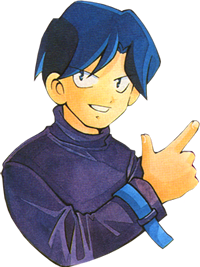
Similarly to the previous game, he’s the player’s rival, but has a more developed role in the game, as he disguises himself as one of Team Great Rocket’s members, all while gathering important information and acquiring card packs or sets for the player.

Imakuni?
The eccentric musician Imakuni?, based on the real-life Japanese performer of that name, returns as a hidden opponent who wanders the islands. GB2 adds a red-clad Imakuni? as well, and beating either one a set number of times earns promo cards such as Slowpoke and Farfetch’d, plus the Imakuni? card itself.
Locations
The game takes place on two different islands, each with many locations:
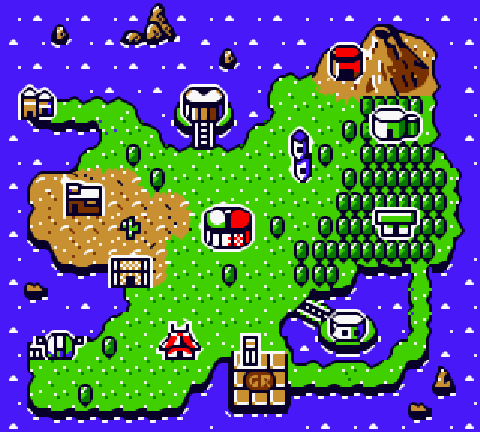

Trading Card Game Island (TCG Island)
There are 13 locations on TCG Island, and they are as follows:
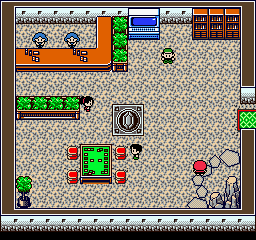
The Eight Clubs: Each Club specialises in a Pokémon type and consists of a number of members and their Club Master:
Rock Club
| Member | Deck |
|---|---|
| Matthew | Rolling Stone Deck |
| Andrew | Awesome Fossil Deck |
| Ryan | Great Earthquake Deck |
| Club Master Gene | Even 3 Years on a Rock Deck |
Lightning Club
| Member | Deck |
|---|---|
| Nicholas | Overflow Deck |
| Brandon | 10,000 Volts Deck |
| Jennifer | I Love Pikachu Deck |
| Club Master Isaac | Electric Selfdestruct Deck; Sky Spark Deck |
Fighting Club
| Member | Deck |
|---|---|
| Chris | Skiller Warrior Deck |
| Michael | New Machampion Deck |
| Jessica | I Love to Fight Deck |
| Club Master Mitch | Raging Billow of Fists Deck |


Water Club
| Member | Deck |
|---|---|
| Joshua | Energy Removal Deck |
| Sara | Splashing About Deck |
| Amanda | Beach Deck |
| Club Master Amy | Rain Dance Confusion Deck |
Grass Club
| Member | Deck |
|---|---|
| Brittany | Poison Bee Deck |
| Heather | Steady Increase Deck |
| Kristin | Glittering Scales Deck |
| Club Master Nikki | MAX Energy Deck |
Science Club
| Member | Deck |
|---|---|
| Joseph | Poisonous Swamp Deck |
| David | Natural Science Deck |
| Erik | Gather Nidoran Deck |
| Club Master Rick | Dark Science Deck |


Psychic Club
| Member | Deck |
|---|---|
| Daniel | Puppet Master Deck |
| Stephanie | Psychokinesis Deck |
| Robert | Phantom Deck |
| Club Master Murray | Psychic Elite Deck; Handed Over GR Deck |
Fire Club
| Member | Deck |
|---|---|
| Jonathan | Immortal Flame Deck |
| Adam | Electric Current Shock Deck |
| John | Flame Festival Deck |
| Club Master Ken | Go Arcanine! Deck |


- Ishihara’s House: Where Mr. Ishihara can mostly be found resting, gathering his strength for when you want to negotiate some trades with him!
- Mason Laboratory: Dr. Mason’s research facility.
- Challenge Hall: Many tournaments are held here, in which the player can participate and earn rare cards. The Challenge Cup works as it did in the previous game, and it is joined by the new GR Challenge Cup and Grand Master Cup.
- The Airport: Here, the player can travel to GR Island using Team Great Rocket’s blimp.
- Pokémon Dome: It is where the Grand Masters await the player and protect the legendary cards. Since they’re based on the Elite Four in the main game series, there are also four Grand Masters in this game.

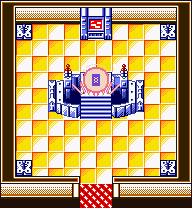

| Grand Master | Deck |
|---|---|
| Courtney | Grand Fire Deck |
| Steve | Legendary Fossil Deck |
| Jack | Water Legend Deck |
| Rod | Great Dragon Deck |
Great Rocket Island (GR Island)

As the base of Team Great Rocket, the island contains mostly facilities belonging to the organisation. The locations on the island are:
- The Game Center: The player can win chips here from the games and later trade them for cards and coins.
- Ishihara’s Villa: Another one of Mr. Ishihara’s homes, where he can be found.
- The Airport: It is used to return to TCG Island.
- Challenge Hall: GR Island’s own hall, with a Challenge Machine for long winning streaks.
- The six Team Great Rocket Forts and the Colorless Altar: These work in a similar way to the Clubs on TCG Island. Each Fort has a Team Great Rocket Leader, accompanied by other members who need to be fought first. The Team Great Rocket members and the Leaders themselves will often force special rules on the player, mostly giving themselves the advantage.
- Team Great Rocket Castle: It is where the boss of the organisation resides, along with his two Big Bosses.
Grass Fort
| Member | Special rules | Deck |
|---|---|---|
| Midori | No special rules | Bug Collecting Deck |
| Yuta | No special rules | Demon Forest Deck |
| Miyuki | Only Grass Energy cards can be used | Sticky Poison Gas Deck |
| Leader Morino | Grass-type Pokémon are not affected by Special Conditions | Mad Petals Deck |
Lightning Fort
| Member | Special rules | Deck |
|---|---|---|
| Renna | Player must use four Pikachu in their deck (Surfing Pikachu and Flying Pikachu cards do not count) | Chain Lightning by Pikachu Deck |
| Ichikawa | Only Lightning Energy cards can be used | This is the Power of Electricity Deck |
| Leader Catherine | Lightning-type Pokémon inflict 10 extra damage | Quick Attack Deck |
Water Fort
| Member | Special rules | Deck |
|---|---|---|
| Miyajima | Only Water Energy cards can be used | Whirlpool Shower Deck |
| Senta | Player must use four Magikarp in their deck | Paralyzed! Paralyzed! Deck |
| Aira | Both players can’t bench more than three Pokémon | Bench Call Deck |
| Leader Kanoko | Water-type Pokémon have their Retreat Cost reduced by one | Water Stream Deck |
Fighting Fort
| Member | Special rules | Deck |
|---|---|---|
| Grace | Only Fighting Energy cards can be used | Full Strength Deck |
| Goda | Player cannot use Super Energy Removal or Energy Removal in their deck | Rock Blast! Deck |
| Leader Kamiya | Fighting-type Pokémon cannot be resisted | Running Wild Deck |
Fire Fort
| Member | Special rules | Deck |
|---|---|---|
| Jes | No special rules | Complete Combustion Deck |
| Yuki | Only Fire Energy cards can be used | Fireball Deck |
| Shoko | Player must use four Eevee in their deck | Eevee Showdown Deck |
| Leader Hidero | Fire-type Pokémon are no longer weak to Water | Gaze Upon the Power of Fire! Deck |
Psychic Stronghold
| Member | Special rules | Deck |
|---|---|---|
| Kevin | The Resistance amount to the Psychic type is increased from -10 to -30 | Super Destructive Power Deck |
| Miwa | Only Psychic Energy cards can be used | Direct Hit Deck |
| Yosuke | Player must use a combination of six Haunter and Gastly (Dark Haunter doesn’t count) | Bad Dream Deck |
| Ryoko | Player cannot use any Trainer cards in their deck | Pokémon Power Deck |
| Leader Mami | Each time a player discards an Energy card, it returns to their hand | Spirited Away Deck |
Colorless Altar
| Member | Special rules | Deck |
|---|---|---|
| Nishijima | Player must use four Spearow, Pidgey or Double Colorless Energy cards in their deck | Snorlax Guard Deck |
| Samejima | Player must use four Dratini, Jigglypuff or Mysterious Fossils in their deck | Sudden Growth Deck |
| Leader Ishii | Player must use four Meowth, Rattata or Dark Pokémon cards in their deck | Eye of the Storm Deck |
Team GR Castle
| Member | Special rules | Deck |
|---|---|---|
| Rui | No special rules | – |
| Kanzaki | Player must use the four legendary cards in their deck | Bad Guys Deck |
| Team Great Rocket King Biruritchi | No special rules | One of four at random: Burn Up!, Smash It!, Throw Out! or Stop Breath! Deck |
Gameplay & Features

As the sequel to Pokémon Trading Card Game on GB, the game showcases most of the features of its predecessor, with the addition of many new ones. The player can now play as a female character called Mint, or choose the male protagonist from the previous game, Mark. Playing as Mint or Mark has no effect on the rival, who is still Ronald.
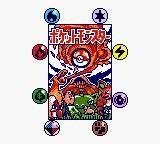
A new island called GR Island was added as the base of Team Great Rocket, where major events of the game take place. The interiors of a few of the clubs on TCG Island have also been greatly enhanced. The player’s opponents now have expressive sprites, reacting with a happy face to winning and a sad one when they lose. There are eight different card sets, or packs, that can be acquired within the game:
- Beginning Pokémon
- Island of Fossil
- Sky Flying Pokémon
- Legendary Power
- Promotion Card
- Psychic Battle
- Team Rocket’s Ambition
- We Are Team Rocket


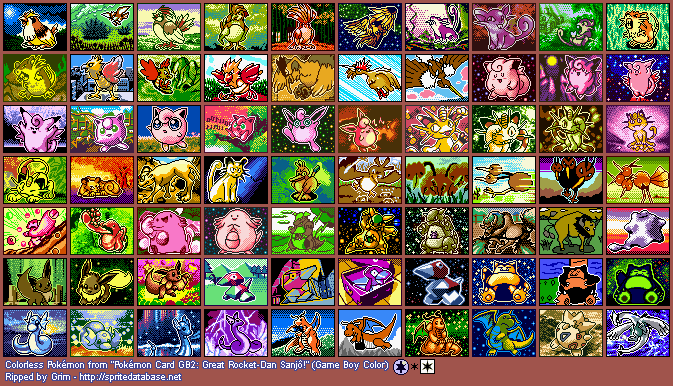
The game features every card from Pokémon Trading Card Game on GB, but a few cards from the real card game’s sets never made it in. These cards are: Caterpie, Cubone, Ditto (two different cards), Electabuzz, Electrode, Flash, Grimer, Guard Spec., Jynx, Kadabra, Koffing, Marowak, Mew, Pikachu, Pokémon Tower and Tangela.
In depth: the fine print

Card Pop!

Pokémon Card GB2: Here Comes Team GR! inherited the Card Pop! feature of the previous game (called Card de Pon! in Japanese), allowing players to link their games through the infrared communication ports, with each of them receiving a randomly generated card.
Card Pop! is still the only way to obtain the Phantom Cards ‘Here Comes Team Rocket!’ and Lugia (the other two Phantom Cards, Venusaur and Mew, can also be bought at GR Island’s Game Center). One should note that Card Pop! only works between two copies of the same game: it is impossible for this game, for example, to Card Pop! with its predecessor, and trying it can cause glitches or even erase save data.
Connectivity
Players who own the game can connect to each other through the Game Link Cable to duel and test their decks, or use the Game Boy Color’s infrared port to exchange deck configurations and cards, or to perform Card Pop!. GB2 can only link with another copy of GB2, so it can’t connect to the first Pokémon Trading Card Game at all, whether on the original cartridge, the 3DS Virtual Console or Nintendo Switch Online.
Japan Only: Names & the Fan Translation

Pokémon Card GB2 never left Japan, so many of its names have no official English version:
- The game was released only in Japan. IGN’s January 2001 preview called it Pokémon Trading Card Game 2: Return of Team Rocket and expected an English version, but none was made.
- The Japanese subtitle GR団参上! has been rendered in English as Here Comes Team GR!, Team Great Rocket Is Here! and The Invasion of Team GR!; there is no official localised title.
- Characters carried over from the first game are known in English by the names Nintendo gave them in 2000, but their Japanese names differ: Dr. Mason is Dr. Ōyama, Courtney is Hiroko, Jack is Kanekōji, Rod is Ryūdō and Nikki is Kunimi.
- Characters new to GB2, including the Fort Leaders, Rui, Kanzaki and Biruritchi, have no official English names, so English references use romanised Japanese names such as Morino, Hiderō and Kanoko.
- Several clubs have different names in Japanese: the Grass, Water, Lightning, Psychic, Rock and Fighting Clubs are the Green, Aqua, Electric, Esper, Stone and Battle Clubs.
- TCG Island is Hajimari no Shima (Island of Beginnings) in Japanese, and GR Island is GR-dan no Shima (Team GR’s Island).
- Card Pop! is called Card de Pon! (カードでポン!) in Japanese.
English-speaking players have relied on an unofficial fan translation by artemis251, released as a complete patch in June 2012, which made the whole adventure playable in English for the first time.
Glitches, exploits and oddities
Linking with the wrong game, cards at the wrong level and a Mewtwo that plays differently:
Card Pop! with the first game
GB2’s Card Pop! is only meant to work between two copies of GB2, but because both games use the same infrared feature it is possible to point a copy of the first Pokémon Trading Card Game at it and attempt the exchange. The two games are not compatible, and attempting it can cause glitches in either game and can even corrupt or erase save data. Anyone playing on original Game Boy Color hardware with both cartridges should keep Card Pop! sessions strictly between copies of the same game.
Cards with the wrong level
Four cards carry a different level in the game from the one printed or listed elsewhere. The Vending series Charmander is LV.10 on the real card but LV.12 in GB2, while the Vending Doduo drops from LV.10 to LV.8. Two cards made for the games also disagree with the official Japanese trading guide: the promotional Moltres is LV.40 in-game but LV.37 in the guide, and the Laboratory Magnemite is LV.14 in-game but LV.15 in the guide. The changes have no effect on play, as levels only label the card.
Team GR’s Mewtwo plays differently
The physical Team GR’s Mewtwo promo packed with the game and the in-game version do not quite match. On the printed card, its Dark Wave Pokémon Power adds bonus damage to attacks by your Dark Pokémon through coin flips, worth 10 or 20 extra. In the game the power is simplified to add a random 0, 10 or 20 damage instead. Both versions stop working while Mewtwo is Asleep, Confused or Paralysed, and the physical card was never legal in official tournaments.
Videos & media
Check out this video of Pokémon Card GB2 for the Game Boy Color, played with the English fan translation.
Pokémon Card GB2 played with the English fan translation (video: Michibiku).
Trivia & facts
- The secret card Dark Raichu, found in the Team Rocket’s Ambition pack, was the first card ever to be released outside Japan before being released there. Wizards of the Coast created it as the secret card of the English Team Rocket set in 2000, and it only reached Japan later in a different expansion, which is why it carries the ‘GB’ symbol in the game instead of the symbol of the Team Rocket expansion.
-

Pokémon Card GB2: Here Comes Team GR! Official Guidebook. Copies of the game came with promo cards of Team GR’s Mewtwo and Lugia.
Further trivia
- It was the first game ever published by The Pokémon Company rather than Nintendo.
- It was the final Pokémon game released for the Game Boy Color in Japan, arriving one week after the Game Boy Advance launched there on 21 March 2001.
- Viewed on the overworld map, GR Island is shaped like a rocket, fitting its role as Team Great Rocket’s home.
- The maze inside the GR Fighting Fort hides treasure chests, two of which hold promo Diglett and Dugtrio cards.
Legacy
What came after
- Pokémon Card GB, the predecessor, released in Japan – 18 December 1998. Released in the West as Pokémon Trading Card Game in 2000; it sold 1.39 million copies in Japan.
- IGN reports the sequel – 23 January 2001. Previewed under the working title Pokémon Trading Card Game 2: Return of Team Rocket, with an English release described as likely.
- Pokémon Card GB2 launches in Japan – 28 March 2001. Game Boy Color only, a week after the Game Boy Advance’s Japanese launch; Team GR’s Mewtwo and Lugia promo cards included. It became the last Pokémon game for the Game Boy Color in Japan.
- Complete English fan translation patch – 15 June 2012. An unofficial patch by the fan translator artemis251 made the whole game playable in English for the first time.
- First game reaches the 3DS Virtual Console – 10 July 2014. Europe first, then Australia (11 July), North America (13 November) and Japan (24 December 2014), without Card Pop!. GB2 was not released.
- First game joins Nintendo Switch Online – 8 August 2023. Pokémon Trading Card Game was added to the Game Boy library; the sequel was not.
- Still unavailable on Nintendo Classics – October 2026. No re-release or official translation of GB2 has been announced.
Where to play it today
As of October 2026 the only official way to play is an original Japanese cartridge on a Game Boy Color, or on a Game Boy Advance or GameCube Game Boy Player, although those later systems lack the infrared port needed for card trades and Card Pop!. The game has never been reissued on the 3DS Virtual Console or Nintendo Switch Online, and it remains entirely in Japanese apart from an unofficial fan translation.
How it was made
Hudson Soft developed the sequel with assistance from Creatures Inc., and Koji Arai returned as director after leading the first Pokémon Card GB. Tsunekazu Ishihara, Shinichi Nakamoto and Takahiro Harada produced it, Teruyuki Fujita wrote the story, Ichiro Shimakura again composed the music and Hideki Kazama provided the package artwork. It was the first game published by The Pokémon Company rather than Nintendo. A build string left in the ROM dates the final compile to 18 January, roughly ten weeks before launch. Japanese site Watch Impress announced the game in January 2001, and IGN covered it on 23 January under the working English title Pokémon Trading Card Game 2: Return of Team Rocket, predicting an English release that never happened. It reached Japanese shops on 28 March 2001, one week after the Game Boy Advance launched, with Team GR’s Mewtwo and Lugia promo cards inside the box.
The real promo cards
Sales & reviews
Sales figures
As the game was only released in Japan, all of its sales came from there: it managed to sell around 845 thousand copies within three weeks of its release. Sales continued to increase very slowly, reaching approximately 860 thousand copies by 5 May 2001, and finally reaching around 890 thousand copies sold across Japan.
The final total matches VGChartz’s estimate of 0.89 million. It is a healthy figure, but well short of the first game, which sold 1.39 million copies in Japan – GB2 arrived a week after the Game Boy Advance launched there, at the very end of the Game Boy Color’s life.
- 890kJapan (estimate)
- 1.39mthe first game, Japan
- 29/40Famitsu
- 441cards
Review scores
As a Japan-only release, Pokémon Card GB2 was reviewed mainly in Japan.
Because the game never left Japan, contemporary reviews were almost entirely Japanese. Weekly Famitsu awarded it 29 out of 40, a solid score for a sequel that offered more of a proven formula: a card pool nearly twice the size of the first game’s, a second island, special-rule duels and a proper villain storyline. In the West, IGN’s early 2001 coverage treated an English version as likely, but the game arrived on an outgoing console a week after the Game Boy Advance launched, and no localisation followed. It sold well below the million-plus achieved by the first game in Japan. Later retrospectives, including Prima Games in 2021 and Wargamer in 2025, have called it the forgotten Pokémon sequel and argued that it deserves an official translation and a place on Nintendo’s classic-game service.
Media & artwork
- Pokémon Card GB2 (Game Boy Color) sprite collection – a huge collection of sprites from the game
- Pokémon Card GB2 (Game Boy Color) screenshots – a collection of in-game screenshots
Further reading
More card game and Game Boy Color links on the site: