  |
|
| Titles | Pokémon Pinball: Ruby & Sapphire ポケモンピンボール ルビー&サファイア (Pokémon Pinbōru Rubī & Safaia) |
| Platform | Game Boy Advance (rumble only through a GameCube controller on the Game Boy Player) |
| Developer | Jupiter |
| Publisher | Nintendo (Daewon C.I. in South Korea) |
| Director | Masaru Kuribayashi |
| Sound | Kazuya Suyama · Ayumi Sano |
| Players | Single player (Pokédex and high scores can be swapped over a Game Link Cable) |
| Genre | Pinball |
| Pokémon | 205 – the Hoenn Pokédex minus Deoxys, plus Chikorita, Cyndaquil, Totodile and Aerodactyl |
| Tables | 2 – the Ruby Field and the Sapphire Field, with six bonus stages between them |
| Released | 1 August 2003 (Japan) · 25 August 2003 (North America) · 9 September 2003 (South Korea) · 26 September 2003 (Australia) · 14 November 2003 (Europe) |
| Re-releases | Wii U Virtual Console: 10 December 2014 (Japan), 11 December 2014 (Europe and Australia), 1 January 2015 (North America) |
| Rating | ESRB E · PEGI 3+ · CERO All Ages · OFLC G8+ |
| Predecessor | Pokémon Pinball (Game Boy Color, 1999) |
| Sales | Over 1 million worldwide (2006); about 291,500 in Japan in 2003 |
Overview
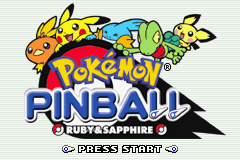 Released on the Game Boy Advance and years later on the Wii U Virtual Console, Pokémon Pinball: Ruby & Sapphire is the sequel to Pokémon Pinball on the Game Boy Color, inheriting most of the previous game’s mechanics with the addition of many fun and entertaining features.
The goal of the game is to obtain all 205 Pokémon and unlock them in the Hoenn Pokédex, while going through the two pinball boards featured in it, with their different areas and mechanics. The Ruby Board and the Sapphire Board each have their own catchable Pokémon, bonus stages and field mechanics. As in the previous game, obtaining the Pokémon relies on activating certain modes on both boards, including the Catch ‘Em Mode, the Egg Mode and the EVO Mode.
Graphics-wise, both game boards are richly decorated and feature various animated Pokémon bumpers that react to being hit by the ball. On the sound side, the game reuses much of its music and sound effects from Pokémon Ruby and Sapphire and other Pokémon games.
More than a regular pinball game, Pokémon Pinball combines fast flipper action with a unique way to catch your favorite Pokémon. Control the flippers to shoot the Poké Ball at targets on one of two PlayFields. Play on either the Ruby or Sapphire field to rack up as many points as possible. Catch over 200 Pokémon – featuring characters from Pokémon Ruby and Pokémon Sapphire!
- Play pinball with your favorite Pokémon!
- Shoot the Poké Ball to find & catch Pokémon!
- Use the Game Boy Advance Game Link cable to share your Pokédex and Hi-Score with a friend! You’ll need a Game Boy Advance Game Link and two Game Paks to link up with a friend (sold separately).
- Play on both the Ruby & Sapphire Fields.
- Try to catch over 200 Pokémon!
— Official description
Quick Answers
The questions people ask about Pokémon Pinball: Ruby & Sapphire, answered first and explained further down the page.
How many Pokémon can you catch in Pokémon Pinball: Ruby & Sapphire?
205. That covers every Hoenn Pokédex entry from Treecko to Jirachi except Deoxys (201 in all), plus four guests: Chikorita, Cyndaquil, Totodile and Aerodactyl. Only the 201 Hoenn Pokémon are needed for the Pokédex ‘complete’ medal; the guests fill four extra unnumbered slots at the end of the list. More →

How do you get Chikorita, Cyndaquil, Totodile and Aerodactyl?
Scan the Japanese GET Special Guests e-Reader card in the hidden e-Reader room, and they become the first Pokémon to appear in any area. Once one is in your Pokédex, it can also turn up as a 1% super-rare spawn, so linking with a game that already has them works too. Neither route exists on Wii U. More →
How do you catch Jirachi?
Travel until you reach the Ruins, which each field visits on every sixth Travel Mode, then open the slot reel and land the Jirachi bonus. Jirachi floats around the table and has to be hit three times within 30 seconds. It is the only way to register Jirachi, number 201 in the game’s Hoenn Pokédex. More →
How do you catch Groudon, Kyogre and Rayquaza?
Clear the matching bonus stage twice in the same game. Groudon is the second stage on the Ruby Field and Kyogre the second on the Sapphire Field, each needing 15 hits inside three minutes. Catching either one adds the Rayquaza stage to the rotation, and beating Rayquaza twice in one game catches it as well. More →
Is Pokémon Pinball: Ruby & Sapphire on Nintendo Switch Online?
No. As of October 2026 it is not in the Game Boy Advance library of Nintendo Switch Online + Expansion Pack, where Pokémon Mystery Dungeon: Red Rescue Team is the only Pokémon GBA game. Its only re-release was on Wii U Virtual Console in December 2014 and January 2015, and that eShop stopped selling games in March 2023. More →
What is the difference between the Ruby and Sapphire fields?
Both share Pikachu, Spoink, the slot reel and the Poké Mart, but the set pieces differ. Ruby uses Sharpedo, Makuhita, Chikorita and Cyndaquil, with Kecleon and Groudon bonus stages; Sapphire uses Wailmer, Plusle and Minun, Seedot and Pelipper, with Duskull and Kyogre stages. Each table also has its own areas, Egg Pokémon and exclusive catches. More →
Pokémon & the Fields
All the Pokémon from the Hoenn Pokédex can be obtained in the game (except for Deoxys), along with four extra Pokémon from the National Pokédex: Chikorita, Totodile, Cyndaquil and Aerodactyl, making a total of 205 obtainable Pokémon. Many Pokémon are also featured on the game boards, whether as Pokémon bumpers or in the different bonus stages.
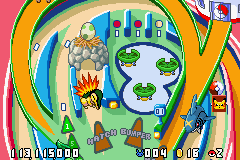
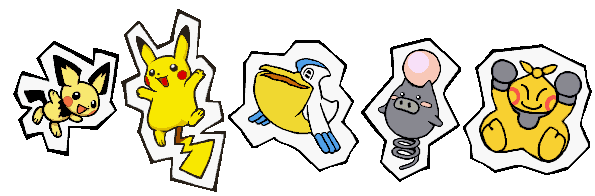
Pokémon Bumpers: These Pokémon appear on both fields, replacing the classic switches, obstacles and bumpers, with each of them having a unique role. Some of the Pokémon bumpers appear on both boards, while others are restricted to either the Ruby or the Sapphire board.
Pokémon bumpers appearing on both boards:
- Pikachu: It will rebound the ball using Thunder Shock and save it from falling when it enters the bottom-left or bottom-right exit lane. After the gauge decorated with a lightning-bolt icon is filled, the player can move Pikachu between the two outlanes using the flipper buttons.
- Pichu: It has a similar function to Pikachu, since it also helps save the ball from a certain fall. Pichu can be activated either from the Poké Mart or through the slot, and it will be linked to the player’s current ball. Losing the ball will result in losing Pichu as well.
- Spoink: The launcher of the ball on both boards.

Pokémon bumpers of the Ruby Board:
- Latios: It is available for a limited time to save the ball from falling. It can be obtained from the Poké Mart or the slot.
- Makuhita: It has different stances and appears in the middle-right section of the board. If the player presses the right flipper when the ball is near Makuhita, which must be in its attack stance, it will launch the ball to the loop where a Nuzleaf is located. Knocking the Nuzleaf back three times opens a bridge to a ball upgrade, or to an extra ball if the ball is already a Master Ball.
- Chikorita: Chikorita will pop up two Linoone with its Razor Leaf when the button near it gets hit.
- Linoone: The two Linoone summoned by Chikorita each have a specific function. The right Linoone will change the battle stance of Makuhita, while the left one will summon a Gulpin.
- Gulpin: The Travel Mode is activated when three Gulpin appear.
- Sharpedo: It will activate the Catch ‘Em Mode if two or more GET lights are shining. When the ball hits Sharpedo, it will swallow it and re-launch it.
- Cyndaquil: Each time it is hit, it will get knocked back a little, until it is knocked underneath the Egg. The heat from Cyndaquil’s flame will then warm the Egg and help it hatch, releasing a Pokémon the player can catch.
- Lotad or Chinchou: These serve as bumpers that help uncover the Pokémon silhouette pieces once Catch ‘Em Mode is activated. Three of them are present in the centre-top section of the board.
- Whiscash: It sends the ball into the Spheal Bonus Stage when the ball is sent towards its mouth. It appears in the centre-top part of the field, replacing the three bumpers. If it is hit from the top, it will get mad and cause the board to shake.

Pokémon bumpers of the Sapphire Board:
- Latias: Like Latios, it is available for a limited time to save the ball from falling and give it back to Spoink.
- Zigzagoon: Hitting the button near Zigzagoon changes its stance, and once it is ready to pounce it can stop the slot reel.
- Minun and Plusle: If the player hits both the Minun and Plusle buttons, the electric barrier blocking the way to the Poké Mart will disappear and it can be accessed to buy boosts.
- Seedot: Hitting the left button opposite Zigzagoon will make a Seedot appear in the basket. If the player manages to do so three times, the Travel Mode will be activated.
- Wailmer: If the player manages to light two or more GET lights and then sends the ball towards Wailmer, it will eat the ball and re-launch it, activating the Catch ‘Em Mode.
- Shroomish: These are the counterpart of the Lotad and Chinchou from the Ruby Board, as they function as bumpers for the Sapphire Board, helping unravel the different parts of the Pokémon silhouette each time they get hit while Catch ‘Em Mode is active.
- Pelipper: It will lift the ball to the Spheal Bonus Stage or simply place it in the top section of the board.
The two fields in detail

Notable Pokémon
There are 205 Pokémon to register: the 201 Hoenn Pokédex entries from Treecko to Jirachi, with Deoxys left out, plus Chikorita, Cyndaquil, Totodile and Aerodactyl. Basic forms mostly come from Catch ‘Em Mode in particular areas, 32 hatch from Eggs, and most middle and final forms can only be obtained through EVO Mode, so all three methods are needed. Each table has exclusives: Treecko, Torchic, Zangoose, Mawile and Solrock on Ruby; Mudkip, Seviper, Sableye and Lunatone on Sapphire. Many more appear as bumpers, launchers, savers and bonus-stage stars.
 Pikachu#025
 Pichu#172
 Aerodactyl#142
 Cyndaquil#155
 Latios#381
 Latias#380
 Groudon#383
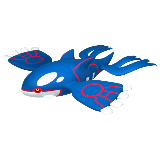 Kyogre#382
 Rayquaza#384
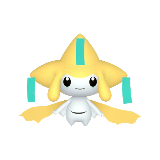 Jirachi#385
- Pikachu – Outlane kickback on both fields; also catchable in the Ruby Field’s Safari Zone.
- Pichu – Joins Pikachu as the Pika Saver, and hatches on either field once five Pokémon have been caught or evolved in a game.
- Aerodactyl – Delivers Eggs on the Ruby Field; one of four guests registered only via the GET Special Guests e-Reader card or a linked Pokédex.
- Cyndaquil – Warms the Ruby Field’s Egg with its back flame; also a catchable guest alongside Chikorita and Totodile.
- Latios – Ruby Field Ball Saver and a 1% super-rare spawn once 100 Pokémon are registered (2% after beating Rayquaza).
- Latias – Sapphire Field Ball Saver with the same super-rare spawn rules as Latios.
- Groudon – Boss of the Ruby Field’s second bonus stage; caught by clearing it twice in one game.
- Kyogre – Boss of the Sapphire Field’s second bonus stage; caught by clearing it twice in one game.
- Rayquaza – Final bonus stage on both fields; clearing it twice in a game adds it to the Pokédex.
- Jirachi – Only available from the Jirachi slot bonus in the Ruins; three hits in 30 seconds.
Game Features
Most of the game’s features are inherited from Pokémon Pinball, with the addition of a few new ones like the Poké Mart and the Egg Mode.
Acquiring Pokémon
There are mainly three different ways to acquire Pokémon in the game, with each method being related to a mode that must be activated on the boards. The different modes are as follows:



The Catch ‘Em Mode: Once the player lights up two or more GET lights, by sending the ball where the GET arrows are pointing, they can activate the Catch ‘Em Mode. This can be done by sending the ball into Sharpedo’s mouth on the Ruby Board or Wailmer’s mouth on the Sapphire Board. Once the mode is activated, a shadowed Pokémon silhouette will appear in the middle of the bottom screen. Hitting the Lotad/Chinchou bumpers on the Ruby Board or the Shroomish bumpers on the Sapphire Board will cause parts of the silhouette to gradually appear. Once the full silhouette is uncovered, it will turn into an actual Pokémon that the player can capture by hitting it three times with the Poké Ball. Only one Pokémon can be caught at a time, and there’s a two-minute time limit to finish the whole process once the shadowy silhouette appears. If the time runs out before the silhouette gets fully revealed or before the Pokémon is caught, both will disappear.
The EVO Mode: This mode allows the player to evolve Pokémon they have already obtained. To activate the EVO Mode, the player will first have to light up three EVO lights, by sending the ball where the EVO arrows are pointing. Then, the ball must be shot where the EVO Start arrow is pointing. The player can then select which Pokémon they want to evolve. With that done, the EVO Mode will start and items corresponding to the Pokémon’s evolution type will spawn on the field. The player will have to collect three of these items, then send the ball into the vortex that will appear in the middle, to complete the evolution. If the Pokémon evolves by reaching a certain level, EXP tokens will spawn on the field. If it evolves through trade, Link Cable tokens will spawn instead. If its evolution is normally done with an evolution stone, the respective stone will spawn around the field. As with the Catch ‘Em Mode, only one Pokémon can be evolved at a time, and there’s a two-minute time limit to finish the whole process once the Pokémon the player wants to evolve is selected.
Egg Mode: It is the new way of obtaining Pokémon introduced in Pokémon Pinball: Ruby & Sapphire. During this mode the player basically has to make a Pokémon Egg appear and then hatch it, releasing a Pokémon they can then hit with the ball to catch. Spawning the Pokémon Egg requires a different method on each board. On the Ruby Board, the player will have to shoot the ball under the nest. Doing so will cause a Totodile to appear carrying the Egg and putting it into the nest, or an Aerodactyl will carry it and drop it in the nest. After that, a Cyndaquil will appear, blocking the ball’s path to the nest. Each time the player hits the Cyndaquil, it will be pushed back, until it is finally placed underneath the nest after three hits; one more hit and the flames on Cyndaquil’s back heat up the Egg and cause it to hatch. On the Sapphire Board, the player has to send the ball into the Egg Incubator to make it appear. Then they have to repeat the same action three more times, which will result in the Egg hatching. Once the Egg hatches, a Pokémon will get out of it and start moving around the board. To capture it, the player has to hit it two times with the ball, within a time limit of one minute.
Furthermore, some Pokémon have a different way of being caught that doesn’t match any of the methods mentioned above. Rayquaza, Groudon and Kyogre can only be caught after their respective bonus stages are completed twice in the same game. Jirachi too, considered the rarest Pokémon in the game, can only be caught after matching the Jirachi Bonus on the slot while in the Ruins area. To make it even harder, Jirachi will be moving around the board and has to be hit three times within 30 seconds to be caught.
Poké Ball upgrades
There are three lights in the top section of the board that will upgrade the Poké Ball if they are all lit at the same time. The ball will transform into a Great Ball, then into an Ultra Ball and finally into a Master Ball, with each transformation multiplying the points earned on the board and in the bonus stages by 2x, 3x and 4x respectively.
Travel Mode (Map Move)
As in the previous game, some Pokémon are only available in certain locations on each board, which requires the player to move between these locations in order to capture all the Pokémon. To do so, the player has to hit certain bumpers that will trigger a change of location.
| Ruby Board | Sapphire Board | |
|---|---|---|
| Locations | Petalburg Forest, Chimney Mountain, Plains, Lilycove, Safari Zone, Granite Cave and Ruins | Petalburg Forest, Lake, Plains, Beach, Desert, Granite Cave and Ruins |
| Bonus stages | Kecleon, Groudon, Rayquaza, Spheal | Duskull & Dusclops, Kyogre, Rayquaza, Spheal |
Slot Reel
This feature won’t work during Catch ‘Em Mode. If the player manages to light up all the Hole lights, they can access the Slot Reel by throwing the ball into the hole that will appear in the middle of the screen. The Slot Reel will spin and can be stopped by the player using the A button, which will give them a random bonus from the following list:
| Bonus | Effect |
|---|---|
| Saver | For 30, 60 or 90 seconds, a Latios/Latias will be on standby waiting to save the ball if it falls, returning it to Spoink to re-launch it. |
| Pika | A Pichu joins Pikachu to guard the other outlane. |
| Get | Triggers the Catch ‘Em Mode |
| Evo | Triggers the EVO Mode |
| Go to Bonus | Instantly moves the player to the bonus stage |
| Extra | Gives the player an extra life |
| Upgrade | Upgrades the ball to the next one |
| Max | Upgrades the ball instantly into a Master Ball |
| Small | Gives the player a bonus of 100 to 900 points |
| Big | Gives the player a bonus of 1 million to 9 million points |
| Coins | Adds 10, 30 or 50 coins for the Poké Mart |
| Bonus Multiplier | Raises the end-of-ball bonus multiplier |
| Timer Up | Adds time to the next mode |
Poké Mart
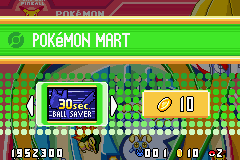
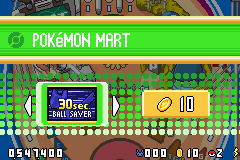
It is the new shop feature, where the player can spend the coins they earned by sending the ball through the coin loop to buy boosts.
| Item | Effect | Cost |
|---|---|---|
| Ball Saver | Saves the ball from falling for 30 seconds | 10 coins |
| Ball Saver | Saves the ball from falling for 60 seconds | 20 coins |
| Ball Saver | Saves the ball from falling for 90 seconds | 30 coins |
| Ball Upgrade | Upgrades the ball to the next level | 40 coins |
| Timer Up | Adds 30 seconds to the next triggered mode or bonus stage | 40 coins |
| Pika | Summons a Pichu to save the ball with Pikachu | 50 coins |
| Bonus Challenge | Instantly transports the player to the Spheal Bonus Stage | 60 coins |
| Extra Ball | Only one is available during the round, and another one is stocked each time Rayquaza is caught. | 99 coins |
In depth: the fine print


The Bonus Stages
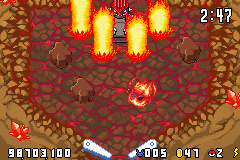
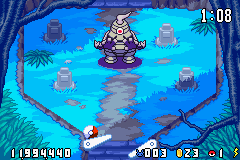
There are three Poké Balls displayed on the board, just above the Latios/Latias saver image. Every time the player catches a Pokémon, one of the Poké Balls will light up, while evolving a Pokémon will get two of them lit. Once the player lights up all three Poké Balls, a vortex will appear and will take the player to a bonus stage if the ball enters it. Completing a bonus stage will unlock the next one on the board, as they work in a linear way, with the final stage being the Rayquaza Bonus Stage on both the Ruby and the Sapphire Boards (Rayquaza joins the rotation once Groudon or Kyogre has been caught). The Kecleon and Groudon Bonus Stages are exclusive to the Ruby Board, while the Dusclops and Kyogre Bonus Stages are exclusive to the Sapphire Board. An additional bonus stage, the Spheal (or Sealeo) Bonus Stage, can be accessed on both boards and doesn’t require the same conditions as the rest of the stages.



The six stages at a glance
| Stage | Field | Target | Reward |
|---|---|---|---|
| Kecleon Bonus | Ruby Field (first stage of the rotation) | Kecleon, using Color Change to turn invisible; a Devon Scope hangs in the tree | 30,000,000 points multiplied by the ball type; opens the Groudon stage |
| Groudon Bonus | Ruby Field (second stage) | Groudon, with falling boulders, a ring of four fire pillars and fireballs | 50,000,000 points multiplied by the ball type; Groudon is caught after a second clear in the same game |
| Duskull and Dusclops Bonus | Sapphire Field (first stage of the rotation) | Duskull (two at a time), then Dusclops | 30,000,000 points multiplied by the ball type; opens the Kyogre stage |
| Kyogre Bonus | Sapphire Field (second stage) | Kyogre, with Sheer Cold and whirlpools | 50,000,000 points multiplied by the ball type; Kyogre is caught after a second clear in the same game |
| Rayquaza Bonus | Ruby and Sapphire Fields (third stage, unlocked by catching Groudon or Kyogre) | Rayquaza, with Thunder and ExtremeSpeed tornadoes | 99,999,999 points multiplied by the ball type; Rayquaza is caught after a second clear in the same game |
| Spheal Bonus | Ruby Field (via Whiscash) and Sapphire Field (via Pelipper); also the 60-coin Bonus Challenge | Spheal and two Sealeo on ice slides beside a hoop | 1,000,000 points per ball and 5,000,000 per Spheal sent through the hoop |

The e-Reader Cards

Since the game is compatible with the e-Reader, players can use some e-cards to unlock special bonuses in the game. Most of the cards were given to those who bought the game at the Pokémon Centers or at certain Pokémon-related events. These are the cards that were released:
| e-Card | Effect |
|---|---|
| Bonus Stage Card (09-A001) | Lets the player play any of the bonus stages |
| GET Special Guests Card | Summons a catchable Aerodactyl, Chikorita, Cyndaquil or Totodile |
| Ruin Area Card | Instantly puts the player in the Ruins area as they start their round |
| Encounter Rate UP Card | Gives the player higher chances of encountering rare Pokémon |
| DX Mode Card | Gives the player an insane amount of bonuses, as they directly start the round with the Master Ball, 9 lives and 99 coins. The number of times that Pichu and Pikachu will save the ball is also increased. |
All five cards were issued only in Japan. The Bonus Stage Card was promoted through Pokémon Scoop and Pokémon Festa 2003, the Ruin Area, DX Mode and Encounter Rate UP cards went to Pokémon Center buyers, and GET Special Guests was an in-store demo card in September 2003. The hidden e-Reader room is still on Western cartridges – hold Right on the title screen and press L and R three times each – but it only accepts a Japanese e-Reader+, and it was switched off entirely in the Wii U release.
Regional Variations
The game reached Japan first and Europe almost four months later, with a handful of differences between the versions:
- The Japanese release labels the shop SHOP and the Catch ‘Em start GET START; English versions renamed them MART and CATCH, including the sign on the shop building.
- All five e-Reader cards were issued only in Japan. The hidden e-Reader room is still on Western cartridges and accepts a Japanese e-Reader+, but an American e-Reader shows the error ’·Region Error· Incompatible Version’.
- The European cartridge lets players choose their language; a saved game always resumes in the language it was saved in, so switching language means starting a new game.
- Pokédex sharing over the Game Link Cable works between any two language versions.
- The game reached Japan on 1 August 2003, North America on 25 August, South Korea on 9 September (distributed by Daewon C.I.), Australia on 26 September and Europe only on 14 November 2003.
- Local titles include Pokémon Pinball: Rubin & Saphir (German), Rubis & Saphir (French), Rubino e Zaffiro (Italian) and Rubí y Zafiro (Spanish).
- Every Wii U Virtual Console version has the e-Reader room disabled, so the card bonuses cannot be used on any of them.

Left in the data
- Placeholder Pokémon icons are stored after the question-mark icon at the end of the Pokémon icon graphics; only the first of them has been drawn in.
- A small debug mode survives in the US version and can be reached with cheat-device codes: it overlays position readouts and lets the ball be stopped with L, steered with the D-pad and released with R.
Glitches, exploits and oddities
A leftover debug mode, a vanishing Kecleon and a couple of other oddities:
Debug free-move freeze
Cheat-device codes for the US version switch on a leftover debug mode that prints three numbers on screen: the ball’s horizontal position, its vertical position and the table’s scroll position. Pressing L freezes the ball in place, the D-pad then drags it anywhere on the screen, and R hands it back to the normal physics. Press R while the ball is parked outside the playfield, though, and the whole game locks up.
Kecleon’s vanishing stripe
In the Kecleon bonus stage, Kecleon uses Color Change to disappear and creep about in the grass until the Devon Scope reveals it. Kecleon’s red stripe is supposed to stay visible at all times, the one part of its body the Pokémon cannot recolour, but in this stage the stripe fades out along with everything else, so there is no visual hint of where it is hiding.
Saved-language lock (European version)
The European Game Boy Color Pokémon Pinball let players switch language and carry on a saved game in the new one. Ruby & Sapphire does not allow this: change the language and resume a suspended game, and the text snaps back to the language that was active when it was saved. The only way to play in another language is to select it and start a fresh game, which loses the run in progress.
’Bonus Challange’ typo
The 60-coin Poké Mart item that sends the ball straight to the Spheal bonus stage is spelt ‘Bonus Challange’ in the English text. It is one of the very few slips in an otherwise tidy localisation, and players see it whenever they browse the shop on either the Ruby or the Sapphire Field, right beside the Extra Ball that most of them are saving their coins for.
Videos & media
Check out these Pokémon Pinball: Ruby & Sapphire videos, including a TV commercial, the intro and the Wii U trailer.
A US TV commercial.
The intro / opening video.
The official trailer for the Virtual Console re-release on Wii U.
Trivia & facts
- Pokémon Pinball: Ruby & Sapphire was the first Pokémon game to be released on the Wii U Virtual Console, in December 2014.
- The game music changes when the player clears the Rayquaza Bonus Stage.
- The game can be played on the Nintendo GameCube with the help of the Game Boy Player accessory. This allows the use of the rumble feature of the GameCube controller, making the controller shake when Whiscash causes the screen to shake.

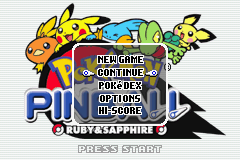
The more simplistic international logo (left) vs. the cuter, more colourful Japanese logo (right).
Further trivia
- Each field’s mascots only hatch on the other table: Plusle, Minun, Seedot and Shroomish, all fixtures of the Sapphire Field, are Ruby-only Egg Pokémon, while the Ruby Field’s Chinchou, Lotad and Gulpin hatch only on Sapphire.
- Gloom evolves into Vileplume on the Ruby Field but always into Bellossom on the Sapphire Field.
- Early cartridges use AGB-E06 boards with battery-backed SRAM, so saves are lost when the battery runs flat; later batches moved to AGB-E11 boards with FRAM, which needs no battery.
- The game was announced at E3 2003 as plain ‘Pokémon Pinball’, and that shorter name is still printed in the bottom-left corner of both fields and behind the intro.
- Most of the sound effects, especially the move sounds, and much of the music were lifted from Pokémon Ruby and Sapphire Versions.
- Catching all 201 Hoenn Pokémon earns a ‘complete’ medal on the Pokédex; the four guest Pokémon are not required.
- Beating the Rayquaza stage doubles the chance of a super-rare Latios or Latias appearing, from 1% to 2%, the same boost the Encounter Rate UP e-Reader card gives.
Legacy
What came after
 Revealed as ‘Pokémon Pinball’ at E3 2003 – May 2003. Shown on the Game Boy Advance line-up; Nintendo Power issue 169 (June 2003) carried an early preview.
- Japanese Game Boy Advance launch – 1 August 2003. Entered the Japanese chart at No. 4 with about 39,400 copies in its first week.
- North American launch – 25 August 2003. Published by Nintendo; IGN made it its Game Boy Advance game of the month for August 2003.
- South Korean launch – 9 September 2003. Distributed by Daewon C.I.
- Australian launch – 26 September 2003
- European launch – 14 November 2003. Released almost a year after Pokémon Ruby and Sapphire’s Japanese debut and months after the other regions.
 Wii U Virtual Console (Japan) – 10 December 2014. The first Pokémon game on the Wii U Virtual Console; the e-Reader room is disabled.
- Wii U Virtual Console (Europe and Australia) – 11 December 2014. Priced at £6.79 / €6.99 in Europe, a few weeks after Pokémon Omega Ruby and Alpha Sapphire.
- Wii U Virtual Console (North America) – 1 January 2015. Released on New Year’s Day at $7.99.
- Wii U eShop closes to new purchases – 27 March 2023. Existing owners can still redownload it; the game has not been offered on Nintendo Switch Online.
Where to play it today
Original Game Boy Advance cartridges are still the main way to play, and they also run on the GBA SP and Micro, the Nintendo DS and DS Lite, and a GameCube fitted with the Game Boy Player, the only setup with rumble. Early cartridges may need a new save battery. The Wii U Virtual Console version can only be redownloaded by existing owners, and as of October 2026 the game is not in Nintendo Switch Online’s Game Boy Advance library.
How it was made
Pokémon Pinball: Ruby & Sapphire was made by Jupiter, the Kyoto studio behind the 1999 Game Boy Color Pokémon Pinball, and published by Nintendo. Masaru Kuribayashi directed the game and also drew graphics for it; Kazuya Suyama and Ayumi Sano handled the sound, reworking music and effects from Pokémon Ruby and Sapphire Versions, and Satoru Iwata and Tsunekazu Ishihara were executive producers. Hiro Nakamura and Seth McMahill localised the English text, with Kayo Sadahisa producing the European version. The game was first shown simply as ‘Pokémon Pinball’ at E3 in May 2003 and previewed under that name in Nintendo Power issue 169. It later appeared at the Games Convention in Leipzig and the ECTS in London before its European launch, and reached Japan on 1 August 2003, about eight months after Ruby and Sapphire.
Pokémon Pinball: Ruby & Sapphire elsewhere
Sales & reviews
Sales figures
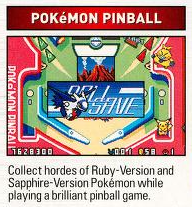
Within three weeks of its release, Pokémon Pinball: Ruby & Sapphire sold around 132 thousand copies in Japan alone. Sales then grew slowly: estimates put the total at around 440 thousand copies in Japan, nearly 380 thousand in Europe and 680 thousand in North America, for a global figure of about 1.56 million copies sold.
The regional split is an estimate with no official source. The firm figures are about 291,500 copies in Japan by the end of 2003 (after a first week of roughly 39,400 at No. 4 on the chart) and ‘over 1 million’ worldwide, quoted in a 2006 press release; it also topped Amazon.com’s video game chart for the week ending 8 October 2003.
- 1m+worldwide (2006)
- 291.5kJapan, 2003
- 205Pokémon
- 81Metacritic
Review scores
The game was very well received, earning great scores on major review websites. Let’s take a look at these reviews:
- Craig Harris from IGN enjoyed this sequel, stating “There are plenty of pinball games to choose from on the Game Boy Advance. But as good as those games go, Pokemon Pinball tops”, while giving the game a score of 8.8/10, the equivalent of ‘Great’ on the IGN scale.
- Jeff Gerstmann from GameSpot also liked the game mechanics, rating it 7.3/10, which equates to ‘Good’ on the GameSpot scale.
- On GameRankings (which closed in 2019), Pokémon Pinball: Ruby & Sapphire received a fairly high score of 80.03% from 27 reviews, while it scored 81 on Metacritic, from 22 critics.
Critics were broadly won over, and the game settled at 81 on Metacritic and just above 80% on GameRankings. IGN’s Craig Harris rated it the best pinball game on the Game Boy Advance, Game Informer singled out its accurate ball physics and GameNOW praised how quickly anyone could pick it up. Reviewers liked the way catching, hatching and evolving gave each game a goal beyond the high score, and enjoyed the bright, busy tables. The doubts came mostly from pinball purists: GameSpot’s Jeff Gerstmann felt it was too close to the Game Boy Color original and too easy to hold attention for long, Edge missed proper skill shots, and The Guardian wanted multiball and more contrast between the two boards. Famitsu gave it 34 out of 40.
Awards and honours:
Media & artwork
- Sprite gallery from Pokémon Pinball: Ruby & Sapphire
- Box art from Pokémon Pinball: Ruby & Sapphire, including several different regional variations and editions
- Screenshots from Pokémon Pinball: Ruby & Sapphire
Further reading
More pinball and Game Boy Advance links on the site: