  |
|
| Titles | Pokémon Stadium 2 ポケモンスタジアム金銀 (Pokémon Stadium Kin Gin) |
| Platform | Nintendo 64 (512-megabit cartridge), with the N64 Transfer Pak |
| Developers | Nintendo EAD · HAL Laboratory |
| Publisher | Nintendo |
| Director | Takao Shimizu |
| Producers | Kenji Miki · Tsunekazu Ishihara · Satoru Iwata · Shigeru Miyamoto |
| Music | Hajime Wakai |
| Players | 1–4 |
| Genre | Turn-based battle / strategy, with mini-games |
| Pokémon | All 251, from Bulbasaur to Celebi |
| Released | 14 December 2000 (Japan) · 26 March 2001 (North America) · 7 April 2001 (Australia) · 10 October 2001 (Europe) |
| Re-releases | Nintendo Switch Online + Expansion Pack, 8 August 2023 (no Transfer Pak features) |
| Rating | ESRB E · OFLC G8+ |
| Predecessor | Pokémon Stadium (2000) |
| Successor | Pokémon Colosseum (GameCube, 2003) |
| Sales | 2.54 million shipped |
Overview
 After the remarkable success of the original Pokémon Stadium, Nintendo didn’t keep Pokémon fans waiting long for a sequel, featuring all 251 Pokémon from the first and second generations.
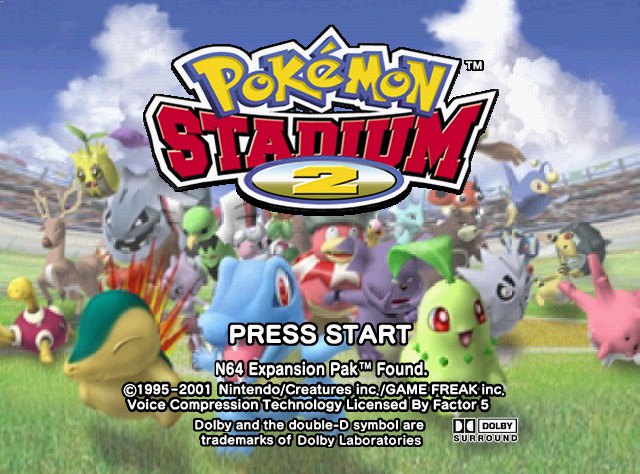
Just like its predecessor, Pokémon Stadium 2 succeeded in bringing the Pokémon into a 3D world, with amazing animations and moves. In fact, the Pokémon graphics were improved, with lots of new move animations, though the backgrounds still looked blurry. Sound-wise, the game once again used the Game Boy-style cries, which disappointed the fans who had hoped, this time, for unique Pokémon voices like those in the animated series (only a Pikachu from Yellow speaks with its anime voice). The style of play was practically the same too, with the game focusing mainly on battles, the goal being to beat all the Stadium Cups and the Gym Leader Castle.
The main differences between the games were the changes to the Stadium Cups: the Pika Cup was removed, the Petit Cup was replaced by the Little Cup, and the Challenge Cup was added. The Gym Leader Castle now includes all the Gym Leaders from the Kanto and Johto regions. Pokémon Stadium 2 also offers new modes like the Pokémon Academy and My Room, along with the option of a female player icon. The Transfer Pak was still the most prominent feature of the game, linking it to both trilogies – the first generation (Red, Blue and Yellow) and the second (Gold, Silver and Crystal) – which lets players transfer, store and trade their Pokémon.
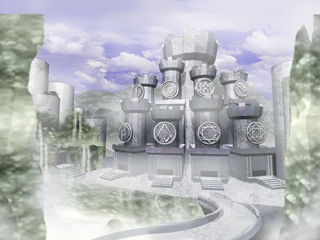
As a strategy game, Pokémon Stadium 2 doesn’t have a storyline; everything revolves around clearing the Stadium and the Gym Leader Castle, reached from the White City hub.
Hundreds of Pokémon in Three-mendous 3-D! What’s sweeter than victory in a Pokémon battle? Victory in a 3-D arena on the N64! Set your strategy then stand back while your Pokémon battle it out. You can even see the Pokémon you’ve trained rendered in 3-D and ready for battle!
- Nearly 250 Pokémon! Transfer Pokémon from the Red, Blue, Yellow – even Silver and Gold – versions of Pokémon for Game Boy. Or play with Rental Pokémon from the game.
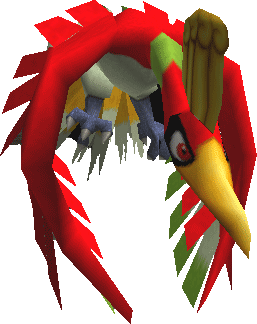
- See them all in glorious 3-D! Pit Ho-Oh, Lugia, Entei, and Pichu against all-time favorites like Mewtwo, Charizard, Blastoise, and Pikachu.
- Become the Stadium Champion! Take on 21 Pokémon Trainers in the Gym Leader Castle and try to win it all!
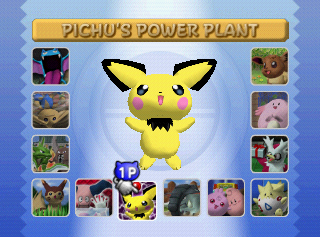
- 12 all-new mini-games! Try to bump the other Hitmontop out of the arena in Topsy-Turvy or charge up more energy than anyone else in Pichu’s Power Plant.
— Official description
Quick Answers
The questions people ask about Pokémon Stadium 2, answered first and explained further down the page.
How do you unlock Round 2 in Pokémon Stadium 2?
Clear every Stadium cup and division plus the whole Gym Leader Castle in Round 1. The Rival then appears in White City; beat him and Round 2 opens, with tougher teams and a sunset-coloured hub. You also receive a Farfetch’d that knows Baton Pass. Press C-Right on the main menu to swap between rounds. More →
How do you get to battle Red in Pokémon Stadium 2?
Finish the Johto side of the Gym Leader Castle first: eight Gyms, a Team Rocket takeover, the Elite Four and Champion Lance. That opens the Kanto castle, where the eight Kanto Leaders can be taken on in any order. Beat all eight and Red challenges you at Mt. Silver as the final opponent. More →
Is Pokémon Stadium 2 on Nintendo Switch Online?
Yes. It joined the Nintendo 64 library for Nintendo Switch Online + Expansion Pack on 8 August 2023 and also runs on Switch 2. There is no Transfer Pak support, so the GB Tower, My Room, Mystery Gift and Game Boy imports are missing, and Mewtwo, Lugia and Ho-Oh cannot be used at all. More →
How many mini-games are in Pokémon Stadium 2?
Twelve, from Gutsy Golbat to Eager Eevee, each for four players with computer opponents filling any empty slots. Alongside them sit Mini-Game Champion, a race to collect coins, and two quizzes: a 100-second solo quiz and the four-player Quiz for All. Winning a seven-coin Champion match against three Hard opponents unlocks Very Hard. More →
What is different about the Japanese version of Pokémon Stadium 2?
It is called Pokémon Stadium Kin Gin, launched on the same day as Pokémon Crystal and only reads Japanese Game Boy cartridges. It alone has Mobile Stadium, which loads online battle data from Crystal. The Western releases add longer text boxes, a Pikachu voice clip at start-up and a fix for Lance’s duplicate Quick Claw. More →
How do you unlock the faster GB Tower speeds?
For Red, Blue and Yellow, the Doduo Game Boy (double speed) unlocks after clearing either the Gym Leader Castle or every Round 1 cup, and the Dodrio Game Boy (quadruple speed) after clearing both. Gold, Silver and Crystal need the same feats in Round 2, and Dodrio runs those games at triple speed. More →
Game Modes
Several fun modes are present in the game, each with its own rules and requirements, along with hidden modes that can only be unlocked after completing parts of the game. Most of the battle modes include a Round 2 difficulty, which is unlocked after clearing the game.
- Battle Now: A casual battle mode where the player chooses whether to battle the AI (‘Cal’ from Gold and Silver) or another player. The Pokémon used are level 40, mostly unevolved. Unlocking Round 2 makes the Pokémon level 70 and fully evolved.
- Event Battle: A casual player-versus-player mode in which players can use the Stadium Cup rules or choose specific ones for their battles. Pokémon Stadium 2 added the ‘Rule Edit’ feature, allowing custom rules to be created. This mode also requires both players to plug a Game Boy Pokémon game into their Transfer Pak, since the Pokémon used are those in the Game Boy games’ parties.
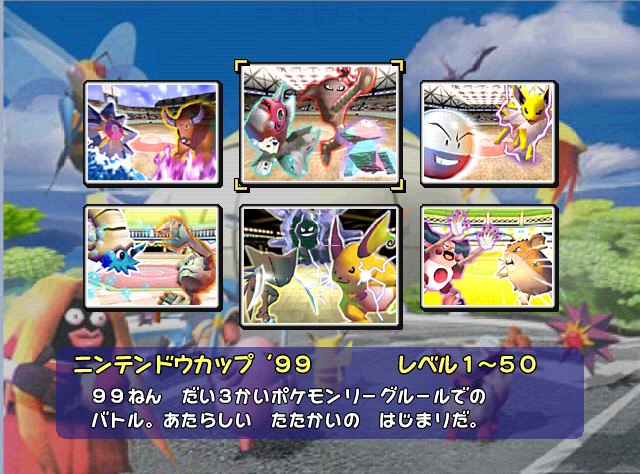
- Stadium: The main game mode, in which the player can take part in four player-versus-AI cups. Each cup requires the player to defeat eight trainers, following different sets of rules and difficulties.
- Little Cup: This replaces the first game’s Petit Cup. It now only lets level 5 unevolved Pokémon that can evolve take part. The moves Dragon Rage and SonicBoom have no effect in the Little Cup.
- Poké Cup: Only Pokémon between levels 50 and 55 can take part, and Mew, Mewtwo, Lugia, Ho-Oh and Celebi are banned. The combined level of the team cannot exceed 155. This cup comes in four difficulties, each named after a Poké Ball (Poké Ball, Great Ball, Ultra Ball and Master Ball divisions), and defeating all the trainers unlocks the next, harder division, starting from Poké Ball.
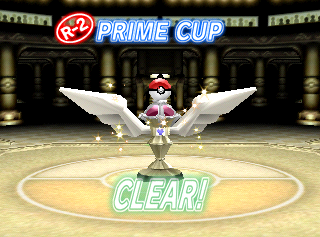
- Prime Cup: All Pokémon, including legendaries, can be used in this cup, up to level 100. All the opponents have level 100 Pokémon, which may include legendary ones. Unlike in the previous game, the Prime Cup no longer comes in four divisions, only one.
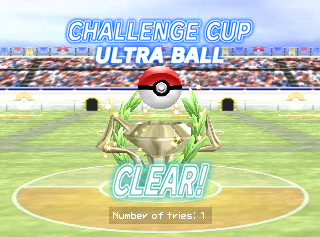
- Challenge Cup: A new cup in Pokémon Stadium 2. It’s different from the other cups, since the player’s Pokémon are random rentals. It also has four difficulty levels, as in the Poké Cup, each setting the Pokémon at a certain level (Poké Ball 30, Great Ball 45, Ultra Ball 60 and Master Ball 75).
- Free Battle: A free-for-all battle mode in which up to four players can battle or team up against each other, using the rules of the different Stadium Cups or custom-made ones.
- Gym Leader Castle: Another mode that changed from the last game. The player battles the Gym Leaders of the Johto region, and in each Gym there are a varying number of trainers to defeat before reaching the Gym Leader. Once the player beats all the Johto Gyms, they face the Elite Four, followed by the Champion, Lance. Defeating Lance unlocks the Kanto region’s Gym Leader Castle, and defeating all the Kanto Gym Leaders unlocks a special last opponent: Red, the protagonist of the first-generation games (see below).
- Mini-games: Twelve mini-games, with four difficulty levels, that can be played alone or against other players. There are also Pokémon quizzes that test the players’ Pokémon knowledge.
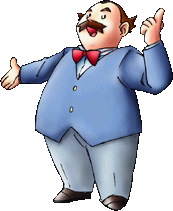
- Pokémon Academy: An academy, run by Earl, where the player can learn a lot about the game’s strategies through classroom lectures and tests. It also has a library where players can study different Pokémon, items and moves. It’s a pretty good way for someone new to Pokémon to gain the basic understanding that will help them in battles.
- VS Rival: Clearing all the Stadium Cups and the Gym Leader Castle unlocks the Rival’s lair in White City, where he awaits the player. Defeating the Rival unlocks the Round 2 difficulty of the game, and earns a Farfetch’d that knows Baton Pass.
Mini-games
In depth: the fine print
The Gym Leader Castle: Johto, Kanto & Red
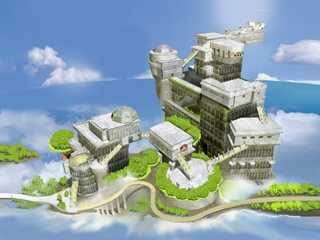
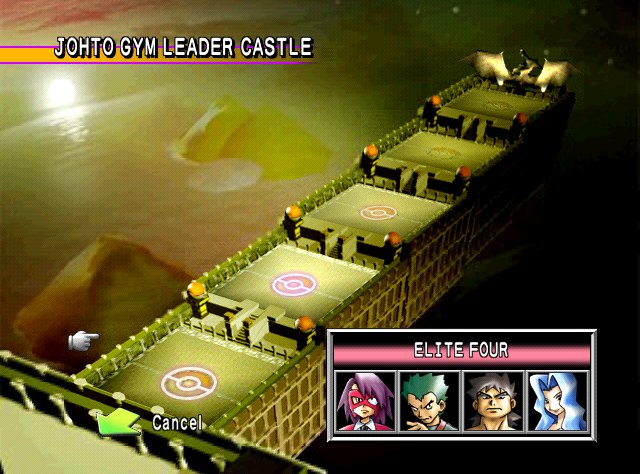
Stadium 2’s Gym Leader Castle is twice the size of the first game’s. The Johto run takes in eight Gyms, a Team Rocket takeover, the Elite Four and Champion Lance; beating Lance opens the Kanto castle, whose eight Leaders have no Gym trainers and can be taken on in any order. Beat all eight and Red is waiting at Mt. Silver.
| # | Opponent | Role | Type | Notes |
|---|---|---|---|---|
| 1 | Falkner | Johto Gym Leader | Flying | The first room of the castle. A single Bird Keeper, Matt, has to be beaten before Falkner, and as with every room the decor reflects the Leader’s favourite type. |
| 2 | Bugsy | Johto Gym Leader | Bug | Two warm-up battles come first: Bug Catcher Chaz and the Twins, Min and Lyn. Bugsy himself is the second Leader of the Johto run. |
| 3 | Whitney | Johto Gym Leader | Normal | Lass Lois and Beauty Rita guard the Goldenrod room. Whitney, the Normal-type Leader, is the third stop on the Johto run, fought straight after Bugsy. |
| 4 | Morty | Johto Gym Leader | Ghost | Medium Holly and Sage Ty must both be beaten before Morty, the fourth Johto Leader and the only Ghost-type specialist in the castle. |
| 5 | Chuck | Johto Gym Leader | Fighting | Only one Gym trainer, Black Belt Nick, stands between the player and Chuck, the fifth Leader in the Johto sequence. |
| 6 | Jasmine | Johto Gym Leader | Steel | The Olivine room has no Gym trainers at all, so Jasmine is faced straight away. She is the sixth Johto Leader. |
| 7 | Team Rocket | Villains | Mixed | Four Rocket battles interrupt the run before Mahogany, echoing the hideout and Radio Tower episodes of Gold and Silver. The two Executives are the pair later named Archer and Ariana. |
| 8 | Pryce | Johto Gym Leader | Ice | Boarder Alvin and Skier Carol come first. Pryce is the seventh Johto Leader and the first fought after the Team Rocket takeover. |
| 9 | Clair | Johto Gym Leader | Dragon | Two Cooltrainers, Gloria and Vince, guard the eighth and last Johto Gym. Beating Clair, Lance’s cousin, opens the way to the Elite Four. |
| 10 | Will | Elite Four | Psychic | The first of the Johto Elite Four, fought in sequence with the other three members and Lance as the climax of the Johto castle. |
| 11 | Koga | Elite Four | Poison | The former Fuchsia Gym Leader, now an Elite Four member as in Gold and Silver, is the second opponent of the Elite Four run. |
| 12 | Bruno | Elite Four | Fighting | The third Elite Four member, carried over from the original Kanto Elite Four, and the second Fighting-type specialist of the Johto castle after Chuck. |
| 13 | Karen | Elite Four | Dark | The last of the Elite Four and the castle’s only Dark-type specialist, fought immediately before Champion Lance as the final hurdle of the Elite Four run. |
| 14 | Lance | Champion | Dragon | The Johto Champion. Beating him with a team transferred from a Game Boy game also lets one Pokémon relearn a move it learned at an earlier level. |
| 15 | Brock | Kanto Gym Leader | Rock | The Kanto castle has no Gym trainers, and its eight Leaders can be challenged in any order once Lance has been defeated. |
| 16 | Misty | Kanto Gym Leader | Water | The Cerulean Leader is one of eight Kanto opponents that can be taken on in any order after the Johto castle is cleared. |
| 17 | Lt. Surge | Kanto Gym Leader | Electric | Vermilion’s Electric-type Leader is one of the eight Kanto opponents; like the others he is faced without any Gym trainers first. |
| 18 | Erika | Kanto Gym Leader | Grass | The Celadon Leader brings the castle’s only Grass-type challenge. Like the other Kanto Leaders she has no Gym trainers and can be fought at any point in the Kanto run. |
| 19 | Janine | Kanto Gym Leader | Poison | Koga’s daughter took over the Fuchsia Gym in Gold and Silver, so she holds the room here while her father sits on the Elite Four. |
| 20 | Sabrina | Kanto Gym Leader | Psychic | The Saffron Leader is the second Psychic-type specialist of the castle after Will, and can be challenged in any order with the other Kanto Leaders. |
| 21 | Blaine | Kanto Gym Leader | Fire | The castle gives Blaine his Cinnabar Island Gym again, rather than the makeshift Seafoam Islands Gym he uses in Gold and Silver. |
| 22 | Blue | Kanto Gym Leader | Mixed | Red’s old rival, now the Viridian Gym Leader as in Gold and Silver, is the only Leader in the castle without a type speciality. |
| 23 | Red | Final opponent | Mixed | Listed as ‘???’ until he appears, Red challenges the player only after all eight Kanto Leaders have fallen, mirroring his secret battle at Mt. Silver in Gold and Silver. |
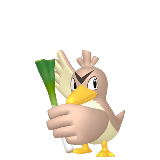 Farfetch’dRival prize, Round 1
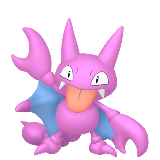 GligarRival prize, Round 2
 XatuOptions screen
 SmeargleIV colours
 HitmontopTopsy-Turvy
 CelebiPoké Cup ban

Integration with Other Titles
As in the previous game, the Transfer Pak is the most important feature, not only linking Pokémon Stadium 2 to the first-generation trilogy (Red, Blue and Yellow) and the second-generation trilogy (Gold, Silver and Crystal), but also unlocking many new options alongside those from Pokémon Stadium:
- GB Tower: Plays the linked Game Boy Pokémon games on the television – at normal speed at first, then faster once the Doduo and Dodrio modes are unlocked.
- Pokémon Lab: By far the most useful feature of the Transfer Pak. The Lab PC lets the player browse the boxes in their linked Pokémon game, organise their Pokémon and transfer them to Pokémon Stadium 2. It also provides extra boxes the player can use to store Pokémon from the other games. The Pokémon Lab also makes trading between different games possible when they’re inserted in the Transfer Paks of two controllers. Moreover, there’s a Pokédex the player can use to look up every Pokémon in the game and where it can be found on the Johto and Kanto maps.
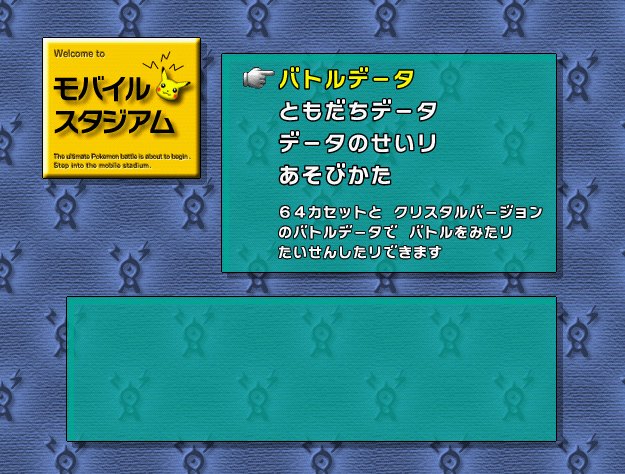
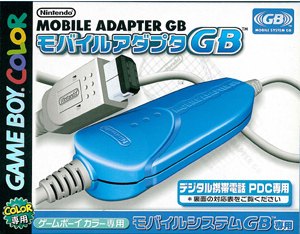
- Mobile Stadium (Japanese version only): With a Japanese Pokémon Crystal that has used the Mobile System GB plugged into the Transfer Pak, it downloads saved battles from Crystal and lets the player watch them in 3D.
- Mystery Gift: A feature that lets the player send a daily gift to their second-generation Pokémon games by linking them through the Transfer Pak. The gifts range from rare items to decorations.
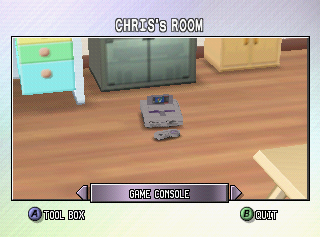
- My Room: This feature requires a second-generation game in the Transfer Pak. It lets the player view their New Bark Town bedroom in 3D and decorate it with the different items obtained in the Game Boy game.
Regional Variations
Japan’s version arrived more than three months before North America’s and ten months before Europe’s, and it differs in several ways:
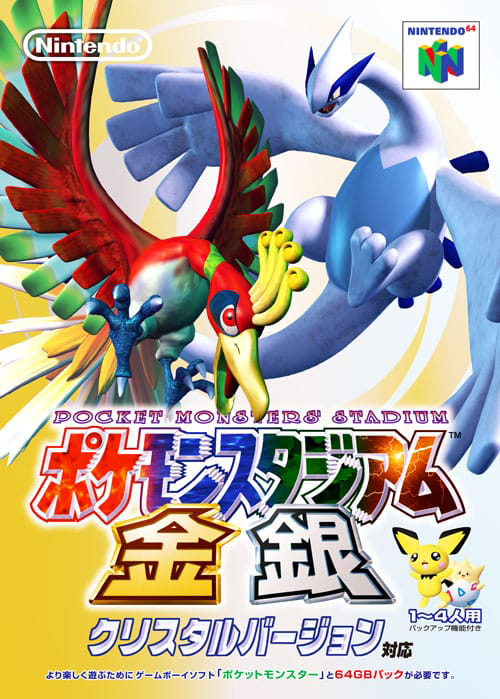
- Japan’s version is Pokémon Stadium Kin Gin (Gold Silver), because the Japanese Pokémon Stadium 2 was the 1999 game sold in the West as Pokémon Stadium; the Japanese logo carries a ‘Crystal Version compatible’ tag.
- Mobile Stadium is exclusive to the Japanese version: with a Japanese Crystal cartridge that has used the Mobile System GB, players could load downloaded battle records, such as Nintendo Cup 2000 replays, and watch or fight them in 3D.
- The Japanese version only reads Japanese Game Boy games, while the English and European versions work with each other’s cartridges; Korean Gold and Silver are not compatible with any version. Western releases still recognise the Japan-only Pokémon Green.
- The Western boxes and manuals leave Crystal off the compatibility list because Stadium 2 came out about four months before Crystal outside Japan, even though the game works with it.
- Localised versions play Pikachu’s voice when the game starts, where the Japanese version uses human voices, and they lengthen the in-battle text boxes so trainer portraits no longer spill over.
- In the Japanese Round 2, Lance’s Tyranitar and Feraligatr both hold a Quick Claw, breaking the duplicate-item rule; the Western versions give Feraligatr a Mystic Water.
- The consoles in My Room change by region: a Famicom and Super Famicom in Japan, an NES and SNES (with Super Mario World replacing SimCity) in North America, and an NES with an SNES-branded Super Famicom in the non-English European versions.
Left in the data
- Three decorations never made it into the gift tables: a Tentacool Doll and a Pikachu Bed, apparently meant as Stadium 2 exclusives but left out by oversight, and an Unown Doll whose model was later reused in Pokémon Channel. All three work if hacked into the game or the Game Boy titles, and Carrie has unused lines for each.
- Delibird’s Delivery contains unused presents, including a crushed food can, an Ash doll, a baseball glove and ball, a wooden bat, a toy computer and a potted Christmas tree.
- Pichu mugshots sit among the trainer and Gym Leader portraits, alongside an unused nametag for the GB Tower and an unused background for the quiz menu.
- A low-poly Fearow model is stored with the mini-game models, although Fearow appears in none of the mini-games, and many Pokémon still carry animations left over from the first Stadium’s intro.
- Every trainer has lines for a drawn match, which almost never happens against the computer; they can only be seen by forcing a time limit with a cheat device.
Glitches, exploits and oddities
Most of Stadium 2’s quirks come from its links to the Game Boy games:
Japanese Pokédex data with Western Blue
Connecting an English or European copy of Pokémon Blue makes the lab’s Pokédex read the area data for the Japanese Blue, a different game with its own wild Pokémon tables. As a result the map shows locations that are wrong for the Western cartridge, such as Lickitung in the Safari Zone, Jynx in the Seafoam Islands and Raticate in Cerulean Cave. It only affects the information on screen; the Game Boy game itself is untouched.
Early Sabrina via the Color Case
Because the Color Case can move items between Generation I games, a player can send a drink such as Fresh Water into a fresh Red, Blue or Yellow file long before reaching the Celadon vending machines. Handing it to a thirsty Saffron gate guard opens the city early, letting the player skip several routes and tunnels and challenge Sabrina as their second Gym Leader. The case is also the only legitimate way to multiply once-per-game items such as the Master Ball.
Hidden Game Boy Advance and GameCube presents
In the Japanese version, Delibird’s Delivery was meant to gain two special presents through Mobile Stadium: a prototype silver-and-teal Game Boy Advance and an early GameCube design, replacing the Game Boy and the Nintendo 64. A bug can make them appear without Mobile Stadium at all. It is not known whether Nintendo ever officially distributed either present, so the bug remains the only confirmed way to see them in the Japanese game.
Egg tints give away Shinies
The 3D Egg model is not quite uniform: ordinary Eggs carry faint tints that vary slightly from one Egg to the next, and the difference is enough to tell whether an Egg will hatch into a Shiny Pokémon. Checking an Egg transferred from Gold, Silver or Crystal in Stadium 2 can therefore give the secret away long before it hatches on the Game Boy, something the handheld games themselves never reveal.
Videos & media
Check out these Pokémon Stadium 2 videos, including the official trailer, the intro and a TV commercial.
The official trailer for Pokémon Stadium 2.
The opening ‘cinematic’ video from Pokémon Stadium 2.
A TV commercial for Pokémon Gold & Silver featuring Pokémon Stadium 2.
The Mobile Stadium theme music. This feature was only available in Japan, so the music can’t be heard in the Western versions of the game.
Trivia & facts
- If a Pikachu from Pokémon Yellow is transferred, it says its own name as its cry.
- Clearing every Round 1 cup or the Gym Leader Castle unlocks the Doduo GB Tower, which runs linked games at double speed. Completing both unlocks the Dodrio GB Tower, which runs Red, Blue and Yellow at four times the speed and Gold, Silver and Crystal at three times (the Generation II games need the Round 2 versions of the same feats).
- Clearing the Gym Leader Castle and the Stadium, and beating the Rival, unlock alternative title screens.
-
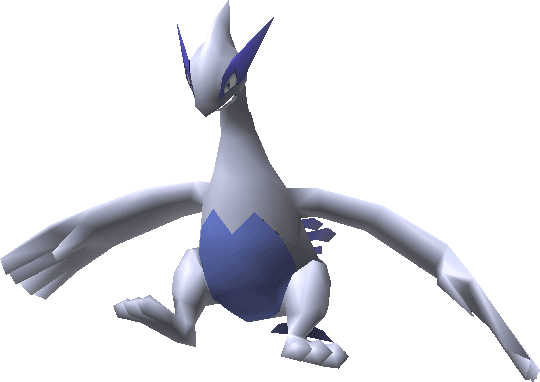
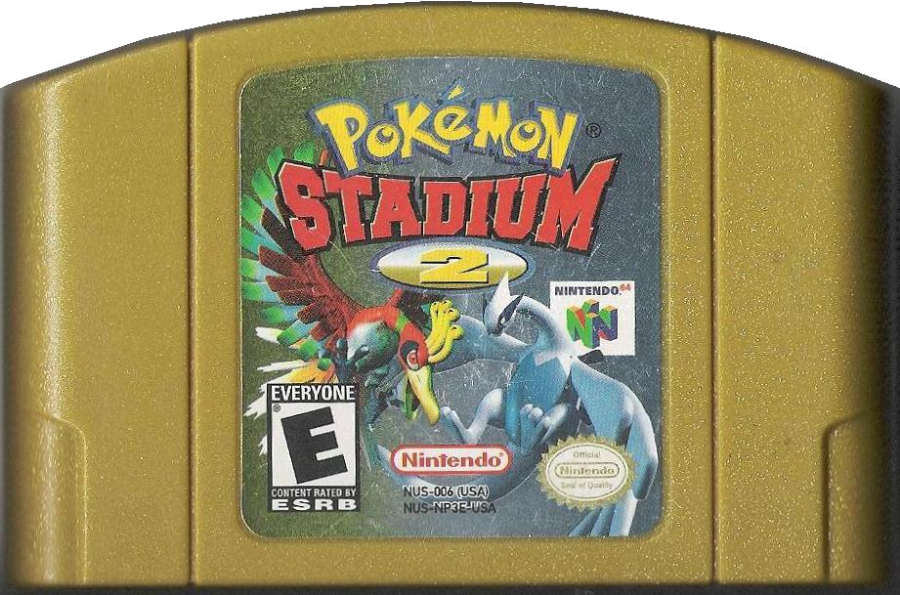
Concept art. The gold and silver colours of the game’s cartridges are a reference to Pokémon Gold and Pokémon Silver.
- Electabuzz’s model still has six fingers, as in Pokémon Stadium.
- In Japan the game is called Pokémon Stadium Kin Gin (Gold Silver), because the previous game was released there as Pokémon Stadium 2 – Japan had three Stadium games in all.
- Computer trainers sometimes pop up to address the player during matches.
Further trivia
- At 512 megabits (64 MB), Stadium 2 shares the title of largest Nintendo 64 cartridge with Conker’s Bad Fur Day and Resident Evil 2.
- The cartridge drawn on the Game Pak Check screen looks remarkably like the one for Road Rash 64.
- Nintendo Power’s player’s guide to the game was the first official Nintendo source to use the word ‘Eeveelution’, which the games themselves did not adopt until Pokémon Ranger: Shadows of Almia.
- Until Pokémon Black 2 and White 2 were announced, it was the only Pokémon game outside Asia with a number in its title.
- It was the last Pokémon game on the Nintendo 64, and the only one of the N64 Pokémon games built around Generation II.
- Moves the game considers illegal for a Pokémon are shown in purple in the battle menu, along with the trainer’s name, but the colouring is purely cosmetic.
Legacy
What came after
- Japanese release as Pokémon Stadium Kin Gin – 14 December 2000. Launched the same day as Pokémon Crystal, with Mobile Stadium support for Crystal’s Mobile System GB data.
- North American release – 26 March 2001. Arrived about four months before Pokémon Crystal, so the box and manual list only Red, Blue, Yellow, Gold and Silver.
- Australian release – 7 April 2001. PAL release with an OFLC G8+ rating.
- European release – 10 October 2001. Released in English, French, German, Italian and Spanish, compatible with Western Game Boy games.
- Pokémon Colosseum – 21 November 2003 (Japan). The next home-console Pokémon battle game, on GameCube; Stadium 2 was the last Pokémon game on the Nintendo 64.
- Nintendo Switch Online + Expansion Pack – 8 August 2023. Added to the Nintendo 64 library on the same day Pokémon Trading Card Game joined the Game Boy library; no Transfer Pak features.
- Nintendo Switch 2 – 5 June 2025. Playable on Switch 2 from launch through the Nintendo 64 – Nintendo Classics app.
- Nintendo Classics release in Taiwan – 9 September 2025. Released for the Nintendo 64 – Nintendo Classics app in Taiwan.
Where to play it today
As of October 2026 the easiest way in is Nintendo Switch Online + Expansion Pack, whose Nintendo 64 – Nintendo Classics app runs the game on Switch and Switch 2. That version is rentals only: with no Transfer Pak there is no GB Tower, My Room, Mystery Gift or imported team, and Mewtwo, Lugia and Ho-Oh are unavailable. For the full experience you still need a Nintendo 64, a Transfer Pak and original Game Boy cartridges with working saves.
How it was made
Pokémon Stadium 2 was made by Nintendo under director Takao Shimizu, with Tsutomu Kaneshige as program director; Kenji Miki, Tsunekazu Ishihara, Satoru Iwata and Shigeru Miyamoto produced it and Hiroshi Yamauchi was executive producer. Nintendo of Europe also credits HAL Laboratory, the studio Iwata had led before moving to Nintendo in 2000. Hajime Wakai composed the score, Junichi Masuda is credited for the original Game Boy music, Ken Sugimori for the original character designs and Ikue Otani for Pikachu’s voice. Once referred to as Pokémon Stadium 3, the project was being called Pokémon Stadium Gold/Silver by July 2000 and was shown at Nintendo Space World that August. In October 2000 Nintendo fixed the Japanese launch for 14 December, the same day as Pokémon Crystal, announced official tournaments and set the North American date, and the game was backed by a reported US$7 million marketing budget.
Pokémon Stadium 2 elsewhere

Sales & reviews
Sales figures
Although many people were waiting for its release, Pokémon Stadium 2 didn’t sell as well as its predecessor. Even so, it shipped about 2.5 million copies and was reported as one of the ten best-selling games of 2001.
The exact figure is 2.54 million units shipped (CESA Games White Paper, 2021), which makes it the 18th best-selling Nintendo 64 game.
- 2.54mshipped
- 251Pokémon in 3D
- 12mini-games
- 64 MBcartridge
Review scores
Like the previous game, Pokémon Stadium 2 won the approval of a good majority of critics, who were genuinely astonished by the 3D Pokémon and the fluid animation of their moves. Yet again, many admitted they had hoped for unique Pokémon voices like those in the animated series, and were disappointed once more by the generic sounds. Very likely the reason those sounds weren’t included was the limited space on N64 cartridges (64 MB, or 512 megabits, at most) – had the game been on CD or DVD, things might have been rather different.
- The game still managed high scores from reviewers, with IGN’s Chris Carle scoring it a strong 7.5 out of 10 and saying “The battle system, which dominates game play, is easy to follow, as it mirrors the Game Boy skirmishes any Pokefan is well-versed in. However, even if you have never explored the world of Pokémon, everything about Stadium 2 is user-friendly”.
- GameSpot’s Gerald Villoria also gave the game a high score of 7.2 out of 10, writing “If battle is the heart of the Stadium series, the graphics are clearly the body. The 249 Pokémon available in Stadium 2 are rendered in full 3D, complete with a proper repertoire of over-the-top attack effects. The characters are large, nicely rendered, and faithfully represent what you would expect of the cartoon and handheld’s newest stars. The techniques are each accompanied by a brief animation, such as an onscreen sandstorm, a colorful shower of light, impressive chrome effects, and the like”.
- As for Nintendo Power, it gave Pokémon Stadium 2 a score of 4 out of 5 stars.
Critics broadly agreed that Stadium 2 was a clear step up from the first game, with every Pokémon from both generations, sharper models and a far richer set of extras, but most added that its value depended on owning a Transfer Pak and the Game Boy games. Without them, reviewers found the rental-driven battling thin and repetitive. The 3D models and showy move effects drew praise, while the soundtrack and the reliance on Game Boy-style cries came in for criticism. Earl’s Academy was singled out as a clever way to teach newcomers, and the mini-games were seen as fun if slight party fare. Japanese magazines were warmer than most Western outlets, and aggregate scores settled in the mid to high seventies.
Awards and honours:
Media & artwork
- Official artwork gallery from Pokémon Stadium 2 – artwork of prominent Pokémon models
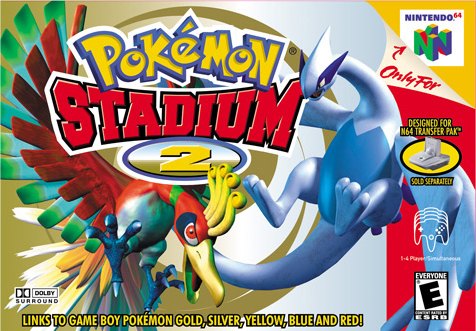
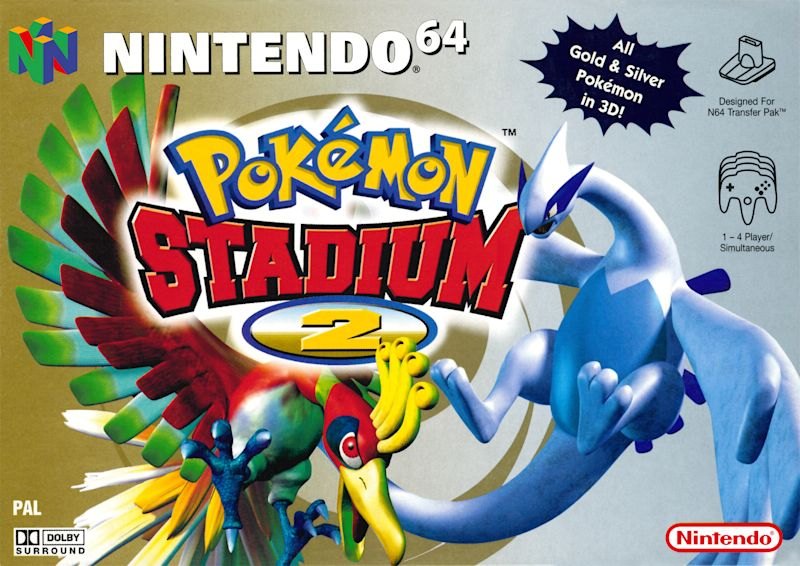
- Box art from Pokémon Stadium 2, including several regional variations
- Screenshots from Pokémon Stadium 2
Further reading
More Nintendo 64 and Generation II links on the site: