
Written for Generation V
When this was written a wild shiny was a 1 in 8,192 chance. From X & Y the base odds are 1 in 4,096, and later games added plenty of new methods: chain fishing, the DexNav in Omega Ruby & Alpha Sapphire, SOS battles in Sun & Moon, catch combos in Let’s Go, and Mass Outbreaks and Sparkling Power in Scarlet & Violet.
Introduced in generation II, shinies are rare alternate colorations of Pokémon. While every Pokémon has a shiny form, differences in the color palettes of shinies and normal Pokémon can range from being incredibly drastic, such as in Kyogre’s pink shiny form to the right, or being incredibly subtle, such as in the case with Bibarel’s slightly lighter brown shiny form.
However, what shinies do have in common is the fact that they are generally incredibly rare. While Gold and Silver (and later HeartGold and SoulSilver) introduced a “free shiny” in the form of the Red Gyarados which was battled and possibly captured through the plot of the game, the chance of actually just bumping into a shiny Pokémon in the wild is about 1/8,192.
In general, while shinies are rare and thus often sought after by collectors, the difference between a shiny Pokémon and a normal Pokémon is purely aesthetic. That means, for example, that a shiny Lugia doesn’t necessarily have higher stats or better attacks or anything of the like just because it’s a shiny.
Shininess in Generation II

The only real linkage between shinies and stats existed in Generation II, when shininess was determined based on a Pokémon’s IVs. The main reason this was done, however, was not to imply that shinies should be constituted by a certain stat distribution, but to allow for backward compatibility of shininess with Generation I games.
Since shinies didn’t exist before generation II, generation I games weren’t able to store data for shininess, but they did store IV data for Pokémon. Therefore, by using IVs as the determining factor for shininess, shininess wouldn’t be lost by transferring Generation II Pokémon to Generation I games and, in turn, it was possible for Pokémon transferred from a Generation I game to a Generation II game to end up being shiny.
Shininess Versus Forms
Gastrodon and Shellos’s East and West forms can easily be confused for shinies by new fifth generation players because they carry significant color palette changes (pink versus blue) much in the 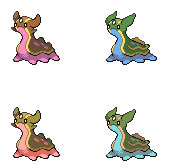 manner of shiny Pokémon. However, the shiny versions of Gastrodon’s forms (shown below on the left) actually have slightly lighter colors than the normal forms rather than a major hue change.
In general, shiny forms of Pokémon do not have any visual changes outside of the color palette. Examining closely, you can see that while Gastrodon’s forms are similar in shape and pose, the West form (pink) has ears curled more upright than the East form (blue). The East form also has a different pattern on its back, sporting streaks rather than dots. These changes in the actual physical features of a Pokémon’s sprite are not the kinds of changes that would be seen between a shiny and a nonshiny Pokémon although different forms of Pokémon do also have shiny forms. (Hey, form of a form anyone?)
Obtaining Shinies More Easily
A 1/8,192 chance of finding a shiny isn’t very promising at all and as a result, many Pokémon trainers don’t find their first shinies until well into their gaming experience if ever at all. It’s even worse if you’re looking for a specific of your favorite Pokémon or whatever else.
Luckily, in many games there are methods to make obtaining shiny easier, at least for a good majority of Pokémon (legendaries are usually excluded unfortunately).
In generation II, since shininess was determined by IVs, and IVs were partially inherited from parents, if you bred a shiny Pokémon, you were much more likely to get a shiny Pokémon. However, generation III’s changes to the shiny mechanics meant that shininess was no longer partially breedable, at least until the Masuda method was introduced in Generation VI, allowing you to multiply your chances of a shiny five times by breeding together Pokémon from different countries (A Japanese Ninetales and an American Vulpix for example).
The most notable change Generation IV brought to making shinies more accessible, however, was in the form of Poké Radar shiny chaining, a method using the Poké Radar to gradually increase the chance of finding a shiny Pokémon in a wild patch of grass to as high as 1/200.
Poké Radar shiny chaining is limited only to wild Pokémon found in patches of grass. However, it does make many shiny Pokémon much more accessible, and if you’re interested in learning more about how to chain, see our Poké Radar Shiny Chaining Guide.
The Shining Charm
In Black and White 2, an item called the Shining Charm was introduced. The Shining Charm is a key item obtained when a player completes all 649 entries in their Pokédex, and it increases the chance of encountering a shiny Pokémon by 300% or 3 times. That means that with the shiny charm, your natural chance of encountering a shiny is about 1 in 2,370. In addition the Shining Charm bonus can be stacked on top of the Masuda method for breeding shinies to increase the shiny chance down to 1 in 1,024.