Between 1999 and 2003, Wizards of the Coast held the licence to publish the Pokémon Trading Card Game in English. Their job was not simply translation. Every card had already been designed, illustrated and printed for a Japanese audience, and a number of those illustrations were judged unsuitable for the Western market once someone actually looked at them.
The result is one of the more interesting corners of vintage Pokémon collecting: a small group of cards that exist in two visually different versions, where the Japanese original shows something the English release does not. Some of the changes are obvious. Several are so subtle that most players never noticed. One of them is not censorship at all, but a lawsuit.
Why it happened at all
Pokémon cards are released in Japan first and localised afterwards, so in every case the “original” artwork is the Japanese one. Wizards were localising a product aimed squarely at children into markets — principally the United States — with different sensitivities around religious symbols, gambling, suggestive imagery and racial caricature.
What makes the cases below worth reading together is how varied the reasoning is. There is no single policy at work. Some cards were redrawn entirely, one had a single element quietly erased, one was renamed as well as redrawn, and one was removed from the game for two decades for reasons that had nothing to do with its picture.
Base Set: where it started
Jynx — recoloured before the controversy, not after
Jynx’s original design, with a black face, drew comparisons to blackface caricature. Wizards recoloured the face and body purple for the English release, and five Jynx cards ultimately carried altered artwork. The chronology is commonly reported the wrong way round: the recolour came before the public criticism, not in response to it. Author Carole Boston Weatherford’s widely cited comments were published in January 2000 and were directed at the animated series, by which point the card had already been changed. This was Wizards acting pre-emptively rather than reacting.
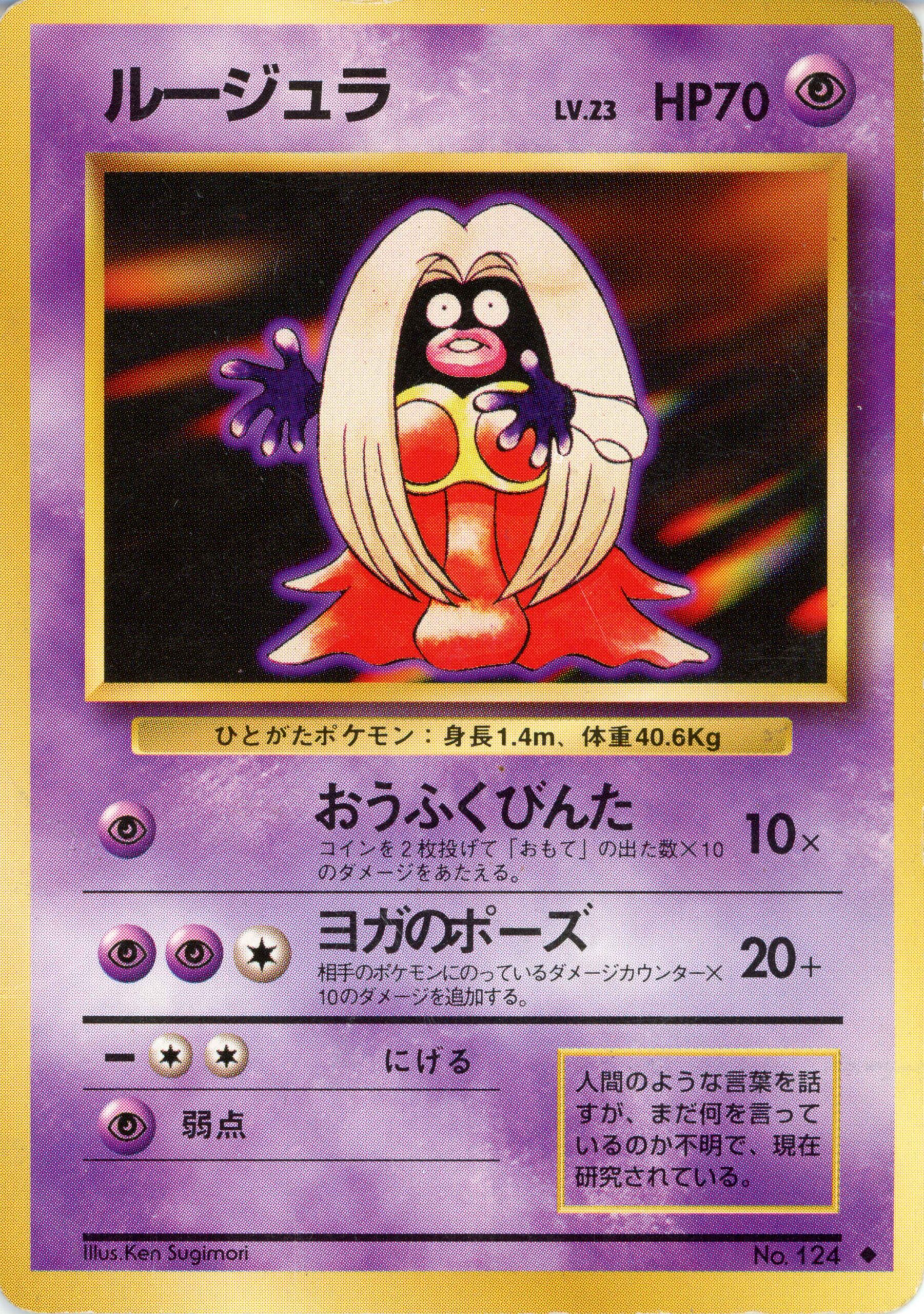 Japanese original — Expansion Pack
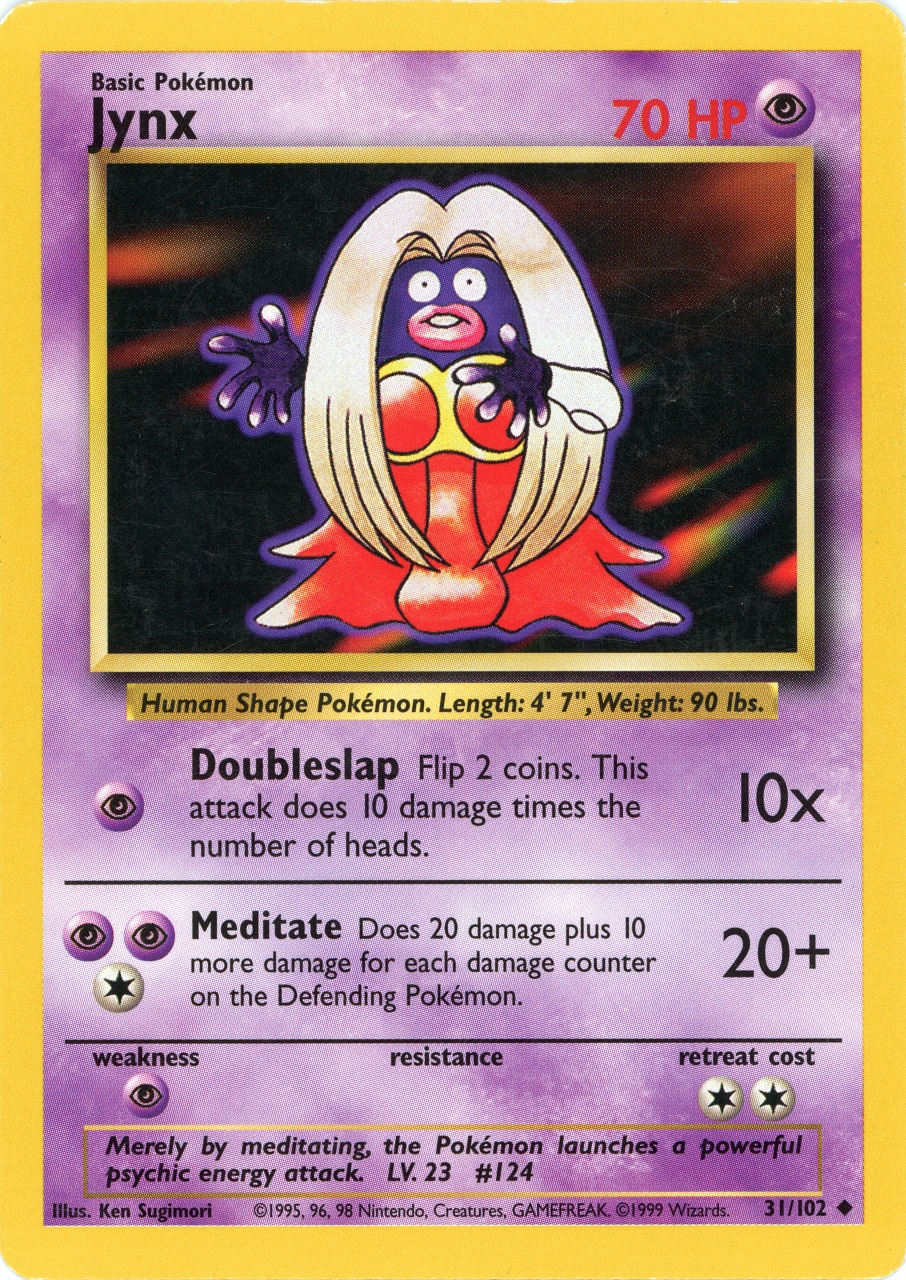 English release — Base Set
Team Rocket: a redrawn gaze
Grimer — eyes redrawn
The Japanese Rocket Gang artwork was widely read as showing Grimer looking up a girl’s skirt from a drain. The illustrator, Kagemaru Himeno, has denied that was the intention — but for the English Team Rocket release Grimer’s eyes were redrawn to look straight ahead. Oddly, the card’s attack was altered too: the English “Poison Gas” puts the opponent to sleep rather than poisoning them, a change nobody has satisfactorily explained.
 Japanese original — Rocket Gang
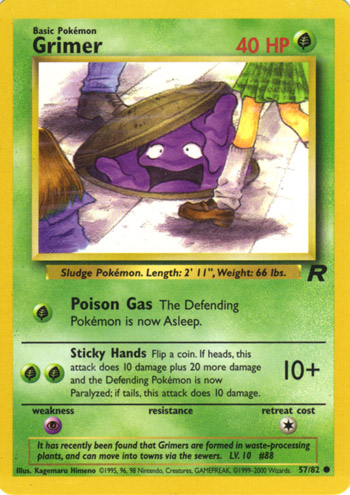 English release — Team Rocket
The Gym sets: four in two releases
The two Gym sets account for more altered cards than any other part of the Wizards era, which is unsurprising given they are also the sets most rooted in Japanese visual culture.
Sabrina’s Gaze — the first full redraw
The Japanese art shows Sabrina holding a Master Ball, with her middle finger positioned in a way that reads, unfortunately, as a rude gesture. It is subtle enough that many people do not see it immediately. Wizards judged it not worth the risk on a card aimed at children and commissioned entirely new artwork — Sabrina with her arm extended, throwing a Poké Ball. This is generally regarded as the first Pokémon card to receive a completely redrawn illustration for its English release. It appears in Gym Heroes.
 Japanese original — Challenge from the Darkness
 English release — Gym Heroes
Sabrina’s Gengar — the graveyard that disappeared
The Japanese illustration shows Gengar standing in a graveyard, with several tombstones and crosses clearly visible behind it. For the English release those details were removed — and unusually, nothing was drawn in to replace them, leaving the card with no discernible background setting at all. It is the only case on this list where Wizards erased elements rather than commissioning a redraw, and the most likely reason is practical: this is a holofoil card, so a plainer background still reads well against the foil. Sabrina’s Gengar is also one of Gym Heroes’ headline chase cards, which makes it the most valuable card on this list by some margin.
 Japanese original — Challenge from the Darkness
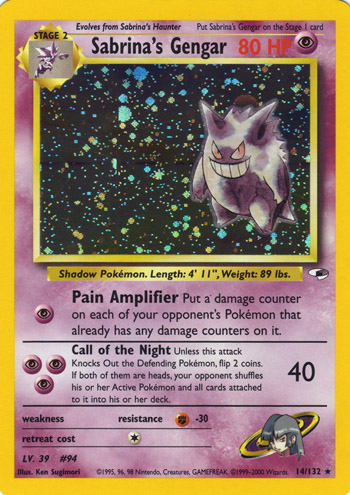 English release — Gym Heroes
Koga’s Ninja Trick — the manji
The Japanese illustration carried an omote manji (卐), a Buddhist symbol used in Japan for centuries to mark temples on maps. It is a mirror image of the swastika appropriated by the Nazis, and while the two are historically distinct, the resemblance was obviously going to cause problems in Western markets. It was replaced with a different symbol for the Gym Challenge release.
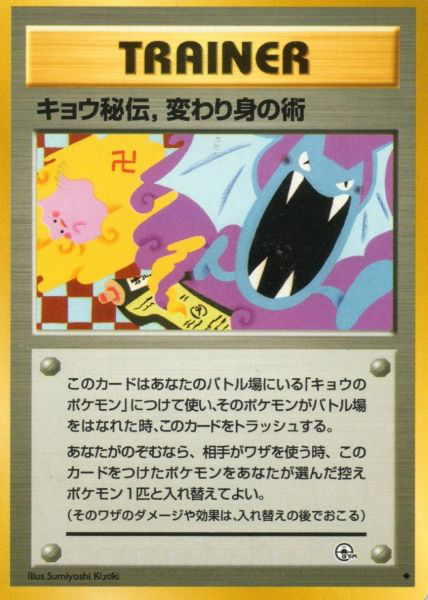 Japanese original — Challenge from the Darkness
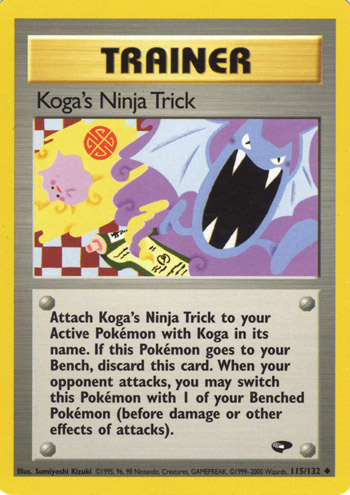 English release — Gym Challenge
Misty’s Tears — redrawn entirely
The Japanese artwork was considered unsuitable for the Western market and was replaced for the English release, which instead shows a Squirtle trying to stop Misty’s tears from falling. Also from Gym Challenge.
 Japanese original — Hanada City Gym
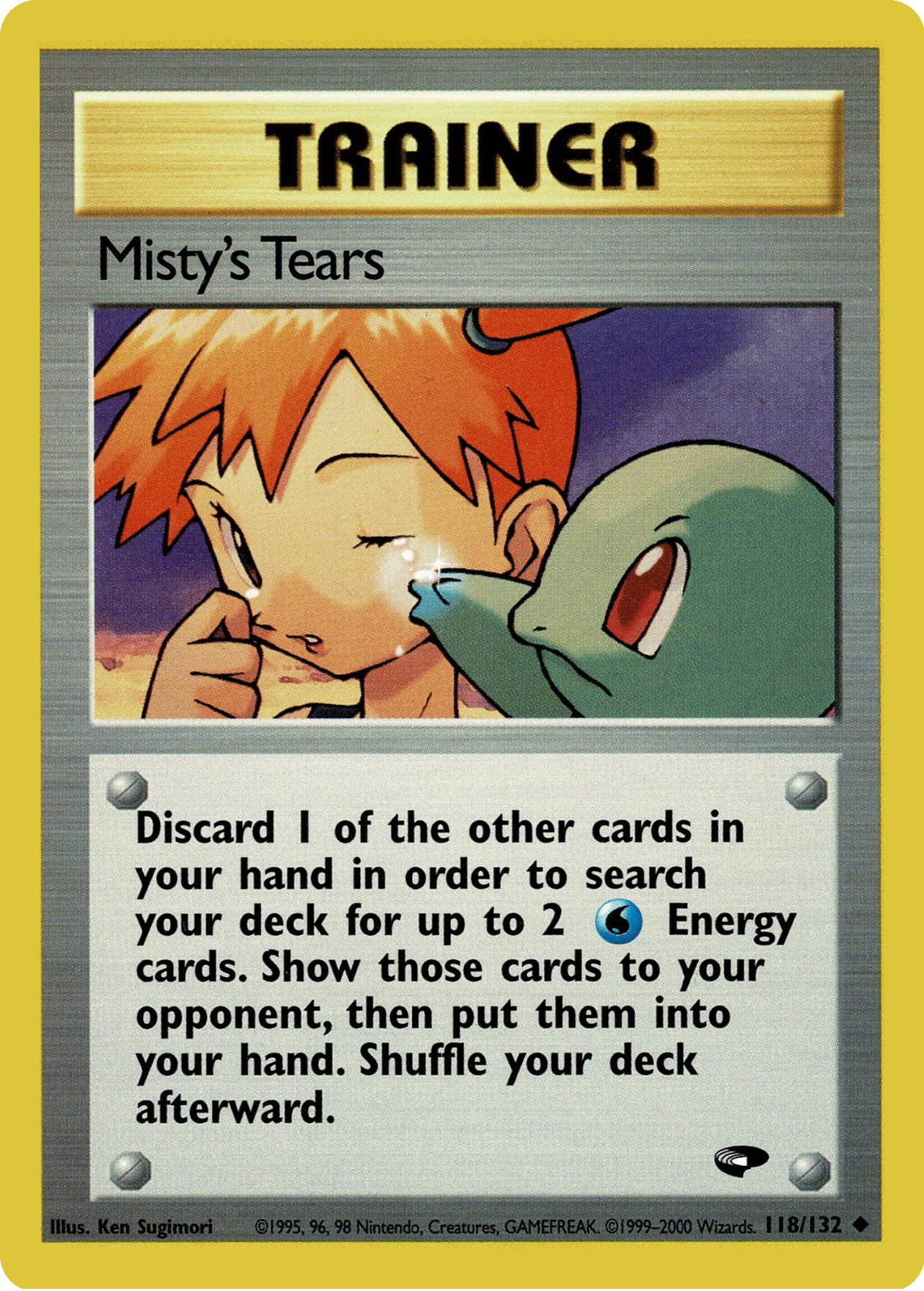 English release — Gym Challenge
Two further Japanese cards did not survive the crossing at all. Imakuni?’s Doduo, named after a Japanese musician associated with the franchise, and _____’s Chansey, a joke card with a deliberately blank owner name, were both cut from the English Gym Challenge set — not for content, simply because neither made sense outside Japan.
Neo Genesis: milk and slot machines
Moo-Moo Milk — the udder
The Japanese illustration depicts a Sentret feeding from an udder. Designers judged that parents outside Japan might object, and replaced it with bottles of milk in a barn, with a curious Cleffa peering round the door. There is a neat postscript: later Japanese reprints adopted the Western artwork, making this one of the few cases where the localised version became the definitive one. From Neo Genesis.
 Japanese original — Gold, Silver, to a New World…
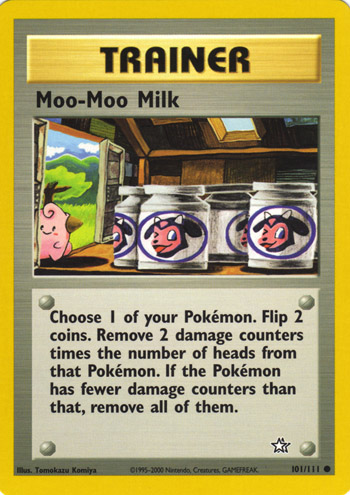 English release — Neo Genesis
Arcade Game and Card-Flip Game — the gambling problem
Following the scrutiny that Pokémon Red and Blue attracted over their in-game slot machines, Wizards took a firm line on gambling imagery. Both cards originally depicted rows of Game Corner slot machines. Both were altered — and Arcade Game was renamed as well as redrawn: the Japanese スロットゲーム translates literally as “Slot Game”, which became the deliberately vaguer “Arcade Game”, with the word removed from the machine itself as well as the title.
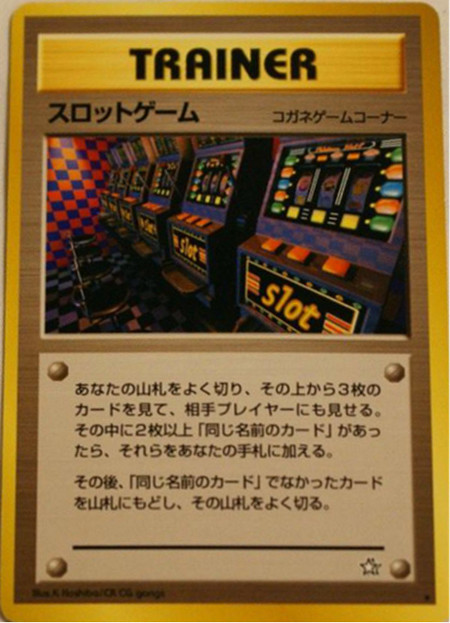 Japanese original — Gold, Silver, to a New World…
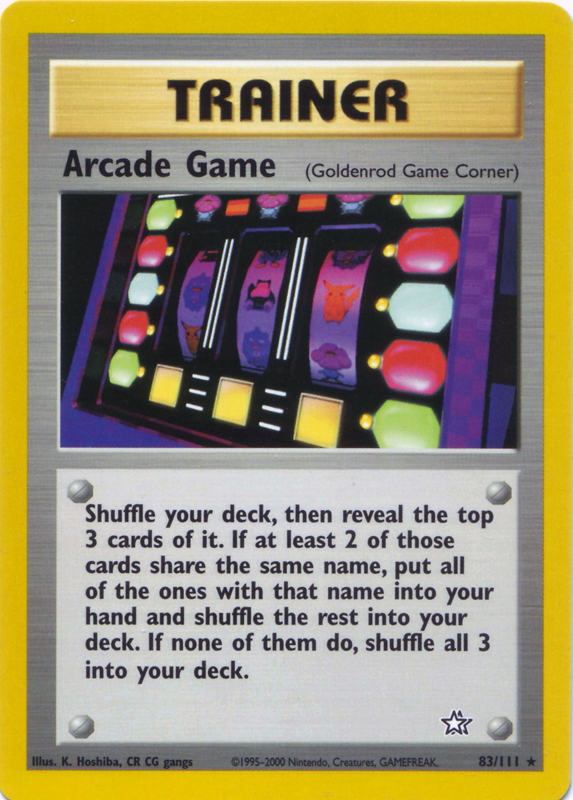 English release — Neo Genesis
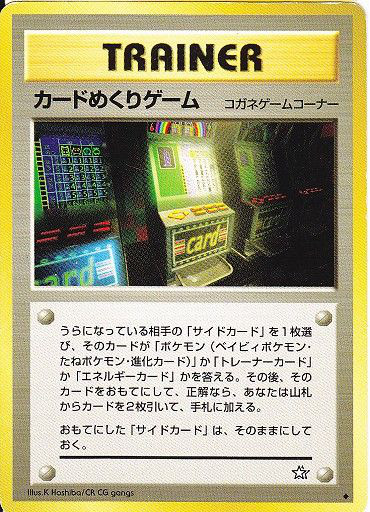 Japanese original — Gold, Silver, to a New World…
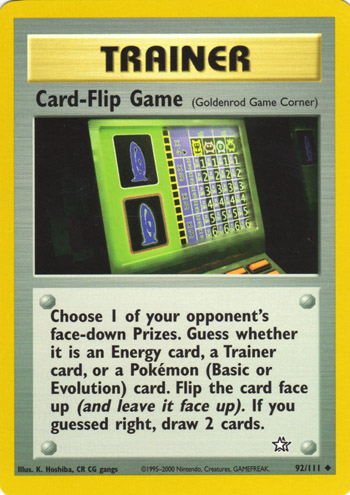 English release — Neo Genesis
The Kadabra case: not censorship at all
The most famous absence in Pokémon TCG history belongs in a different category entirely. Kadabra vanished from the game for roughly two decades, and no artwork was ever altered.
Illusionist Uri Geller, known for spoon-bending, took legal action against Nintendo, arguing that Kadabra appropriated his identity. The parallels are not hard to see: Kadabra bends spoons, and its Japanese name ユンゲラー (Yungeraa) sits very close to Geller’s own ユリゲラー (Yurigeraa). The specific trigger was Dark Kadabra from Team Rocket, which cast the Pokémon as a villain — something Geller objected to particularly strongly.
The consequence was that Kadabra simply stopped appearing on cards. Geller publicly relented in 2020 and the Pokémon has since returned. It is a useful reminder that a card can disappear from the game for reasons that have nothing to do with what is printed on it.
After Wizards
Wizards lost the licence in 2003, and alterations of this kind became rare almost immediately — partly because the game had matured, partly because localisation concerns were being caught earlier in the design process.
Magmortar (Dragons Exalted, 2012)
The Japanese Dragon Blade artwork shows Magmortar pointing its cannon arm directly at the viewer against a background of smoke, reading unmistakably as a Pokémon that has just fired a gun. It was altered for the English release, and stands as the first card censored in over a decade — and the most recent example in the game’s history.
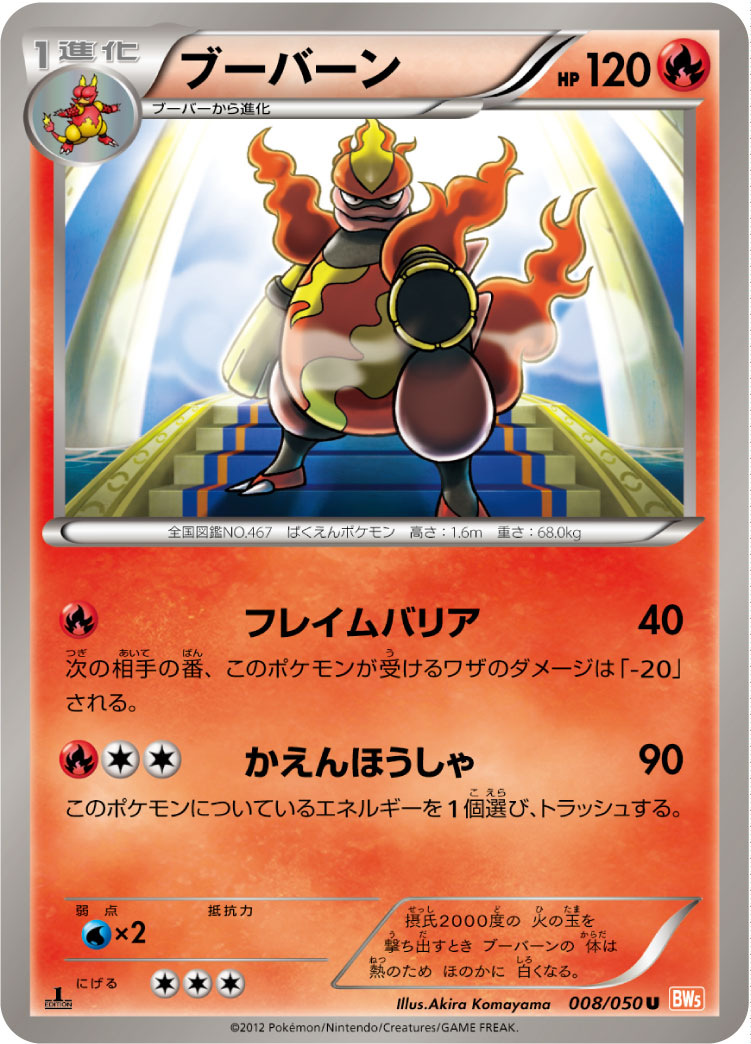 Japanese original — Dragon Blade
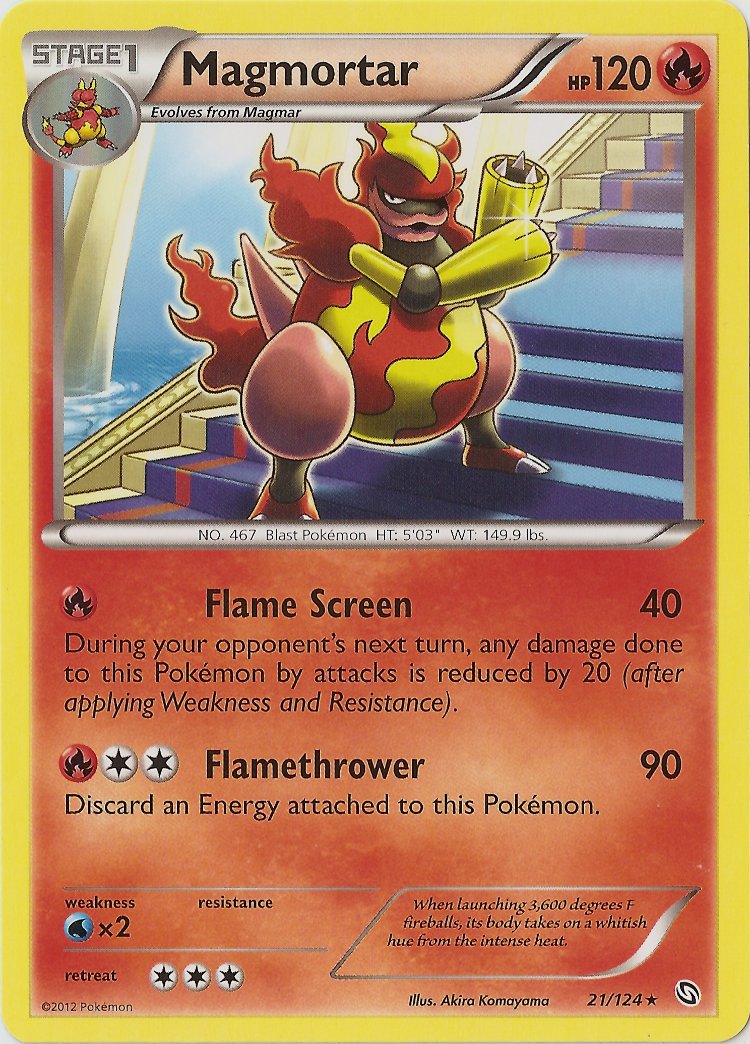 English release — Dragons Exalted
Collecting the originals
Because Japanese cards come first, every original version described here still exists and can still be bought. Over the last few years this has quietly become a collecting category in its own right — assembling the Japanese counterparts of every altered card.
It is also an unusually affordable one. These are not chase cards; most are commons and uncommons whose interest is entirely historical. Grimer, Koga’s Ninja Trick and Moo-Moo Milk tend to be the easiest starting points. Sabrina’s Gaze is the notable outlier, and illustrates the point neatly: the Japanese original trades at roughly ten times the English version, purely because of what it shows.
Card values move constantly. Treat any figure as directional and check live sold comps before buying.
For the full card lists and set histories, see our Pokémon TCG hub.