  |
|
| Titles | Pokémon Ga-Olé ポケモンガオーレ (Pokemon Gaōre) 寶可夢加傲樂 (Taiwan) · 宝可梦加傲乐 (mainland China) · 포켓몬가오레 (South Korea) |
| Platform | Arcade: a dedicated cabinet with a 50-inch portrait screen, blue and orange disk slots and buttons, a Poké Ball lever, a Multi-Scanner, a Ga-Olé Pass reader and a built-in disk printer; online-connected |
| Developer | Takara Tomy A.R.T.S. and Marvelous |
| Publisher | Takara Tomy A.R.T.S. (Japan); overseas editions run with Marvelous and local distributors such as SEGA Taiwan |
| Music | Hideaki Takatori (theme songs, with lyrics by Aya Ikeda) |
| Players | 1 |
| Genre | Kids’ arcade battle-and-catch game with collectible disks |
| Business model | Pay per play: ¥100 a battle round and ¥100 a disk (up to ¥600 for a standard three-round game in Japan); optional ¥500 Ga-Olé Pass save card |
| Disks | 1,294 numbered disks in 20 Japanese sets (1,238 standard, 56 secret), plus promotional P disks; separate lists overseas |
| Series | Japan: original, Dash, Ultra Legend and Grand Rush, five sets each · Taiwan: a launch edition, then the Legend, Rush and STAR series |
| Released | 7 July 2016 (Japan) · 5 December 2020 (Taiwan) · 12 December 2020 (mainland China) · 2 August 2021 (South Korea) · 13 October 2021 (Hong Kong) · November 2021 (Singapore) · January 2022 (Malaysia) |
| Service ended | Japan: autumn 2020, venue by venue from September; the Asian editions carried on |
| Predecessor | Pokémon Tretta (see Pokémon arcade games) |
| Successor | Pokémon Mezastar (Japan, 17 September 2020) |
| Sales | No totals published; Takara Tomy A.R.T.S.’s biggest Pokémon kids’ arcade hit to 2020 · 50 million+ disks sold in Taiwan by March 2023 |
Overview
 Pokémon Ga-Olé is a children’s arcade game from Takara Tomy A.R.T.S. and Marvelous that switched on in game centres across Japan on 7 July 2016. Revealed at Takara Tomy A.R.T.S.’s summer business meeting in Tokyo on 13 April 2016, it was the third Pokémon machine from the partnership behind Pokémon Battrio and Pokémon Tretta, and it arrived with a genuinely new trick: every Pokémon a player catches is printed onto a fresh plastic disk inside the cabinet and dropped into their hand on the spot.
A game starts with a ¥100 coin. The tall cabinet pairs a 50-inch portrait screen with two disk slots, one blue and one orange, a matching pair of big buttons and a chunky Poké Ball lever. Each credit buys a 20-second, two-on-two battle against wild Pokémon: players slot in two of their own disks or borrow rental Pokémon, then hammer the buttons and stop roulettes to attack and defend. A weakened Pokémon can be caught in Get Time! with a thrust of the lever, and another ¥100 prints it as a disk. After each round a War Cry calls in stronger opponents, Legendary Pokémon among them, for up to three rounds.
The machine was refreshed every two to three months. Twenty sets in four series, the original run followed by Dash, Ultra Legend and Grand Rush, brought 1,294 numbered disks to Japanese arcades between July 2016 and June 2020, along with new mechanics borrowed from the main series as they appeared: Mega Evolution, Z-Moves in time for Sun and Moon, Ultra Beasts and, at the end, Double Rush Pokémon that know two moves. Takara Tomy A.R.T.S. later called it the biggest hit of any of its Pokémon kids’ arcade machines.
In Japan, Ga-Olé was wound down in the autumn of 2020 as Pokémon Mezastar took over, venue by venue rather than on a single closing day. By then a second life had already been lined up: localised machines opened in Taiwan and mainland China in December 2020, then in South Korea, Hong Kong, Singapore and Malaysia, and Taiwan’s edition carried on with Legend and Rush series of its own. It has never been released in Europe, the Americas or Oceania.
ガオーとオタケビ!よびだせ伝説!
業界初!「成型物オンデマンド配出システム」搭載!
— Official description, from Takara Tomy A.R.T.S.’s April 2016 announcement. In English: “Roar and war cry! Summon the legends! An industry first! Equipped with an on-demand moulded-item dispensing system!”
Quick Answers
The questions people ask most about Pokémon Ga-Olé, answered first and explained further down the page.
Can you still play Pokémon Ga-Olé in Japan?
No. Grand Rush set 5, the last Japanese set, arrived on 8 June 2020, and from early September 2020 the machines were taken out venue by venue, the last of them during the autumn. Pokémon Mezastar replaced it from 17 September 2020, and its first set even accepted Meteor Mark disks from Grand Rush set 5, but Mezastar has since left Japanese arcades too. More →
Where can you play Ga-Olé in 2026?
Only in Asia. Localised machines opened in Taiwan and mainland China in December 2020, South Korea in August 2021, Hong Kong in October 2021, Singapore in November 2021 and Malaysia in January 2022, and the official overseas website still sends players in Taiwan, South Korea, Hong Kong, Singapore and Malaysia to regional pages. Ga-Olé has never been released in Europe, the Americas or Oceania. More →
How much does a game of Ga-Olé cost?
In Japan a battle round costs ¥100, a second and third round ¥100 more each, and printing a caught Pokémon’s disk another ¥100, so Takara Tomy A.R.T.S. put the most a standard three-round game could cost at ¥600. Extra offers such as Evolution Chance! cost ¥100 on top, and the Ga-Olé Pass save card was ¥500. Abroad the price is set locally: NT$30 a credit in Taiwan and S$2 a play in Singapore. More →
How do you catch Pokémon in Ga-Olé?
Battle first: damaging a wild Pokémon fills its Get Gauge. When the round ends, Get Time! begins, and the ball on screen flicks between Poké Ball, Great Ball, Ultra Ball and Master Ball until you thrust the Poké Ball lever. A better ball and a fuller gauge improve the odds, and a successful catch can be printed as a disk for ¥100. More →
What do the stars on a Ga-Olé disk mean?
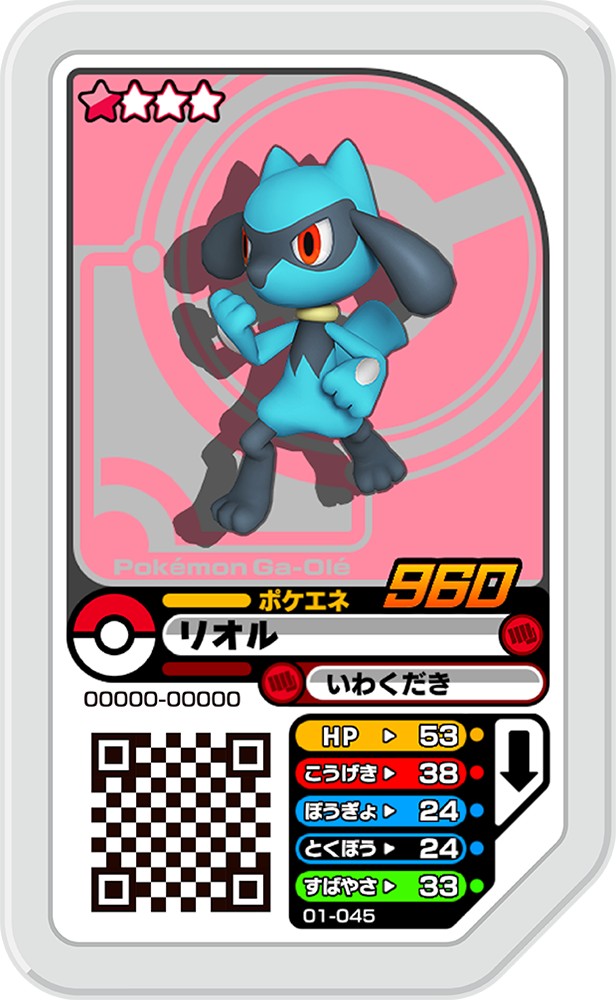
They show the Pokémon’s Grade: one red star for Grade 1, two blue for Grade 2, three yellow for Grade 3, four purple for Grade 4 and five multi-coloured stars for Grade 5. Hollow stars show room to grow, meaning the Pokémon can still evolve or move up a Grade through the Evolution Chance! and Grade Up Chance! offers. More →
Do Ga-Olé disks work with other Pokémon games?
Yes, in two ways. The QR code on every disk can be read by the QR Scanner in Pokémon Sun, Moon, Ultra Sun and Ultra Moon, where it is worth 20 points instead of the usual 10. And disks from Grand Rush set 5, the final Japanese set, carry a Meteor Mark that let them be scanned on Pokémon Mezastar when it launched. More →
How many Ga-Olé disks are there?
The twenty Japanese sets hold 1,294 numbered disks: 1,238 standard disks and 56 secret ones, which include rare Shiny variants. Promotional disks from films, magazines, McDonald’s Happy Meals and events sit outside the sets with a P collection number, and the overseas editions have separate disk lists of their own. More →
Is there a sequel to Pokémon Ga-Olé?
Yes. Pokémon Mezastar took over in Japan on 17 September 2020, swapping disks for flat tags and adding two-player co-operative battles, and more than ten million tags were dispensed in its first month. Marvelous’s overseas Ga-Olé website now promotes Mezastar as well, while the Taiwanese edition of Ga-Olé carried on with new series of its own. More →
Ga-Olé disks and the waves
Disks are what Ga-Olé is all about. Each one is a rounded plastic tile that the cabinet prints the moment a Pokémon is caught, and reads back through its blue and orange slots in every game after that. Japan had twenty sets in four series between July 2016 and June 2020, each set refreshing the courses, the Legendary Pokémon and the disk designs every two to three months. When the Japanese run ended, Taiwan and the other Asian editions carried the game on with disks and series of their own.
- 20Japanese sets in four series, 2016–2020
- 1,294numbered disks in Japan
- 56of them secret disks
- 83disks in Dash set 2, the biggest set
Anatomy of a disk

Grades and stars
A disk’s stars show its Grade, from 1 to 5, and the colour changes at every step:
| Grade | Stars | Examples |
|---|---|---|
| Grade 1 | One red star | Unevolved Pokémon such as Riolu (01-045) |
| Grade 2 | Two blue stars | Lucario (01-046), Riolu’s evolution |
| Grade 3 | Three yellow stars | Lucario (01-047), after a Grade Up |
| Grade 4 | Four purple stars | Lucario (01-048), which can Mega Evolve; the special Zeraora disk from the final course |
| Grade 5 | Five multi-coloured stars | Most Legendary headliners, from Volcanion and Zygarde to Lugia and Arceus |
 Four purple stars
Hollow stars show room to grow. A Grade 1 Riolu disk carries hollow stars alongside its single red one because its line can climb all the way to Grade 4: Evolution Chance! turns it into a Grade 2 Lucario, Grade Up Chance! lifts Lucario to Grades 3 and 4, and the Grade 4 Lucario can Mega Evolve in battle.


The waves: every Japanese set
Japan’s twenty sets came in four series of five, each series launched in the first week of July with a new theme song and, after the first, a headline mechanic of its own. A new set usually arrived every two to three months, opening with two or three courses and switching on more over the following weeks:
 the Fighting Spirit Drink item and drops of Gold Fragments and Gold Sand. The series held 358 disks over five sets, and Dash set 2 alone had 83, the most of any Japanese set.
| Series | Set | Released | Disks (standard + secret) | Highlights |
|---|---|---|---|---|
| Original 231 disks |
Set 1 | 7 July 2016 | 59 + 4 | Launch set: Zygarde, Volcanion and Journey Partners courses, then Xerneas and Yveltal courses from 4 August 2016 |
| Set 2 | 15 September 2016 | 42 + 3 | Trainer and Battle mode added | |
| Set 3 | 8 December 2016 | 38 + 4 | Z-Moves and the Pokémon Z-Ring link; Evolution and Grade Up offers straight after a capture | |
| Set 4 | 16 February 2017 | 40 + 1 | Only one secret disk | |
| Set 5 | 27 April 2017 | 38 + 2 | Last set of the original series | |
| Dash 358 disks |
Dash set 1 | 6 July 2017 | 73 + 2 | Dash System replaces the Cheer Balloon; Get Combo; Fighting Spirit Drink; Gold Fragments and Gold Sand |
| Dash set 2 | 14 September 2017 | 81 + 2 | The largest Japanese set, with 83 disks | |
| Dash set 3 | 14 December 2017 | 68 + 3 | – | |
| Dash set 4 | 15 February 2018 | 62 + 2 | – | |
| Dash set 5 | 26 April 2018 | 63 + 2 | Last Dash set | |
| Ultra Legend 353 disks |
Ultra Legend set 1 | 5 July 2018 | 70 + 8 | New UL numbering and layout; Lugia, Ho-Oh, Latias, Latios and Zygarde; the first Ultra Beasts (Nihilego, Buzzwole) and Beast Ball Chance!; Battle Leader Emako from 16 August 2018 |
| Ultra Legend set 2 | 13 September 2018 | 63 + 4 | – | |
| Ultra Legend set 3 | 29 November 2018 | 68 + 2 | – | |
| Ultra Legend set 4 | 14 February 2019 | 67 + 2 | Meltan and Melmetal | |
| Ultra Legend set 5 | 25 April 2019 | 67 + 2 | Last Ultra Legend set | |
| Grand Rush 352 disks |
Grand Rush set 1 | 4 July 2019 | 73 + 4 | Double Rush and Rush Combo; Mewtwo, Mew, Solgaleo and Lunala; Legendary beasts, Lugia and Ho-Oh courses; Battle Leader Yarma from 8 August 2019 |
| Grand Rush set 2 | 12 September 2019 | 64 + 2 | Kyogre and Groudon Double Rush Course; Mega Diancie Course; Alola League Champion Course | |
| Grand Rush set 3 | 28 November 2019 | 68 + 2 | – | |
| Grand Rush set 4 | 13 February 2020 | 68 + 2 | – | |
| Grand Rush set 5 | 8 June 2020 | 66 + 3 | Final Japanese set, delayed from 23 April 2020; Mega Mewtwo X and Y, Primal Kyogre and Groudon, Black and White Kyurem, Arceus; Meteor Mark for Mezastar; Battle Leader Karimi | |
| Total | 20 sets | 2016–2020 | 1,238 + 56 | 1,294 numbered disks |

Overseas editions
Ga-Olé’s second life began just as its first was ending. The Asian editions did not simply reuse the Japanese sets: each started afresh with region-specific disks, in the local language and at local prices. Singapore’s machines, for example, cannot read Japanese, Korean, Hong Kong or Taiwanese disks, and Singapore disks do not work with Japanese products. Taiwan, where SEGA Taiwan distributes the machines, has gone furthest, with series of its own. The launches and series so far:
| Date | Edition | What arrived |
|---|---|---|
| 5 December 2020 | Taiwan | Launch edition in Traditional Chinese, the first outside Japan; NT$30 a credit |
| 12 December 2020 | Mainland China | Launch edition in Simplified Chinese |
| 2 August 2021 | South Korea | Korean edition |
| 13 October 2021 | Hong Kong | English edition |
| November 2021 | Singapore | Part 1 of the English edition, which took over from Pokémon Tretta; S$2 a play |
| 21 January 2022 | Singapore | Machines begin upgrading, one by one, to Part 2 |
| January 2022 | Malaysia | English edition |
| March 2022 | Taiwan | The Legend series, Taiwan’s second |
| 23 March 2023 | Taiwan | Rush 1 opens the Rush series, launched with an event in Taipei |
| March 2024 | Taiwan | Rush 5, the first set of the STAR series, and a year-long Ga-Olé Festival with Zeraora and Mew cups |
By the time of the Rush 5 STAR series, Taiwanese machines also had two attacks of their own: Double Charge, in which a Pokémon uses two different moves in one attack after a roulette and a round of button-mashing, and Charge Combo, in which two specific disks attack together. Both echo the Double Rush and Rush Combo of Japan’s last series.
Gameplay
A game of Get by Battle, the main mode, runs the same way in every set:
- Pay and pick: a ¥100 coin opens the Pokémon Center, where you choose a mode and then a course.
- Battle: two of your disks, or two rental Pokémon, take on two wild Pokémon for 20 seconds.
- Catch: in Get Time!, thrust the Poké Ball lever, then pay ¥100 to have the catch printed as a disk.
- Call and continue: a War Cry summons two stronger Pokémon, and another ¥100 takes you into the next round, up to three in all.
- Finish: a Last Chance! throw, offers to evolve or Grade Up a catch, and the score screen.
Modes and courses
How a battle works


Catching and printing
Evolution, Mega Evolution, Z-Moves and Double Rush
 Pokémon marked with the Double Rush icon can trigger Double Rush Chance! on reaching the end of the gauge: if the roulette lands on a Double Rush space, the blue button fills the first move’s meter and the orange button the second, and filling both unleashes the two moves back to back.
 Rush Combo links fixed partners, such as the final forms of the Kanto starters, Vaporeon, Jolteon and Flareon, or Nidoking and Nidoqueen, who strike one after another when both their roulettes land.
Prices, the Ga-Olé Pass and tickets
 capsules, drinks and scopes, and from Set 2 registered members also earned Member Points, 50 for every ¥100 spent, which could be exchanged for tickets and promotional disks.
Links with other games
Characters
Ga-Olé has no story to speak of, so its cast is small: the player’s own Trainer on screen, and the hosts who took the game on stage around Japan.


- The player: Ga-Olé Pass holders choose a boy or a girl as their on-screen Trainer, along with a nickname, when they first register the pass, and that choice can’t be changed later. The avatar stands in for the player through battles and on the results screens.
- Ga-Olé Leaders Kazuki and Ren: the real-life hosts who compered Ga-Olé’s stage shows and competitions around the country.
- Ga-Olé Navi Girl Emily: joined them in 2017 and also hosted tournaments for players.
- The Trainers and Battle Leaders: the computer opponents of Trainer and Battle mode havea section of their ownjust below.
Trainer and Battle opponents
Trainer and Battle arrived with Set 2 in September 2016. Instead of wild Pokémon, it pits the player against a ladder of computer Trainers in four-Pokémon battles, rated from one star to five. Beating the four regular Trainers unlocks the set’s Battle Leader, and anyone who takes the Leader on can pay ¥100 to print one of the Legendary prize disks, in a special WINNER edition for those who win. The line-up changed with the sets; here are three of them.
Ultra Legend set 1
Opened on 16 August 2018, six weeks after the set itself: Performer Kento (★), Uniform Girl Yūko (★★), Silent Boy Keita (★★★) and Conductor Shin (★★★★), then Battle Leader Emako (★★★★★).

Ultra Legend set 1: Performer Kento
Rank: The easiest of the five
The first rung of the ladder: beat Kento and the three regular Trainers after him to unlock Battle Leader Emako.

Ultra Legend set 1: Battle Leader Emako
Prize: A Latias or Latios disk for ¥100, in a WINNER edition for victors
Emako came back for Grand Rush set 5 as one of its five Battle Leaders, this time with a team that can all use Z-Moves.
Grand Rush set 1
Opened on 8 August 2019, a month after the set launched: Gardener Nonoko (★; Donphan, Ninetales, Tyranitar and Gyarados), Traveler Leo (★★; Politoed, Emboar, Slowking and Nidoking), Mischievous Girl Kumiko (★★★) and Elite Employee Masanari (★★★★; Volcarona, Togekiss, Vanilluxe and Flygon), then Battle Leader Yarma (★★★★★).

Grand Rush set 1: Mischievous Girl Kumiko
Team: Venusaur, Charizard, Blastoise, Pikachu
Kumiko pairs Pikachu with the final forms of the Kanto starters, who can link up in a Rush Combo, the partner attack that arrived with the Grand Rush series.

Grand Rush set 1: Battle Leader Yarma
Team: Pidgeot, Scizor, Reshiram, Zekrom
Yarma’s Unova Legendaries double as his prize: a Reshiram or Zekrom promotional disk for ¥100, in a WINNER edition for anyone who beats him.
Grand Rush set 5
The last Japanese line-up was made up entirely of Battle Leaders: Tanze, Takade, Racto and a returning Emako, whose team could now all use Z-Moves, and then Karimi (★★★★★).

Grand Rush set 5: Battle Leader Racto
Team: Every member can Mega Evolve
Racto is the Mega Evolution specialist of the last set, which had Mega Mewtwo X and Y among its headliners.

Grand Rush set 5: Battle Leader Karimi
Prize: A Xerneas or Yveltal promotional disk for ¥100, in a WINNER edition for victors
The last Trainer and Battle opponent of the Japanese run. His prize disks bring things full circle: Xerneas and Yveltal had headlined the very first set back in 2016.
Pokémon
Ga-Olé’s disks span every generation from Kanto to Galar. The launch set’s 63 disks were built around the Kalos Legendaries Zygarde, Xerneas and Yveltal and the Mythical Volcanion; later sets added Alola Pokémon, Ultra Beasts, Meltan and Melmetal and, by the final set, the fully evolved Galar starters. Many of the 1,294 Japanese disks show the same species at different Grades or in Mega, Primal and other alternate forms, so the number of different Pokémon is far smaller. Most Pokémon know a single move, but Grand Rush headliners such as Mewtwo, Arceus and the Kyurem forms know two.
Notable Pokémon
 ZygardeLaunch headliner
 VolcanionMythical, Set 1
 XerneasSet 1; Karimi’s prize
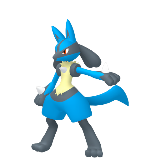 LucarioGrades 2 to 4
 PikachuOutbreak-chu!! event
 Magearna2016 film disk
 Zeraora2018 film disk
 MewtwoMega X and Y
 LugiaUltra Legend headliner
 NihilegoFirst Ultra Beast
 ArceusGrand Rush set 5
 MelmetalUltra Legend set 4
- Zygarde – The Legendary star of the launch set, with a Zygarde Course of its own; it returned in all three Formes in Ultra Legend set 1 and again in Grand Rush set 5.
- Volcanion – A Mythical Grade 5 disk with a launch course in Set 1, tied to the 2016 film, which also gave away a promotional Volcanion disk.
- Xerneas – Its course and Yveltal’s opened on 4 August 2016. In Grand Rush set 5 the pair can Rush Combo, and they are the prize for facing Karimi.
- Lucario – The textbook example of Grades, rising from Grade 2 to Grade 4 and able to Mega Evolve; Pokémon Tretta players could also unlock it as a Support Pokémon.
- Pikachu – Star of the Pikachu Outbreak-chu!! event from 7 to 21 August 2016, with secret disks in Set 1 and a place among the Tretta link rewards.
- Magearna – A promotional disk for Japanese audiences of Volcanion and the Mechanical Marvel from 16 July 2016.
- Zeraora – Given to up to three million Japanese cinema-goers with The Power of Us in 2018, and the subject of a special Grade 4 disk in the final course of the Japanese run.
- Mewtwo – Led Grand Rush set 1’s Mewtwo Strikes Back Course and returned in the final set able to Mega Evolve into Mega Mewtwo X and Y.
- Lugia – The Grade 5 headliner of Ultra Legend set 1, with a Z-Move course of its own, and back with Ho-Oh in Grand Rush set 1.
- Nihilego – The first Ultra Beast in the game, appearing in Ultra Legend set 1 until 8 August 2018; when it reached Get Time!, Beast Ball Chance! added Beast Balls to the roulette.
- Arceus – A Grade 5 Double Rush disk with its own course in Grand Rush set 5, the last Japanese set.
- Melmetal – Joined Meltan in Ultra Legend set 4, and both were reissued with the Grand Rush layout in Grand Rush set 1.
Double Rush and Rush Combo stars
Some of the Pokémon behind Grand Rush’s two big mechanics, Double Rush headliners and fixed Rush Combo partners:
 KyogreDouble Rush course
 GroudonDouble Rush course
 KyuremBlack and White, Double Rush
 VenusaurRush Combo
 CharizardRush Combo
 BlastoiseRush Combo
 VaporeonRush Combo
 JolteonRush Combo
 FlareonRush Combo
 NidoqueenRush Combo
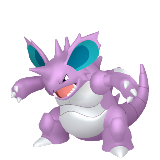 NidokingRush Combo
 YveltalRush Combo, set 5
 RillaboomRush Combo, set 5
 CinderaceRush Combo, set 5
 InteleonRush Combo, set 5
Events & key dates
The main dates of the Japanese run, from the reveal to the handover to Mezastar. Every set is in the waves table above, and the overseas launches have a table of their own:
| Date | What happened |
|---|---|
| 13 April 2016 | Ga-Olé is announced at Takara Tomy A.R.T.S.’s Summer Business Meeting in Tokyo |
| 7 July 2016 | Set 1 launches across Japan with the Zygarde, Volcanion and Journey Partners courses |
| 16 July 2016 | Magearna promotional disks for Japanese audiences of Volcanion and the Mechanical Marvel |
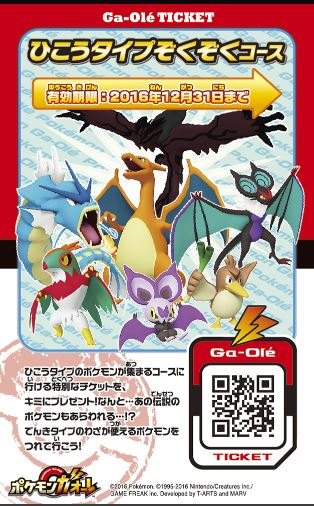
| 4 August 2016 | Xerneas, Yveltal and Mystery courses added, plus a Flying-type course ticket for Ga-Olé Members |
| 7–21 August 2016 | The Pikachu Outbreak-chu!! event |
| 15 September 2016 | Set 2 adds Trainer and Battle mode |
| 8 December 2016 | Set 3 brings Z-Moves and the Pokémon Z-Ring link |
| 6 July 2017 | Dash set 1 starts the Dash series and the Dash System |
| 5 July 2018 | Ultra Legend set 1 starts the Ultra Legend series, with the first Ultra Beasts |
| 16 August 2018 | Ultra Legend set 1’s Trainer and Battle mode opens, with Battle Leader Emako |
| 4 July 2019 | Grand Rush set 1 starts the Grand Rush series, with Double Rush and Rush Combo |
| 8 August 2019 | Grand Rush set 1’s Trainer and Battle mode opens, with Battle Leader Yarma |
| 12 September 2019 | Grand Rush set 2 adds the Kyogre and Groudon Double Rush Course |
| 8 June 2020 | Grand Rush set 5, the final Japanese set, launches after a COVID-19 delay from 23 April |
| 22 July 2020 | The last limited courses: the Special Black Kyurem and White Kyurem Double Rush Course and the Zeraora disk |
| Early September 2020 | Machines start to be withdrawn, venue by venue |
| 17 September 2020 | Pokémon Mezastar launches in Japan |
Glitches, exploits and oddities
Printing every disk inside the cabinet is clever, but it isn’t foolproof:
Printing errors
Because each disk is printed at the moment of capture, a machine occasionally turns out a faulty one, with artwork that is only partly printed, a missing colour layer or similar defects. Takara Tomy A.R.T.S.’s customer service replaces a defective disk by post, but plenty of collectors keep their misprints, which are prized as rarities. A cabinet also stops working until staff restock it when it runs out of blank disks or printing supplies.
Videos & media
Ga-Olé’s theme songs did a lot of its promotion in Japan. Three official music videos and two live performances:
The official music video for “Dash! Pokémon Ga-Olé!”, the Dash series theme, from the Japanese Pokémon channel.
The Dash theme sung live on stage at the International Tokyo Toy Show.
“Ultra Legend! Pokémon Ga-Olé!”, the theme of the Ultra Legend series.
The music video for “Grand Rush! Pokémon Ga-Olé!”, the theme of the last Japanese series.
The Grand Rush theme performed live at the International Tokyo Toy Show 2019.
Trivia & facts
-

The launch catchphrase logo. The launch catchphrase was “Gaō to Otakebi! Yobidase Densetsu!”, roughly “Roar and war cry! Summon the legends!”. Gaō is the Japanese sound of a roar, and it is also where the game’s name begins.
- At 45 by 73 mm, a Ga-Olé disk is roughly twice the size of a piece from Pokémon Tretta, the machine it replaced in Japanese arcades.
- Scanning a Ga-Olé disk with the QR Scanner in Pokémon Sun and Moon or Ultra Sun and Ultra Moon is worth 20 points, double the 10 points of an ordinary QR code.
- Grand Rush set 5 was due on 23 April 2020 but slipped to 8 June because of Japan’s COVID-19 restrictions. Its courses had been meant to close on 1 July, and instead ran on until the machines began to be retired that September.
- One last surprise was saved for Mezastar: a special Grade 4 Zeraora disk numbered GR5-XXX, from the final Japanese course, let out a War Cry when scanned on Pokémon Mezastar, calling two extra opponents to join the boss.
- The December 2020 launch in mainland China was the first time any Pokémon arcade machine had been released there.
- The cabinet stands 1,822 mm tall, weighs 155 kg and has a footprint of 724 by 855 mm, with its 50-inch screen turned on its side to portrait.
- The first Ultra Beasts took turns: Nihilego appeared in Ultra Legend set 1 until 8 August 2018 and Buzzwole after that, and either one brought Beast Balls into the Get Time! roulette.
-

A Ga-Olé Pass. A full Ga-Olé Pass holds 400 saves, but the promotional trial passes handed out to new players held just 50.
Legacy
What came after
- Final Japanese set – 8 June 2020. Grand Rush set 5, held back from 23 April 2020 by COVID-19 restrictions; its disks carry a Meteor Mark for Mezastar
- End of the Japanese service – Autumn 2020. Machines were withdrawn venue by venue from early September 2020, after a run of four years and two months
- Pokémon Mezastar – 17 September 2020. The successor swapped disks for tags, and more than ten million were dispensed in its first month
- Taiwan and mainland China – December 2020. Taiwan opened on 5 December and mainland China on 12 December, the first editions outside Japan
- South Korea, Hong Kong and Singapore – August to November 2021. South Korea on 2 August, Hong Kong on 13 October and Singapore in November 2021
- Malaysia – January 2022. An English edition, the last new market so far
- Legend series in Taiwan – March 2022. Taiwan’s second series
- Rush series in Taiwan – 23 March 2023. Launched with an event in Taipei; the Rush 5 STAR series followed in March 2024
- Mezastar’s Asian edition – 1 April 2025. The successor began opening in Hong Kong, Indonesia, Malaysia and Singapore, with Taiwan and mainland China a day later, in many of the markets Ga-Olé had served
Where to play it today
In Japan, Ga-Olé is finished: the final set arrived in June 2020 and the machines were withdrawn venue by venue from September 2020 as Pokémon Mezastar took over. Mezastar’s first set accepted Meteor Mark disks from Grand Rush set 5, but that is history now too, as Mezastar itself made way for Pokémon Frienda in July 2024. Outside Japan the localised editions have carried on. Marvelous’s official overseas website still points players in Taiwan, South Korea, Hong Kong, Singapore and Malaysia to their regional pages, where machines take local money and print region-specific disks, and a November 2024 guide still counted about 48 places to play in Singapore alone. Mainland China, where Ga-Olé opened in December 2020, is no longer among the regions listed, and Mezastar’s own Asian edition has been opening in many of the same countries since April 2025, so it is worth checking with a local arcade before making a special trip. Ga-Olé has never been sold in Europe, the Americas or Oceania, and there has never been a home or mobile version.
How it was made
Ga-Olé came from the partnership behind Pokémon Battrio and Pokémon Tretta: Takara Tomy A.R.T.S., which also built and distributed the cabinets, and Marvelous. It was unveiled on 13 April 2016 at Takara Tomy A.R.T.S.’s Summer Business Meeting in Tokyo, where the company’s president, Hiroyuki Usami, said he wanted to make it a major hit together with Pokémon (“ポケモンと協力して、『ポケモンガオーレ』を大ヒットさせたい”). Marvelous, for its part, admitted to feeling the pressure of following Battrio and Tretta, and pitched the machine to operators on its low stock risk.
That low risk came from the centrepiece, which Takara Tomy A.R.T.S. billed as an industry first for children’s machines: rather than dispensing pre-made pieces, the cabinet prints each caught Pokémon onto a blank disk inside the machine, so it could offer more than 50 kinds of disk from the very first day, all from an online-connected cabinet built around a 50-inch portrait monitor.
Ga-Olé beyond the arcade
Popularity & reception
Plays and players
Takara Tomy A.R.T.S. has never published play counts or disk totals for the Japanese run, but in October 2020 it described Ga-Olé as the biggest hit of any of its Pokémon kids’ arcade machines, after four years and two months in Japanese arcades. It took Ga-Olé roughly 800 days to pass 100 million plays, a mark its successor Mezastar reached in 451. Abroad, ahead of the Rush series launch in March 2023, the Taiwanese edition was reported to have sold more than 50 million disks, with machines at more than 700 partner locations and over 100,000 players.
- 50m+disks sold in Taiwan by March 2023
- 700+partner locations in Taiwan
- 100,000+players in Taiwan
- 4 yearsin Japanese arcades, 2016–2020
What players and the press said
As a children’s arcade machine, Ga-Olé was never reviewed in the usual sense, and it has no Metacritic or Famitsu scores. Coverage of the April 2016 reveal concentrated on the on-demand disk printer, which lets any cabinet produce whichever Pokémon a player catches instead of drawing on pre-made stock, and on the outsized 50-inch portrait screen. Abroad, local guides took to it too: Singapore’s Little Day Out called the game “best known for its innovative fusion of physical and digital gameplay”.
Ga-Olé’s reputation rests on its long run rather than on reviews. It kept Japanese arcades busy for more than four years before Pokémon Mezastar took its place, and abroad it became a fixture of Pokémon events across Asia, with Singapore staging Ga-Olé championships and dedicated play stations. Even its faults found fans: collectors prize the misprinted disks that the cabinet’s printer occasionally turns out.
Further reading
More Pokémon arcade games on the site: