
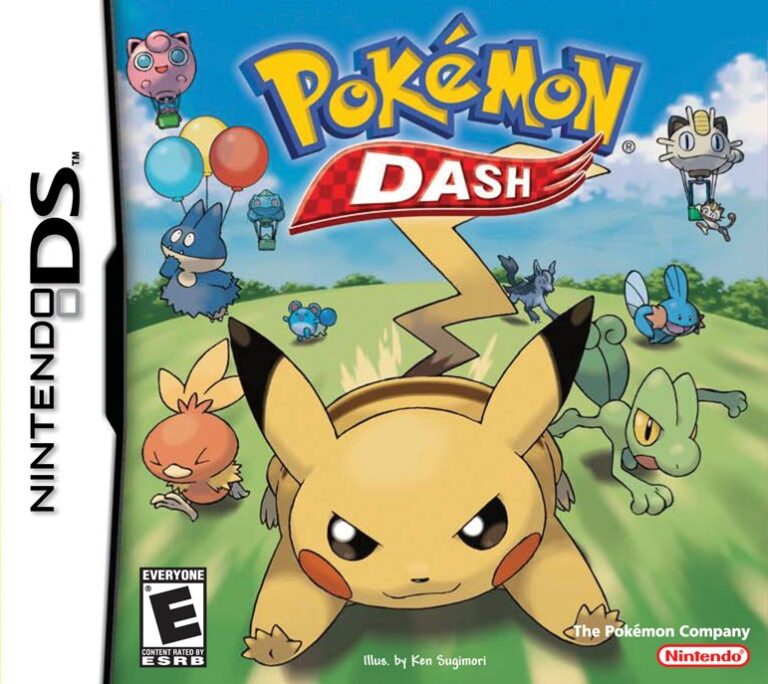
  |
|
| Titles | Pokémon Dash ポケモンダッシュ (Pokémon Dasshu) 포켓몬대시 (Pokémon Daesi, South Korea) |
| Platform | Nintendo DS (Game Boy Advance slot for the GBA link) |
| Developer | Ambrella |
| Publisher | Nintendo (The Pokémon Company in Japan) |
| Producers | Kunimi Kawamura · Hitoshi Yamagami (executive producers Satoru Iwata and Tsunekazu Ishihara) |
| Music | Miki Obata (sound) |
| Players | 1–6 (2–6 over DS wireless play, one Game Card each; no DS Download Play) |
| Genre | Racing (touch-screen action racing) |
| Courses | 25 Grand Prix courses in five cups, plus Special Cups made from GBA games |
| Pokémon | 18 characters; Pikachu is the only one you control |
| Released | 2 December 2004 (Japan) · 14 March 2005 (North America) · 7 April 2005 (Australia) · 11 March 2005 (Europe) · 22 March 2007 (South Korea) · 2 December 2004 (Taiwan) |
| Re-releases | None – not on Virtual Console or Nintendo Switch Online (October 2026) |
| Rating | ESRB E · PEGI 3+ · CERO All ages · OFLC G |
| Predecessor | None – Ambrella’s previous Pokémon game was Pokémon Channel (GameCube, 2003) |
| Successor | None – Ambrella’s next Pokémon game was My Pokémon Ranch (WiiWare, 2008) |
| Sales | An estimated 770,000 worldwide; 360,185 in Japan by the end of 2006 |
Overview
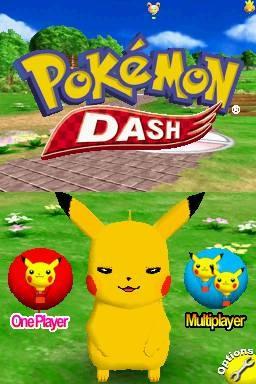 Released on Nintendo DS, Pokémon Dash is a Pokémon-themed racing game, where the player uses Pikachu to race against many other Pokémon through different courses.
The game starts out with a training mode, five practice races against Munchlax, where the player gets familiar with the game mechanics, especially how Pikachu dashes by sliding the stylus on the touch screen. Within each course, the player must go through or above different checkpoints in order, to avoid them using any shortcuts (only Expert GP lets them be taken in any order). Other than regular races, the game also includes some fun event courses, themed on a Munchlax flying on balloons or on Pikachu riding on Lapras’s back.
Become the Pokémon Dash Grand Prix Champion!
Make tracks as you put Pikachu through its paces around the course. Race against the clock and other Pokémon rivals passing the checkpoints as you head toward the goal. Fast-Action Fun!
- Race your rivals! – You can race as Pikachu in a whole new way using the stylus slide-action to reach the goal in record time. Don’t be beaten by your rivals!
- Meet Munchlax! – It’s a mad dash racing against rival Pokémon. Don’t be surprised when you run across an unfamiliar face. Meet Munchlax, the pre-evolved form of Snorlax.
- Connect for more courses! – Hook up with Game Boy Advance Pokémon versions: Ruby, Sapphire, FireRed, LeafGreen, and Emerald to create new courses in the shape of your GBA Pokémon!
- Up to six players can compete using their own Pokémon Dash Game Card!
— Official description
Quick Answers
The questions people ask about Pokémon Dash, answered first and explained further down the page.
How do you unlock Hard GP and Expert GP in Pokémon Dash?
Clear all five cups of the Regular Grand Prix to open Hard GP, then clear all five Hard cups to open Expert GP. Only the Green Cup is available at first, and finishing a cup in the top three opens the next one. Expert GP also changes the rules, letting you take the checkpoints in any order. More →

How do you make courses from your Game Boy Advance Pokémon?
Win every Regular Grand Prix cup, then put Pokémon Ruby, Sapphire, Emerald, FireRed or LeafGreen in the DS’s Game Boy Advance slot. Each Pokémon in that save’s party becomes an island course shaped like its sprite, forming a timed, single-player Special Cup. There are 417 possible shapes, covering all 386 species plus extra Unown and Deoxys forms and an Egg. More →
How did you get the Munchlax and Deoxys event courses?
Both were downloaded wirelessly at events in 2005 and stored alongside the Special Cups. The Munchlax course was handed out at Japan’s World Hobby Fair early that year and at the opening of the Nintendo World Store in New York on 14 May 2005. The Deoxys Cup, with all four Formes, was given out only in Japan, at PokéPark 2005. More →
Can you play as any Pokémon other than Pikachu?
No. Pikachu is the only Pokémon you control in every mode, and in multiplayer every player races as an identical Pikachu. The other Pokémon appear as computer rivals, five per difficulty, while Lapras ferries Pikachu over the sea and Diglett restocks its balloons. The one-character roster was among the critics’ biggest complaints. More →
Does Pokémon Dash multiplayer work with only one game card?
No. Up to six people can race over DS wireless play, but every player needs their own DS and their own copy of Pokémon Dash, because the game does not support DS Download Play. One player leads the group and picks the cup and course, and only courses that have already been completed can be chosen. More →
Can you still play Pokémon Dash, and is it on Nintendo Switch Online?
Only on the original cartridge. It has never been re-released and is not part of the Nintendo Classics library on Nintendo Switch Online. The Game Card runs on any DS, DSi or 3DS family system, but building courses from GBA games needs the Game Boy Advance slot found only on the original DS and the DS Lite. More →
Pokémon
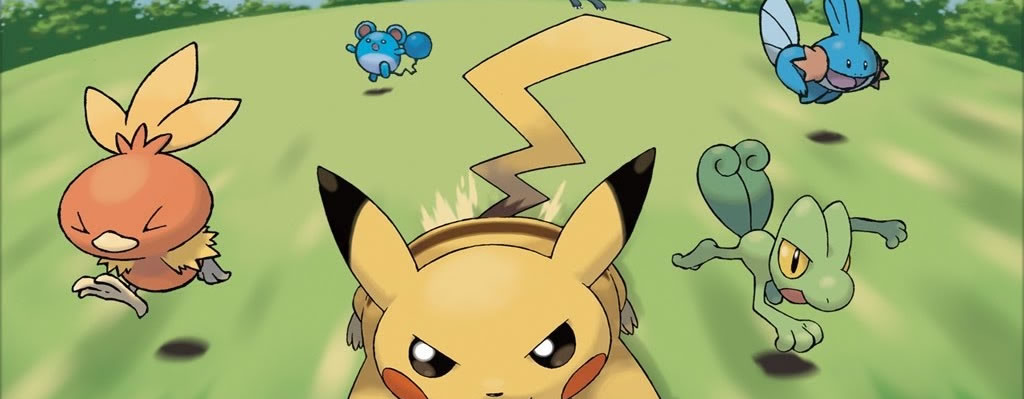
There are 18 Pokémon characters featured in the game, with Pikachu being the only playable one:
 Pikachu#025 · Player
 Meowth#052 · Regular GP
 Teddiursa#216 · Regular GP
 Torchic#255 · Regular GP
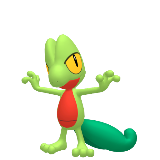 Treecko#252 · Expert GP
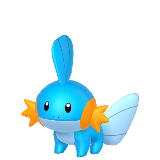 Mudkip#258 · Hard GP
 Mightyena#262 · Expert GP
 Pichu#172 · Hard GP
 Blaziken#257 · Expert GP
 Wynaut#360 · Hard GP
 Bulbasaur#001 · Regular GP
 Charmander#004 · Hard GP
 Aipom#190 · Expert GP
 Jigglypuff#039 · Hard GP
 Marill#183 · Expert GP
 Munchlax#446 · Training & Regular GP
 Diglett#050 · Balloons
 Lapras#131 · Sea ferry
Who’s who

Pikachu
Pikachu is the only Pokémon the player controls, in every mode including multiplayer, where every player races as an identical Pikachu. It runs, swims, floats on balloons and rides Lapras across Pokémon Island.

Munchlax
Munchlax was a brand-new Pokémon when Dash launched. It is Pikachu’s only opponent in the training races, one of the five Regular GP rivals, the newcomer the box text introduces as the pre-evolved form of Snorlax, and the subject of an event course.

Diglett
Diglett pop up on the courses with sky sections and restock Pikachu’s balloons, letting it rise into the air and float over sea, forest and other ground it cannot cross quickly on foot. They do not race and cannot be controlled, but finding them is essential on the island-hopping courses of the later cups.

Lapras
Lapras waits at the water’s edge on island courses and carries Pikachu across the sea on its back, the only quick way over open water. Only one racer can ride it at a time, and once a rival has taken it Lapras has to reappear before anyone else can climb aboard. One of the event-only special courses was built around Pikachu riding Lapras.
Pokémon in the courses
More Pokémon are honoured in the course names and shapes, and the GBA link can turn any of the 386 species of the time, plus the Unown letters, the Deoxys Formes and an Egg, into a course of its own:
 Mankey#056 · Footprint of Mankey
 Luvdisc#370 · Luvdisc Island
 Jirachi#385 · Jirachi Mountain
 Smeargle#235 · Smeargle’s Mark
 Deoxys#386 · Deoxys Cup (event)
 Unown#201 · 28 Special Cup shapes
Game Modes
Pokémon Dash can be played both in single player against the AI, or in multiplayer against other players.
Single Player Modes
Grand Prix Mode: The Grand Prix is the main mode of the game, where the player competes against other Pokémon in five different cups. Each cup has a set of five courses with various field mechanics. Within these courses, Pikachu has to go through the different checkpoints in a certain order and aim for the first spot, although a top-three finish overall is enough to clear a cup.

There are obstacles on the way, like grass, forest and sand, which slow Pikachu’s movements, and the sea and swamps, which slow it almost to a standstill and can make it sink, while lava burns it. Along with them are terrain chips, which let Pikachu run at full speed over one kind of ground for a limited duration. Some courses feature many small islands separated by deep waters. Pikachu can travel from one to another by riding on Lapras’s back or by finding Diglett, which give it balloons, allowing Pikachu to go airborne and fly to the next checkpoint.
The Grand Prix has three different difficulty settings: Regular, Hard and Expert. In order to access the Hard difficulty, the player must first finish the Grand Prix in Regular, while Expert becomes available after finishing it in Hard. As the difficulty increases, the enemy Pokémon change completely and become way faster.
Grand Prix cups and their courses
Green Cup グリーンカップ
| Race | Course | Japanese name |
|---|---|---|
| 1 | Green Fields | わかくさはらっぱ |
| 2 | Running Through | かけぬけルート |
| 3 | Beach Path | うみべのさんぽみち |
| 4 | Footprint of Mankey | マンキーのあしあと |
| 5 | Pikachu Island | ピカチュウ・アイランド |
White Cup ホワイトカップ
| Race | Course | Japanese name |
|---|---|---|
| 1 | White Snow Land | まっしろランド |
| 2 | Trial Swamp | しれんのぬまち |
| 3 | Lake of Mystery | みずうみのひみつ |
| 4 | Cracked Plains | ひびわれへいげん |
| 5 | Luvdisc Island | ラブカス・アイランド |
Blue Cup ブルーカップ
| Race | Course | Japanese name |
|---|---|---|
| 1 | Zigzag Road | ジグザグロード |
| 2 | Steering Stream | みちびきのけいりゅう |
| 3 | Mud Plateau | ドロンそうげん |
| 4 | Star Lake | ほしのみずうみ |
| 5 | Jirachi Mountain | ジラーチ・マウンテン |
Yellow Cup イエローカップ
| Race | Course | Japanese name |
|---|---|---|
| 1 | Smeargle’s Mark | ドーブルのしるし |
| 2 | Lava Island | ようがんのしま |
| 3 | Glacier Island | ひょうけつのしま |
| 4 | Sand Island | すなのしま |
| 5 | Pallet Island | パレット・アイランド |
Red Cup レッドカップ
| Race | Course | Japanese name |
|---|---|---|
| 1 | Twiddle Meadow | くるくるそうげん |
| 2 | Heat Land | しゃくねつランド |
| 3 | Vortex Lagoon | うずまきラグーン |
| 4 | Freezing Spiral | こごえのらせん |
| 5 | Pokémon Park Island | ポケパーク・アイランド |
The cups open in order, from the Green Cup through the White, Blue and Yellow Cups to the Red Cup. Pikachu Island, the Green Cup finale, takes in the areas of the four courses before it.
Grand Prix difficulties and their respective Pokémon enemies
| Regular | Hard | Expert |
|---|---|---|
| Meowth | Charmander | Blaziken |
| Torchic | Mudkip | Mightyena |
| Bulbasaur | Pichu | Aipom |
| Teddiursa | Jigglypuff | Treecko |
| Munchlax | Wynaut | Marill |
Every race has six racers: Pikachu and the five rivals of that difficulty. Here’s a little more about each of them:
| Rival | Difficulty | Type | Notes |
|---|---|---|---|
| Torchic | Regular | Fire | Hoenn’s Fire starter. Its final evolution, Blaziken, waits in Expert GP. Torchic is one of the six Regular GP racers who reunite for the Dash event in My Pokémon Ranch. |
| Teddiursa | Regular | Normal | A Johto Normal type among the gentlest of the first-tier rivals. It is also part of the line-up that triggers the Dash event in My Pokémon Ranch. |
| Bulbasaur | Regular | Grass/Poison | Kanto’s Grass starter and one of the two first-generation Pokémon in the Regular field. Charmander follows it in Hard GP, but Squirtle never appears. |
| Munchlax | Training & Regular | Normal | Pikachu’s only opponent in the five training races before it joins the Regular field. At launch it had not yet appeared in a main-series game. |
| Meowth | Regular | Normal | The fifth Regular GP racer and the second from Kanto. Like the other Regular rivals, it is needed for the Dash event in My Pokémon Ranch. |
| Charmander | Hard | Fire | Kanto’s Fire starter heads the quicker second tier. Hard GP keeps the Regular courses and the fixed checkpoint order, but every rival is faster. |
| Pichu | Hard | Electric | Pikachu’s own pre-evolution, introduced in Gold and Silver, turns up as one of its rivals in the Hard Grand Prix. |
| Mudkip | Hard | Water | Hoenn’s Water starter. With Torchic in Regular GP and Treecko in Expert GP, all three Ruby and Sapphire starters race, one per difficulty. |
| Wynaut | Hard | Psychic | Wobbuffet’s baby form, introduced in Ruby and Sapphire. With Pichu, it is one of two baby Pokémon in the second tier. |
| Jigglypuff | Hard | Normal | The Balloon Pokémon races on foot here. A Normal type at the time, it was retyped as Normal/Fairy in Pokémon X and Y. |
| Treecko | Expert | Grass | Hoenn’s Grass starter completes the set of Ruby and Sapphire starters. In Expert GP every rival can take the checkpoints in any order. |
| Marill | Expert | Water | A Johto Water type, retyped as Water/Fairy from Pokémon X and Y. One of the fastest-tier rivals despite its size. |
| Aipom | Expert | Normal | The long-tailed Johto Normal type is one of the five Expert GP racers, alongside the fully evolved Blaziken and Mightyena. |
| Mightyena | Expert | Dark | Hoenn’s fully evolved Bite Pokémon. At 1 metre tall, only Blaziken outsizes it among the racers, and it is the only Dark type in the field. |
| Blaziken | Expert | Fire/Fighting | Torchic’s final evolution and the only fully evolved starter in the game. It leads the toughest field Pikachu faces in the Grand Prix. |
Time Attack Mode: In this mode, the player tries to complete the course as fast as possible, with no opponents to compete against, as only Pikachu is present on the course. The player may choose any course they have already completed.
In depth: the racing
Multiplayer Mode
The Multiplayer Mode allows players that own the game to play against each other on a course of their choice that they have already completed. Two to six players can join the game, each with their own Game Card, as there’s no DS Download Play.
Event courses
There are also special event courses, saved alongside the Special Cups, that could only be unlocked by downloading them at certain events. They are as follows:


Compatibility with other titles
The player can link Pokémon Dash to the third generation Pokémon games (Ruby, Sapphire, FireRed, LeafGreen and Emerald) by inserting the third generation game in the Nintendo DS’s GBA slot. This will turn each Pokémon in their current party in that game into a course shaped like its sprite, forming a Special Cup of up to six courses, and allowing them to play as many as 417 differently shaped courses. This feature is unlocked after the player wins all five cups of the Regular Grand Prix.
- 386Pokémon species
- 27more Unown letters
- 3more Deoxys Formes
- 1Egg
Those 417 shapes cover every species of the time, the other 27 Unown letters, the other three Deoxys Formes and an Egg. Add the three event-only courses and there are 420 special courses in all.
From E3 tech demo to racer
Pokémon Dash’s roots go back to the Nintendo DS’s first public showing. When Nintendo unveiled the DS at E3 in May 2004, one of the demos visitors could play was a 3D Pikachu on the touch screen, which could be prodded and stretched with the stylus.


A cut-down version of that demo became Dash’s title screen, and the same stretching can be done after winning a race. The racing around it was built by Ambrella, the Tokyo studio behind Hey You, Pikachu! and Pokémon Channel, with steering that needs nothing but strokes of the stylus.
The game was revealed on 7 October 2004 as a Japanese launch title for the DS and arrived with the console on 2 December 2004, published in Japan by The Pokémon Company, making it the first Pokémon game on the system. It was a launch title in Europe too, released on the day the DS arrived there, while North America got it almost four months after the console.
Reviewers would later agree that steering Pikachu with the stylus was a novel showcase for the touch screen, even if the rest of the game drew far less praise.
The road to launch
| Date | Milestone |
|---|---|
| 12 May 2004 | Nintendo shows the DS at E3 with a touch-screen Pikachu demo |
| 7 October 2004 | Pokémon Dash is revealed as a Japanese launch title for the DS |
| 2 December 2004 | Released alongside the DS in Japan, and in Taiwan the same day |
| 11 March 2005 | Released in Europe on the DS’s European launch day |
| 14 March 2005 | Released in North America, almost four months after the DS |
| 7 April 2005 | Released in Australia |
Regional Variations
The Japanese release came first and looked a little different, and which event courses players could get depended on where they lived:
- The Japanese version has a completely different logo, decorated with balloons and a Poké Ball.
- In Japan the game was published by The Pokémon Company and launched alongside the Nintendo DS on 2 December 2004, priced at 4,571 yen before tax; Nintendo published it everywhere else.
- A Taiwanese release arrived on the same day as the Japanese one, and a Korean edition, 포켓몬대시 (Pokémon Daesi), followed on 22 March 2007.
- Event courses differed by region: the four-Forme Deoxys Cup was handed out only in Japan, the Munchlax course in Japan and the United States, and no Pokémon Dash distribution is known to have taken place in Europe.
Left in the data
- A graphics file named taikenban.ncg, a leftover from a sample (trial) version of the game, is still on the Game Card.
- The card contains a buildinfo.txt file meant to hold compile information, but it is blank in every region.
- Data for several Special Cups with no known distribution survives in the game, including an Egg Cup, a cup named ‘??’, an English-language four-Forme Deoxys Cup, and Pikachu cups with balloons and with Lapras.
Glitches, exploits and oddities
A save-wiping ending and a muddy shortcut:
Save wipe during the ending
Japanese players warn that switching the DS off while the ending is playing, after the Red Cup has been won, very often wipes out the save data. It is an easy mistake to make, because the ending is the natural point to stop for the day after clearing the Grand Prix. The credits can be hurried along by touching the screen, so the safe approach is to let them run all the way to the closing distance total before turning the console off.
Crossing swamps without a chip
Swamps are meant to require the swamp chip, as Pikachu slows to a crawl in the mud and sinks if it stays too long. Pikachu only sinks after some time in the swamp, though, so a short dash across a narrow strip of mud is perfectly safe without a chip. That lets Pikachu cut straight through small patches of marsh instead of running round them, one of the simplest ways to shave time off a race.
Videos & media
Check out these Pokémon Dash videos, including TV commercials and the game’s intro.
A US TV commercial for Pokémon Dash.
A South Korean TV commercial for Pokémon Dash.
The intro / opening video for Pokémon Dash.
Trivia & facts
- There’s a reference to Pokémon Dash in My Pokémon Ranch, in the form of a Dash race that gets triggered once Bulbasaur, Munchlax, Teddiursa, Meowth, Torchic and Pikachu are collected – the six racers of the Regular Grand Prix.
- The player can interact with Pikachu on the opening screen by tapping it on the touch screen, allowing them to grab its ears, arms and tail, or stretch its cheeks. The feature comes from the Pikachu tech demo Nintendo showed at E3 2004.
- When the game was first released in Japan, one of the tutorial instructions showed only one arrow, which was changed into three arrows for the international release.
- Pokémon Rumble U makes use of some of the music featured in Pokémon Dash.
- Pokémon Dash is one of the few third generation games that feature Munchlax, a fourth generation Pokémon. It was Munchlax’s first video game appearance, a few months after the Pokémon had been seen in the film Destiny Deoxys.
Munchlax, Pikachu’s training rival.
Further trivia
- There is only one race theme per cup, so the same piece of music plays through all five races of a cup.
- The ending credits can be fast-forwarded by rubbing the touch screen, and they finish with a tally of the total distance Pikachu has dashed.
- Footprint of Mankey is a sky course whose islands, joined up from above, form the shape of Mankey’s footprints.
Legacy
What came after
- Munchlax course at the 21st World Hobby Fair, Japan – January–February 2005. The first downloadable course, received wirelessly and saved with the Special Cups.
- Deoxys Cup at PokéPark 2005, Japan – 18 March 2005. Distributed until 8 May 2005; four courses, one for each Deoxys Forme, which no single GBA cartridge could supply together.
- Munchlax course at the Nintendo World Store opening, New York – 14 May 2005. The only known Pokémon Dash distribution outside Japan.
- South Korean release – 22 March 2007. Released as 포켓몬대시 (Pokémon Daesi), more than two years after Japan.
- Pokémon Rumble U reuses Dash music – 2013. Ambrella brought some of Dash’s music back in its Wii U brawler.
Where to play it today
Pokémon Dash has never been re-released, so as of October 2026 the original Game Card is the only official way to play, and it is not part of Nintendo Classics on Nintendo Switch Online. The card works on every DS, DSi and 3DS family system, and local wireless races still work with one card per player. Building Special Cups from GBA Pokémon games needs the Game Boy Advance slot of the original DS or the DS Lite.
How it was made
Ambrella’s credits name no single director: the ‘Planners and Direction’ credit lists Muneaki Ozawa, Miki Obata, Shin Naka, Yoshihiro Hatta, Norio Matsumura and Kunimi Kawamura. Kunimi Kawamura and Hitoshi Yamagami produced the game, with Satoru Iwata and Tsunekazu Ishihara as executive producers. Miki Obata and Norio Matsumura are credited as game designers and Ein Terakawa and Yoshihiro Hatta with the game concept, while Obata also handled the sound.
Pokémon Dash elsewhere


Sales & reviews
Sales figures
During the first three weeks of its release, the game sold around 109 thousand copies in Japan.
The sales then continued to increase very slowly, reaching about 360 thousand copies sold in Japan by the end of 2006, and an estimated global number of 770 thousand copies sold all around the world.
In Japan, Pokémon Dash sold 56,337 copies in its launch week to 5 December 2004, fourth on the chart, and 277,513 by 9 January 2005 – nearly 70% of what it had sold by the end of 2006 went in those first five weeks, helped by the DS launch and Christmas. Famitsu counted 348,376 by mid-November 2006, 24th among DS games in Japan at that point, and weekly chart totals reached 360,185 by 31 December 2006. The 770,000 worldwide total is a third-party estimate (about 380,000 in Japan, 210,000 in North America, 140,000 in Europe and 40,000 elsewhere); Nintendo and The Pokémon Company have never published an official figure.
- 360,185Japan, end of 2006
- 56,337Japan, launch week
- 770kworldwide (estimate)
- 46Metacritic (28 critics)
Review scores
The game wasn’t that well received, as it mostly gained a combination of bad and average ratings on major review websites. Let’s take a look at these reviews:
- Craig Harris from IGN thought that despite the few interesting features the game presents, it’s still average overall, rating it 5/10, which equates to ‘Mediocre’ on the IGN scale.
- Alex Navarro from GameSpot found the gameplay terribly repetitive and the graphics quite horrible, as he states: “Everything looks flat, ugly, and unpleasant. The Pokémon racers aren’t really any better, though they are marginally better than the nasty race environments.” He rated the game 5.2/10, the equivalent of ‘Mediocre’ on their scale.
- On GameRankings (which closed in 2019), Pokémon Dash received a low score of 48.91%, over 31 reviews, while it scored 46 out of 100 on Metacritic, over 28 critics.
- Overall, the game was quite disappointing as the first Pokémon game to be released on the Nintendo DS, with boring, repetitive gameplay and unattractive graphics.
Reviews ranged from lukewarm to harsh. Critics generally agreed that steering Pikachu with strokes of the stylus was a novel showcase for the touch screen, and Nintendo Power and Electronic Gaming Monthly both called it fun. The trouble was everything around it. Pikachu is the only racer in every mode, multiplayer included; the 25 courses feel alike and can be cleared within a few hours; and the flat overhead graphics drew scorn, with GameSpot dismissing it as one of the laziest uses of the touch screen so far. Game Informer called it more an exercise in anger management than a game. Famitsu was kinder with 31 out of 40, and Nintendo World Report’s American review rated the sound highly, but the game finished with a Metacritic score of 46.
Awards and honours:
Media & artwork
- Box art from Pokémon Dash, including several different regional variations and editions
- Screenshots from Pokémon Dash
Further reading
More Ambrella and Nintendo DS links on the site: