  |
|
| Titles | Pokémon Mystery Dungeon: Rescue Team DX ポケモン不思議のダンジョン 救助隊DX (Pokémon Fushigi no Dungeon: Kyūjotai DX) |
| Platform | Nintendo Switch (game card and Nintendo eShop download; Nintendo Switch 2 compatible) |
| Developer | Spike Chunsoft |
| Publishers | The Pokémon Company (Japan) · Nintendo (elsewhere) |
| Directors | Shin-ichiro Tomie · Hironori Ishigami |
| Producers | Seiichiro Nagahata · Kunimi Kawamura · Takato Utsunomiya · Kazunori Sugiura · Hitoshi Yamagami |
| Music | Keisuke Ito (arrangement and new music) · original music by Arata Iiyoshi and Atsuhiro Ishizuna |
| Players | 1 (online rescue requests through Nintendo Switch Online) |
| Genre | Roguelike dungeon crawler |
| Pokémon | More than 400 to meet and recruit |
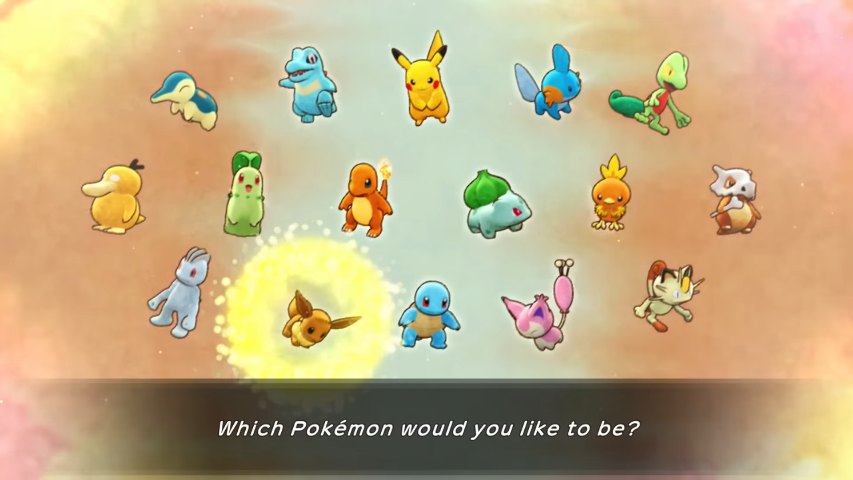
| Heroes | 16 species, picked by the personality quiz or directly; the partner must be a different type |
| Released | 6 March 2020 (Japan, North America, Europe, Australia, Hong Kong, Taiwan) · free demo 9 January 2020 |
| Rating | ESRB E · PEGI 7 · CERO A · ACB G |
| Remake of | Red Rescue Team & Blue Rescue Team (Game Boy Advance and Nintendo DS, 2005) |
| Predecessor | Pokémon Super Mystery Dungeon (Nintendo 3DS, 2015) |
| Sales | 1.99 million by 31 December 2022 (CESA) · 1.26 million by 31 March 2020 (Nintendo) |
Overview
 Pokémon Mystery Dungeon: Rescue Team DX is a Nintendo Switch remake of Pokémon Mystery Dungeon: Red Rescue Team and Blue Rescue Team, the 2005 Game Boy Advance and Nintendo DS pair that started the Mystery Dungeon series. Instead of two versions, DX folds both into a single game, keeping the original story and dungeons while rebuilding almost everything around them. It was developed by Spike Chunsoft, the studio formed when the originals’ developer Chunsoft merged with Spike, and published by The Pokémon Company in Japan and by Nintendo everywhere else.
Revealed in a Pokémon Direct on 9 January 2020, with a free demo on the Nintendo eShop the same day, it launched worldwide on 6 March 2020. You play a human who wakes up as a Pokémon with no idea how it happened, matched to one of 16 species by a personality quiz or simply picked, and you set up a rescue team with a partner. Jobs from the bulletin board and the Pelipper Post Office send the team into dungeons that are laid out afresh on every visit, where each step, attack and item counts as a turn, hunger has to be kept at bay and fainting can cost everything you carry. More than 400 Pokémon can be recruited along the way.
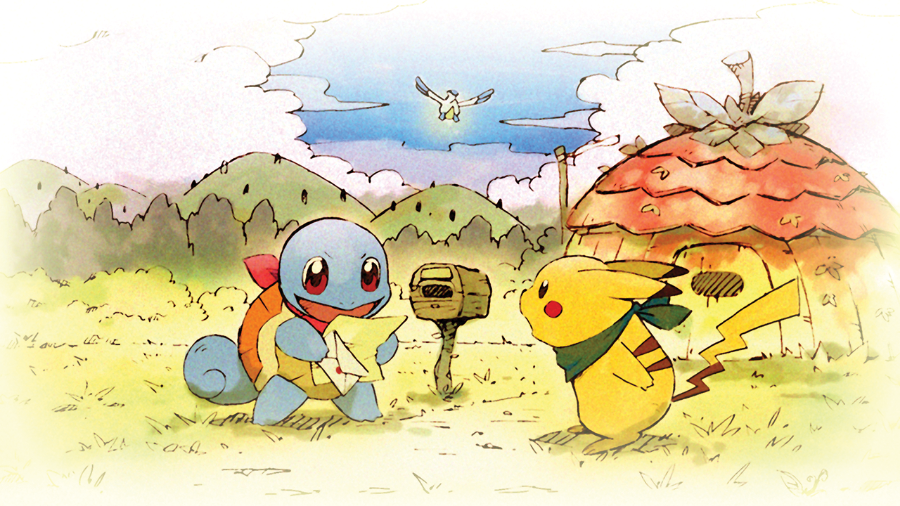
DX layers plenty of new ideas over that 15-year-old core: an auto-move mode, Mega Evolution through the Empowerment Seed, team-wide rare qualities in place of IQ skills, Mystery Houses, rescue team camps, an autosave and crown-marked strong foes that can turn up Shiny. The whole game is redrawn in a soft, hand-painted style inspired by watercolours, with sketchy outlines and textured backgrounds.
It was the first remake of any Pokémon game outside the core series, and the first new Mystery Dungeon game since Pokémon Super Mystery Dungeon in 2015. Critics were split, admiring the art and the quality-of-life changes but finding the dungeon design underneath repetitive, yet players turned up in force: Nintendo reported 1.26 million copies sold by the end of March 2020, and the total had reached 1.99 million by the end of 2022, more than the lifetime sales of Gates to Infinity.
Become a Pokémon. Brave the mystery dungeons.
What if you woke up one day, and you were a Pokémon? You can meet and recruit over 400 Pokémon in a dungeon-crawling adventure within their world! Build a rescue team to take on mysterious, changing dungeons and strategically plan your moves as you venture forth to make the Pokémon world a safer place…and uncover your true purpose along the way.
As you recruit Pokémon, these trusty teammates will need somewhere to stay, so build rescue team camps to house, manage, and strengthen your Pokémon friends. Think hard about who is right for the job and how to approach each mysterious dungeon as you prepare a rescue team. You’ll move a single square at a time or use Auto mode to speed up movement until you engage other Pokémon in turn-based battles—but don’t forget about Pokémon strengths, weaknesses and potential rare qualities! Even the most capable rescue teams need help sometimes, so if you find yourself in trouble, you can send a rescue request to other players online*, or use an offline password system. This version adds Mega Evolved Pokémon, gorgeous watercolor-inspired graphics, and more! Get comfortable in being a Pokémon, there’s a lot of work to do.
— Official description
Quick Answers
The questions people ask about Pokémon Mystery Dungeon: Rescue Team DX, answered first and explained further down the page.
Is Rescue Team DX a remake?
Yes. It remakes Pokémon Mystery Dungeon: Red Rescue Team (Game Boy Advance) and Blue Rescue Team (Nintendo DS) from 2005, folding the two versions into a single Switch game with the same story and dungeons. Everything is redrawn in a watercolour-style 3D look, and new systems such as auto mode, Mega Evolution and rare qualities are added. It was the first remake of a Pokémon spin-off. More →

How many Pokémon are in Rescue Team DX?
More than 400 can be met and recruited. As in the originals, the roster is built on Generations I to III, now joined by later evolutions and pre-evolutions of those Pokémon and extras such as Riolu and Lucario. Nothing from Generation VIII appears, even though the game was released in the Sword and Shield era. More →
Can I choose my Pokémon without the personality quiz?
Yes. The personality quiz is still there and suggests one of 16 species from your answers and gender, but you can turn its suggestion down and pick any of the 16 yourself. Your partner comes from the same 16 Pokémon, as long as it does not share a type with your hero. More →
How do you Mega Evolve in Rescue Team DX?
Feed a Pokémon an Empowerment Seed inside a dungeon. It becomes Awakened, so its moves never miss, and any Pokémon with a Mega form Mega Evolves on the spot. Groudon and Kyogre undergo Primal Reversion instead, and Rayquaza has to know Dragon Ascent. The boost lasts until a status condition strikes or the team leaves the dungeon. More →
How do you get Riolu and Lucario?
Only through Mystery Houses, the locked buildings that appear in post-game dungeons and open with an Invitation. Riolu and Lucario can be among the Pokémon waiting inside small Mystery Houses, alongside Bonsly, Mime Jr. and Weavile, but neither can be found roaming an ordinary dungeon floor. More →
Does Rescue Team DX connect to Pokémon HOME or Sword and Shield?
No. Rescue Team DX has no link to Pokémon HOME, Pokémon Sword and Shield or any other Pokémon game, and recruited Pokémon cannot be moved anywhere else. Its only connected feature is online rescue requests, which need a Nintendo Switch Online membership, and an offline password system covers rescues and Wonder Mail rewards. More →
Can you still buy and play it in 2026?
Yes. It is a standard Nintendo Switch release, sold on game cards and listed on Nintendo’s eShop along with its free demo, and Nintendo marks it as compatible with Nintendo Switch 2. Online rescues need Nintendo Switch Online, but everything else, password rescues included, works offline. More →
Is there a demo, and does progress carry over?
Yes. A free demo arrived on the Nintendo eShop on 9 January 2020, the day the game was revealed in a Pokémon Direct. It covers the start of the adventure, and its save data carries straight over to the full game, so nothing has to be replayed. More →
Story

A rescue team is born
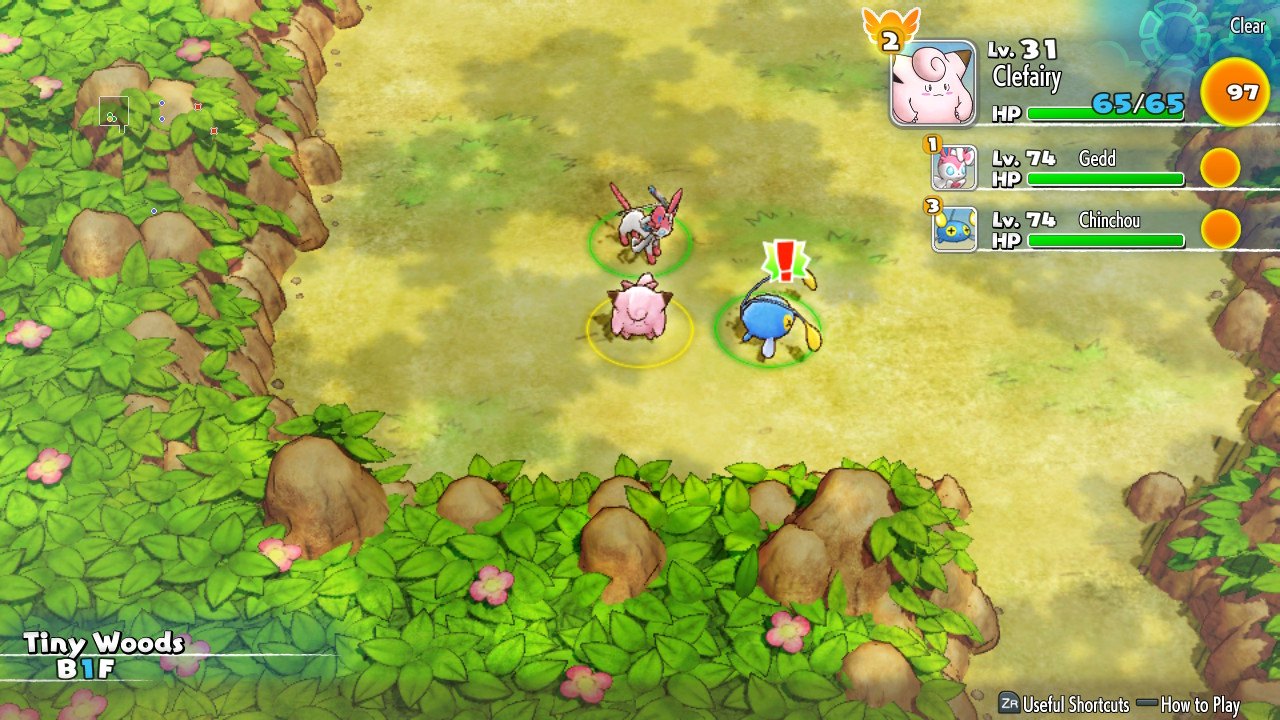
The hero wakes up in Tiny Woods as a Pokémon, remembering nothing except that they were once human. The first Pokémon they meet becomes their partner: after the two of them rescue Caterpie from the woods, the partner talks the hero into starting a rescue team. It is a busy time to go into the rescue business, as natural disasters are striking more and more often and there is no shortage of Pokémon in need of help.
The team’s reputation grows job by job. It climbs Mt. Steel on Diglett’s behalf to take on Skarmory, clashes with Gengar’s spiteful Team Meanies in Sinister Woods and faces the legendary Zapdos at the top of Mt. Thunder, always in the shadow of Alakazam’s Team A.C.T., the most celebrated rescue team in the land. Then, at the Hill of the Ancients, the seer Xatu senses that something is badly wrong with the world.
On the run
Then Gengar strikes. Back in Pokémon Square, he tells the town that the hero is the human from an old legend, who touched Ninetales’ tails, left Gardevoir to bear the curse that followed and is now blamed for knocking the world out of balance. Soon the whole of Pokémon Square has turned against the hero and anyone who stands with them.
The hero and partner flee north, pushing through Lapis Cave, Mt. Blaze, Snow Path and Frosty Forest, battling Moltres and Articuno on the way and gaining an unexpected ally in Absol. Team A.C.T. finally corners the fugitives at the top of Mt. Freeze, but Ninetales steps in, confirms that the hero is not the human from the legend and warns that the disasters have woken Groudon.
The falling star
Cleared of blame, the team heads into Magma Cavern, defeats Groudon and rescues Team A.C.T., who had gone in first and lost. The celebrations are short-lived: Xatu reveals the real cause of the disasters, a meteor on course to strike the world. Only Rayquaza can stop it, so the team climbs Sky Tower, beats Rayquaza in battle to get its attention and persuades it to shatter the meteor.


With the world saved, the hero has to return to the human world and says goodbye as the credits roll. Afterwards, their wish to stay is granted: they reappear at the team base, ready for a long post-game of legendary dungeons.
What DX changes from the GBA and DS originals
Rescue Team DX tells the same story through the same dungeons as Red Rescue Team and Blue Rescue Team, and the turn-based rules underneath are recognisably those of 2005. Almost everything layered on top has changed, though. Spike Chunsoft rebuilt the presentation from scratch, borrowed ideas from later Mystery Dungeon games and the core series, and sanded down many of the rough edges that made the originals such a grind. These are the biggest changes, followed by a side-by-side comparison.
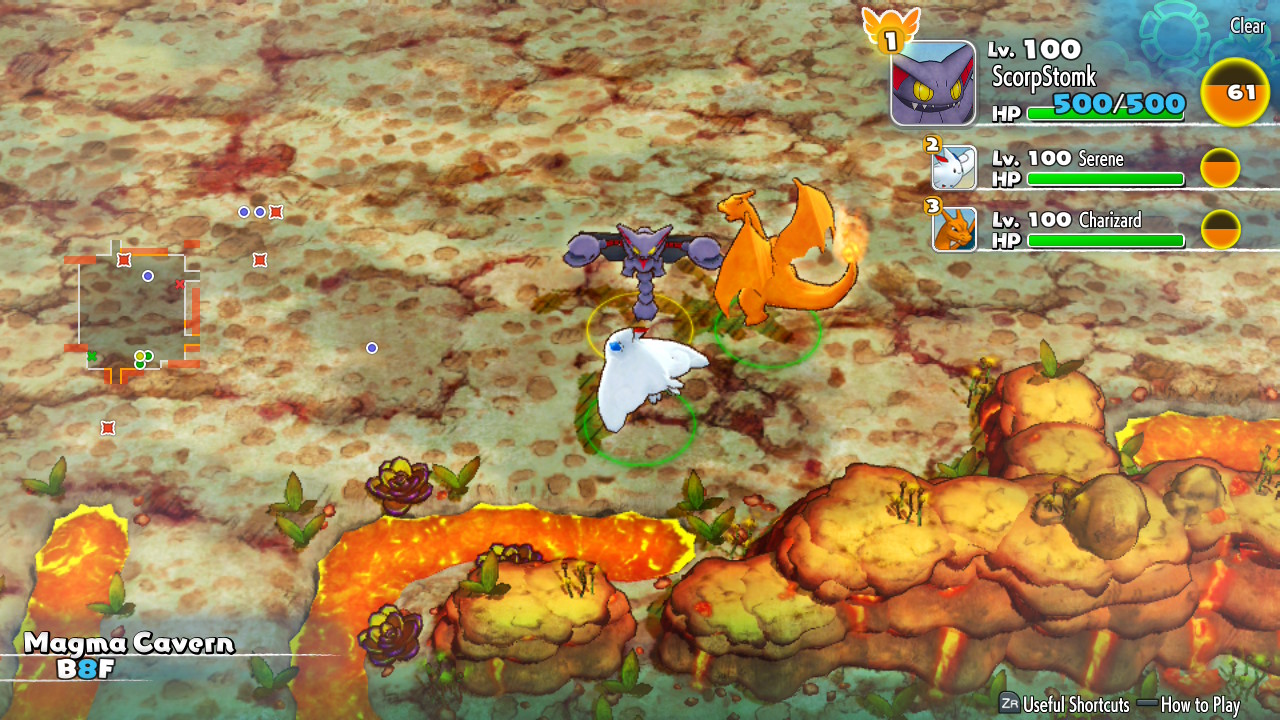
 Mega EvolutionMega Evolution was still eight years away when the originals came out. DX adds it through the Empowerment Seed, which awakens any Pokémon that eats it and Mega Evolves those that can, while Groudon and Kyogre undergo Primal Reversion instead. The boost lasts until a status condition lands or the team leaves the dungeon.
 Rare qualities instead of IQIn the originals, Gummis raised a Pokémon’s IQ, most of all when they matched its type, and a higher IQ unlocked IQ skills. DX drops IQ altogether: each Pokémon can instead hold one rare quality, a passive perk that helps the whole team. Gummis now raise a random stat, and the new Rainbow and DX Gummis can grant, or guarantee, a fresh rare quality.


Side by side
How the remake compares with the 2005 originals, feature by feature:
| Feature | Red & Blue Rescue Team (2005) | Rescue Team DX (2020) |
|---|---|---|
| Look | 2D pixel sprites on tiled maps | 3D models with a hand-painted, watercolour-inspired finish |
| Choosing the hero | The personality quiz decides, from nature and gender; some species locked to one gender | The quiz only suggests: any of the 16 species can be picked, with no gender locks |
| Partner choices | Pikachu or one of the nine Kanto, Johto and Hoenn first partners, of a different type from the hero | Any of the 16 hero species, as long as the type differs |
| Mega Evolution | None | The Empowerment Seed triggers Mega Evolution or Primal Reversion |
| Passive team bonuses | IQ skills, unlocked by raising IQ with Gummis | Rare qualities, one per Pokémon, shared by the whole team |
| Gummis | Raise IQ | Raise a random stat; Rainbow and DX Gummis can grant rare qualities |
| Locked rooms | Doors opened with Keys | Mystery Houses opened with Invitations, the only source of Riolu and Lucario |
| Housing recruits | Friend Areas with fixed space | Rescue team camps from Wigglytuff’s Camp Corner that grow with Rescue Rank |
| Moving through dungeons | Manual control only | Optional auto mode on L, set to Exploring or Finding the Stairs |
| Top rescue rank | Lucario Rank | Grand Master |
| Strong foes | None | Crown-marked strong foes in 27 dungeons, some of them Shiny |
| Friend rescues | Game Link Cable (Red), DS wireless (Blue) and passwords | Online through Nintendo Switch Online, passwords, or rescuing your own team |
| Wonder Mail-only dungeons | Oddity Cave, Remains Island, Marvelous Sea and Fantasy Strait needed codes | All four unlock through normal play |
| Dungeon lengths | Western Cave 99 floors; Mt. Faraway 40 floors | Western Cave 20 floors; Mt. Faraway 60 floors |
| Types | 17, without Fairy | 18, including Fairy |
| Roster | Generations I to III | More than 400 Pokémon, adding later evolutions and relatives |
Gameplay
Rescue Team DX is a roguelike: every dungeon is laid out anew on each visit, nothing moves until you do, and a bad run can cost you your supplies. Between expeditions, the team lives in Pokémon Square, the town at the heart of the game, where it picks up jobs, shops, trains and looks after its recruits.
- 400+Pokémon to meet and recruit
- 8Pokémon in a dungeon party, at most
- 27dungeons with strong foes after a first clear
- 18Makuhita Dojo mazes, one per type
On the job

Building the team

Pokémon Square

Pokémon Square is the town the rescue teams call home, and almost every service a team needs is a short walk from its centre. Several shopkeepers do more than they did in 2005, and the Dojo has been rethought from the ground up.

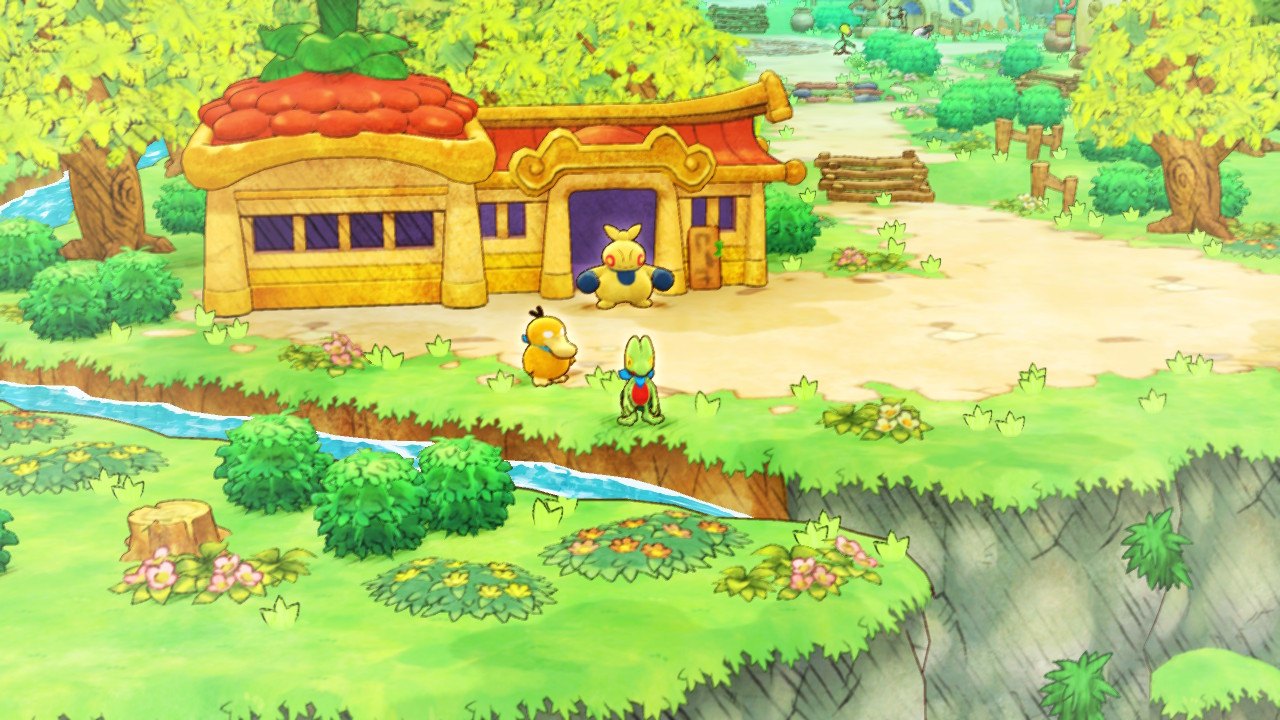
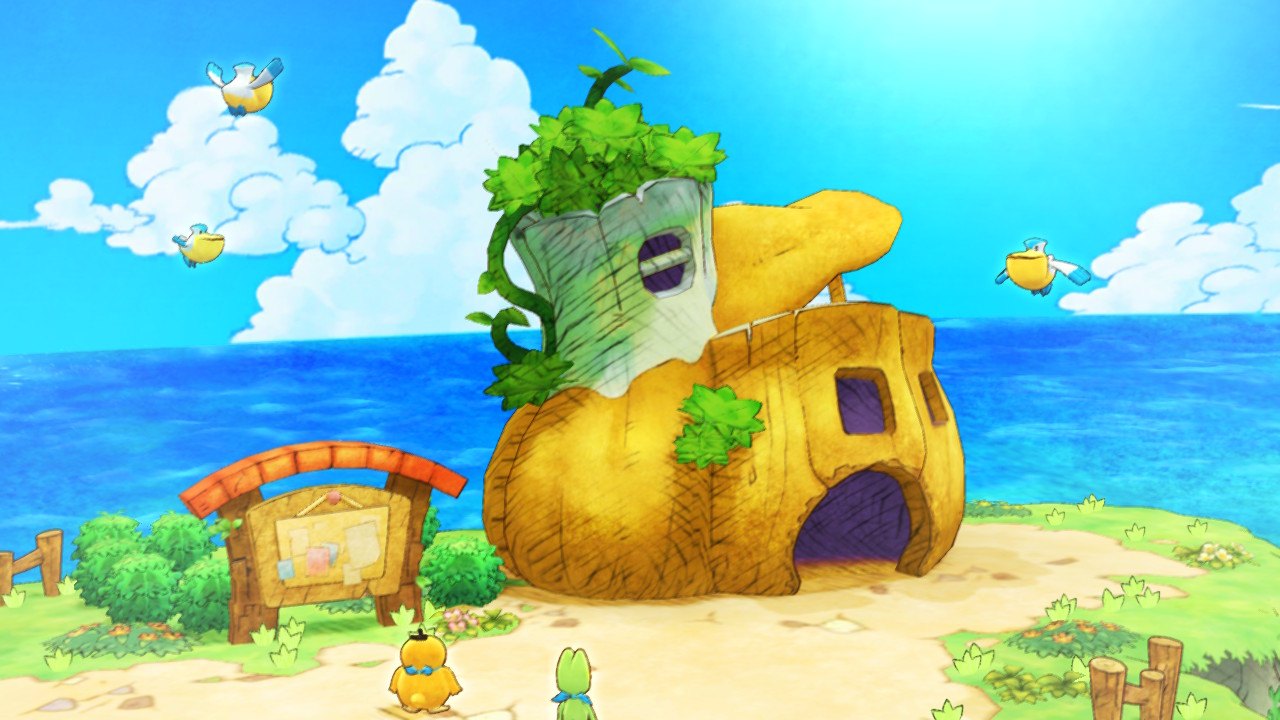

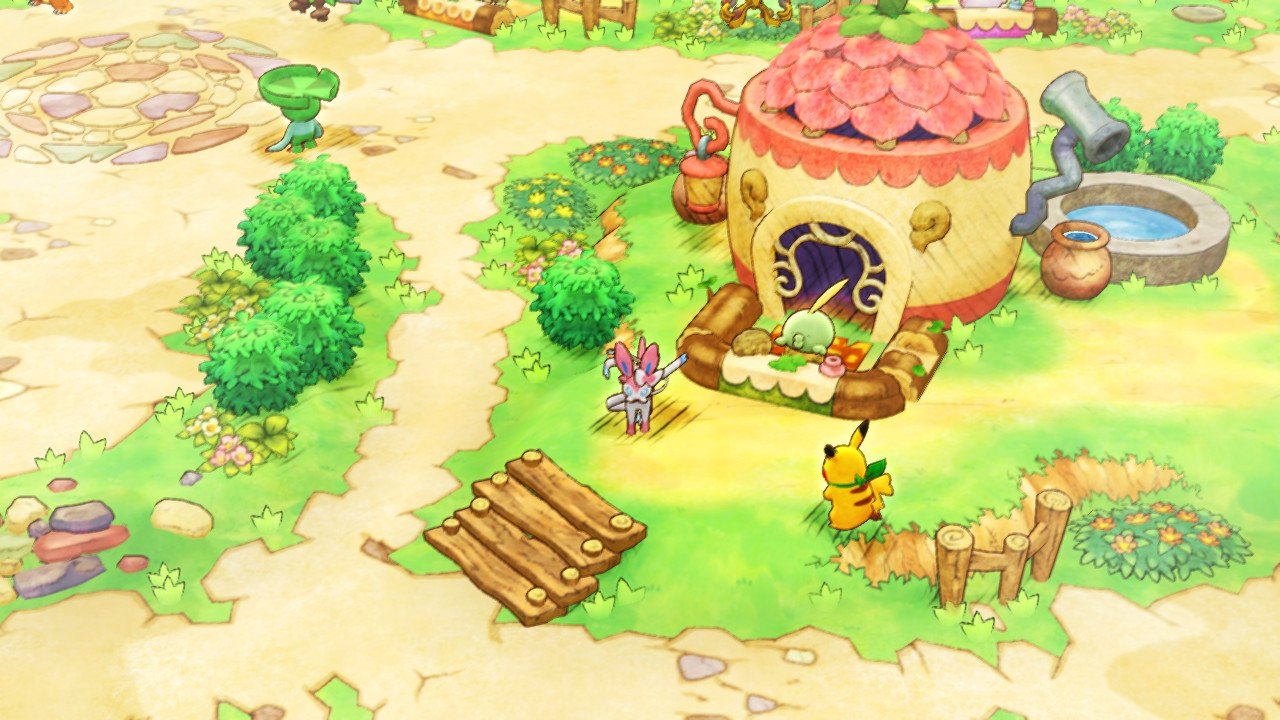
Rescues and connectivity
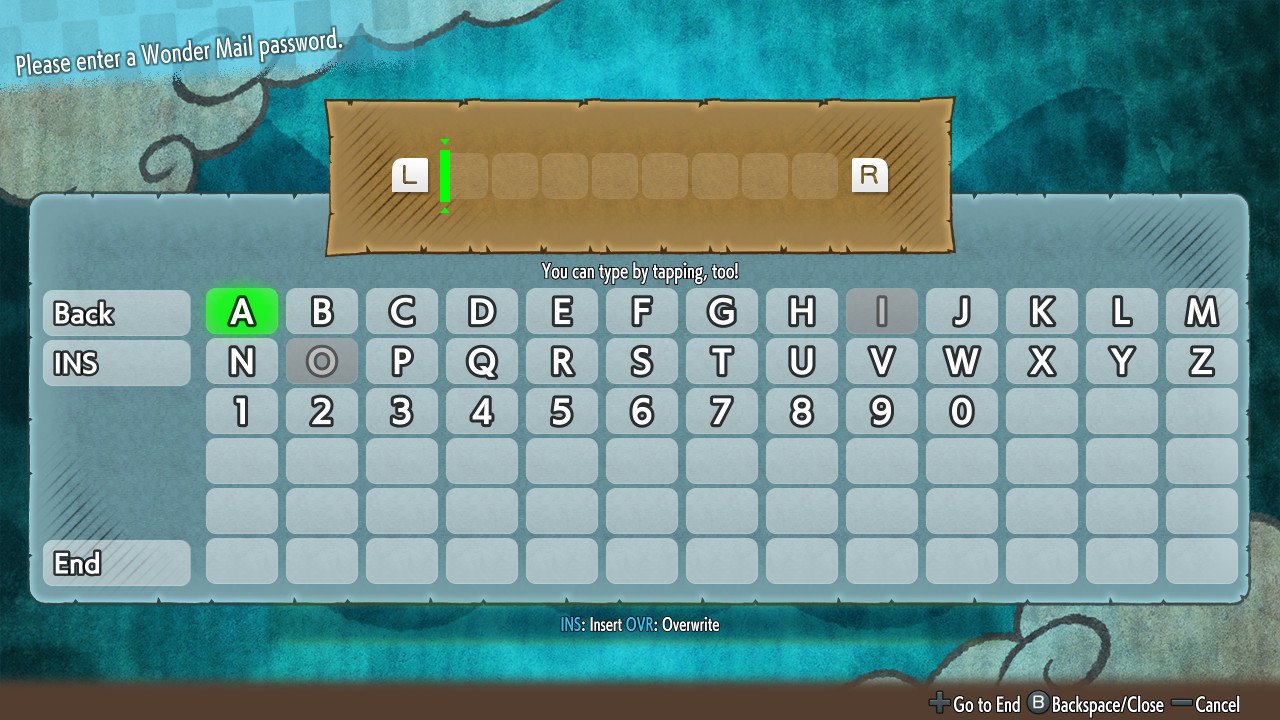
There is no link to Pokémon HOME, Pokémon Sword and Shield or any other Pokémon game, so recruits stay in Rescue Team DX for good.
Mystery Houses and the post-game
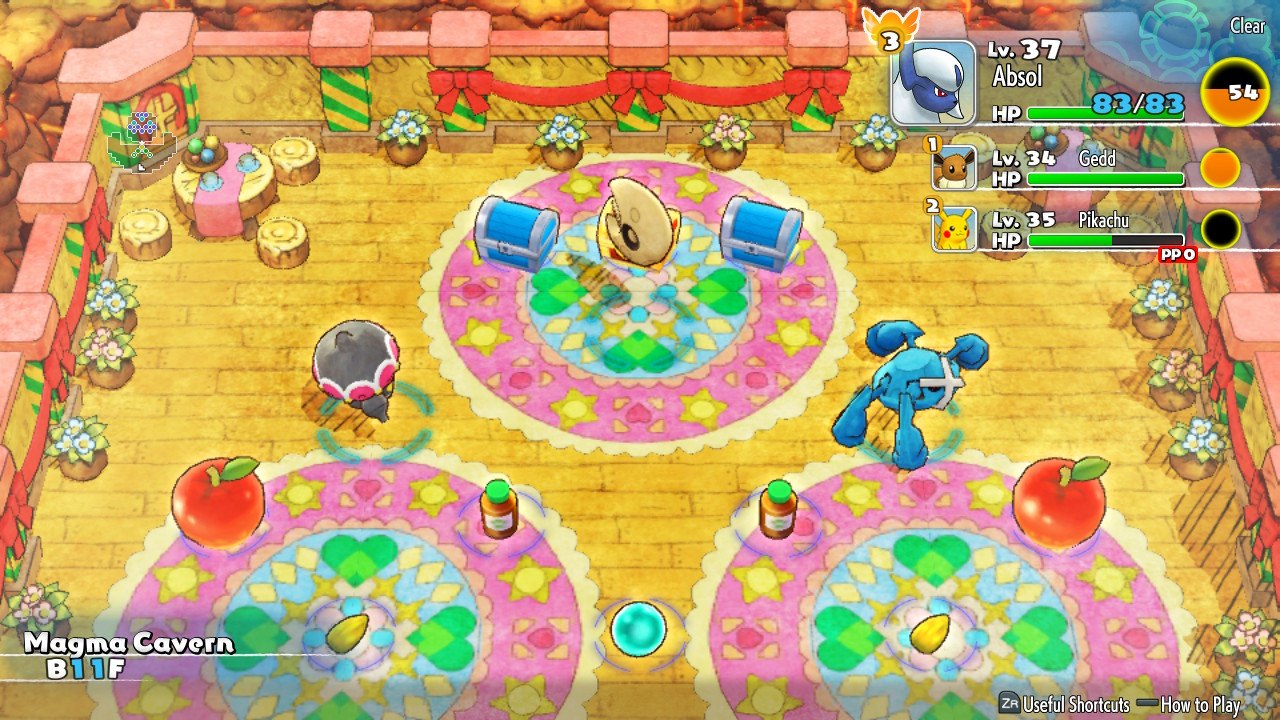
Characters
Rescue Team DX keeps the cast of the 2005 games. The hero and partner can be any of 16 species, so the story is built around them rather than a fixed pair of faces:
- The hero: A human who wakes up in Tiny Woods as a Pokémon, with no memory of their old life. Troubled by dreams of a mysterious voice, they become the scapegoat of the Ninetales legend and, in the end, have to decide whether to stay in the Pokémon world.
- The partner: The first Pokémon the hero meets, who talks them into forming a rescue team after the pair save Caterpie. Always a different type from the hero, the partner stays loyal throughout the escape from Pokémon Square and is the emotional anchor of the ending.
Around them, these Pokémon drive the plot:
 AlakazamTeam A.C.T.
 CharizardTeam A.C.T.
 TyranitarTeam A.C.T.
 GengarTeam Meanies
 MedichamTeam Meanies
 EkansTeam Meanies
 XatuHill of the Ancients
 NinetalesMt. Freeze
 AbsolAlly on the run
 GardevoirThe legend
 RayquazaSky Tower
- Alakazam: Leader of Team A.C.T., the most respected rescue team in the land, with Charizard and Tyranitar. The trio are the heroes’ role models, then their pursuers once Pokémon Square turns on the hero, and finally the team that has to be rescued from Groudon in Magma Cavern.
- Gengar: The scheming leader of Team Meanies, with Ekans and Medicham, a team that treats rescue work as a way to make a profit. Gengar fights the heroes in Sinister Woods and later spreads the Ninetales legend to brand the hero a menace. In DX he is also one of the Pokémon able to Mega Evolve.
- Xatu: A seer at the Hill of the Ancients, beyond Great Canyon, who can see into the future. Xatu senses that the world’s balance is failing and, once Groudon is dealt with, reveals the real threat: a meteor heading for the planet that only Rayquaza can destroy.
- Ninetales: Lives at the top of Mt. Freeze and sits at the heart of the legend Gengar uses against the hero. When Team A.C.T. corners the fugitives, Ninetales steps in, confirms that the hero is not the human from the story and warns that the disasters have woken Groudon.
- Absol: Joins the hero and partner while they are on the run, travelling with them through the most dangerous stretch of the story as they push through snow and ice towards Mt. Freeze.
- Gardevoir: Said to have taken Ninetales’ curse in place of the human who touched its tails. Gardevoir is tied to the voice in the hero’s dreams and, after the main story, can be recruited once the player has helped Gengar.
- Rayquaza: The legendary Pokémon at the summit of Sky Tower. The team has to battle it to get its attention, then persuade it to smash the meteor threatening the world.
Bosses

Most bosses wait at the end of a dungeon, and the legendary ones can usually be recruited after their first or second defeat. The story bosses are listed below in the order the team meets them, followed by the legendary Pokémon of the post-game.
Story bosses
| Boss | Where | Level | Notes |
|---|---|---|---|
| Skarmory Steel/Flying |
Mt. Steel (summit) | Lv. 11 | The first real boss. The young team climbs Mt. Steel on Diglett’s behalf, an early lesson in type matchups, moves and items. |
| Team Meanies Gengar, Medicham & Ekans |
Sinister Woods | Gengar Lv. 15; Medicham and Ekans Lv. 13 | A three-on-three fight against Gengar’s gang, in which Gengar’s Ghost typing and Medicham’s power are the main threats. |
| Zapdos Electric/Flying |
Mt. Thunder Peak | Lv. 17 | The first of the legendary birds. In DX it is a gigantic Pokémon filling a three-by-three area, so positioning matters far more. |
| Moltres Fire/Flying |
Mt. Blaze Peak | Lv. 20 | Fought at the peak of Mt. Blaze on the escape north from Pokémon Square, and just as gigantic as Zapdos. |
| Articuno Ice/Flying |
Frosty Forest (heart) | Lv. 22 | Guards the heart of Frosty Forest on the fugitives’ road to Mt. Freeze, completing the trio of giant birds. |
| Mankey trio Fighting |
Uproar Forest | Lv. 23 each | Three Mankey fought together. The gang later lend a hand with building work at the team base. |
| Groudon Ground |
Magma Cavern Pit | Lv. 28 | Woken by the disasters, it has already beaten Team A.C.T. by the time the heroes arrive. Once recruited, it can undergo Primal Reversion. |
| Rayquaza Dragon/Flying |
Sky Tower Summit | Lv. 33 | The final story battle: beating Rayquaza persuades it to destroy the meteor. If it knows Dragon Ascent, it can later Mega Evolve. |
Post-game legendaries
After the credits, the legendary encounters come thick and fast. These are the bosses of the post-game, with the dungeon and the level each is fought at:
 KyogreStormy Sea · Lv. 40
 RegirockBuried Relic · Lv. 35
 RegiceBuried Relic · Lv. 35
 RegisteelBuried Relic · Lv. 35
 LatiosNorthern Range · Lv. 35
 JirachiWish Cave · Lv. 35
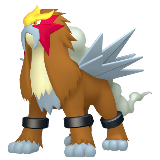 EnteiFiery Field · Lv. 50
 RaikouLightning Field · Lv. 50
 SuicuneNorthwind Field · Lv. 50
 DeoxysMeteor Cave · Lv. 55
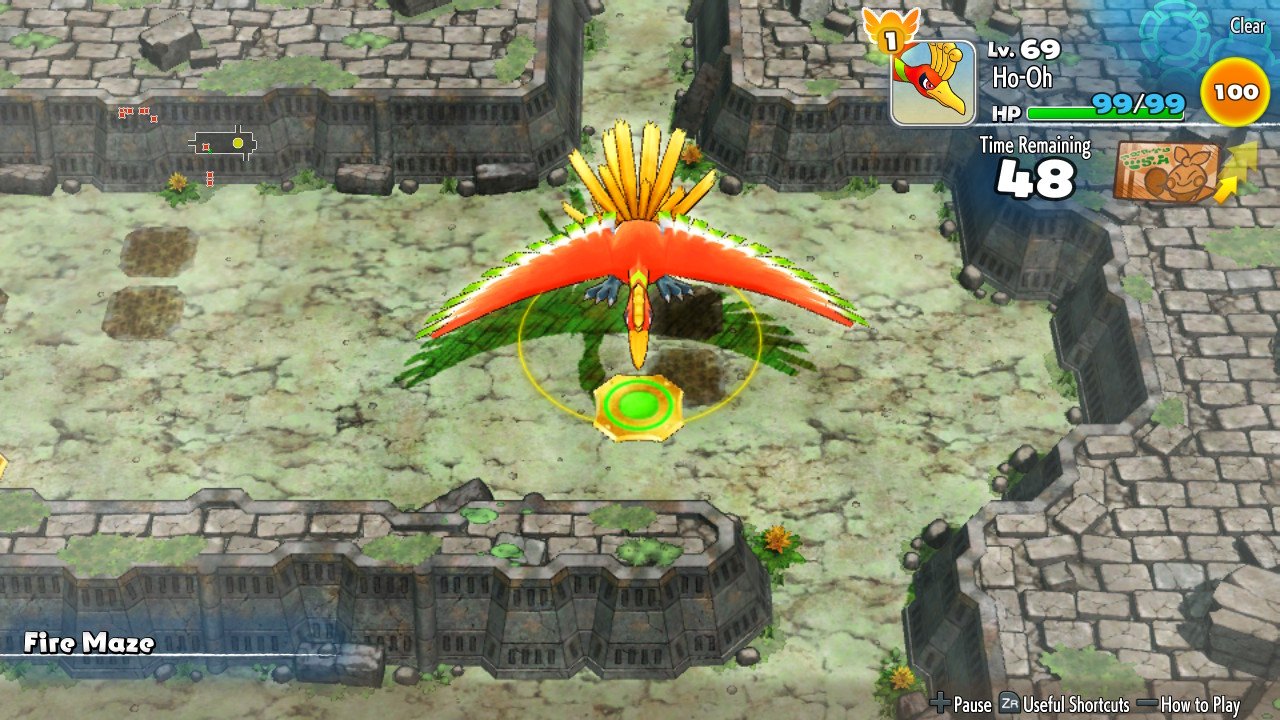
 Ho-OhMt. Faraway · Lv. 60
 LugiaSilver Trench · Lv. 65
 MewtwoWestern Cave · Lv. 70
Spinda in Pokémon Square sends the team after Ho-Oh at the top of the 60-floor Mt. Faraway. Lugia, at level 65, waits in the depths of Silver Trench beneath the sea, and Mewtwo, at level 70 the highest-level boss in the game, sits at the end of Western Cave. Two post-game dungeons also gain notable strong foes after their first clear: a Ditto in Buried Relic and a Ninetales in Northern Range.
Pokémon
More than 400 Pokémon can be met and recruited in Rescue Team DX. The core of the roster is every species from Generations I to III, as in 2005, now joined by later evolutions and pre-evolutions of those Pokémon and by the Fairy type, which did not exist when the originals were made. Nothing from Generation VIII appears, even though the remake arrived in the Pokémon Sword and Shield era.
Playable Pokémon
The hero and partner come from the same 16 species. The personality quiz suggests one for the hero from your answers and gender, but its pick can be turned down, and the partner can be any of the others as long as it does not share a type with the hero:
 BulbasaurGrass/Poison
 CharmanderFire
 SquirtleWater
 PikachuElectric
 MeowthNormal
 PsyduckWater
 MachopFighting
 CuboneGround
 EeveeNormal
 ChikoritaGrass
 CyndaquilFire
 TotodileWater
 TreeckoGrass
 TorchicFire
 MudkipWater
 SkittyNormal
In the originals, Meowth, Machop and Cyndaquil could only be male heroes and Eevee, Chikorita and Skitty only female ones, while partners were limited to Pikachu and the nine first partner Pokémon. DX drops all of those restrictions.


Later-generation newcomers
Among the later relatives of older Pokémon now in the roster are these, along with Riolu and Lucario, who can only be recruited from Mystery Houses:
 Ambipom#424
 Lickilicky#463
 Weavile#461
 Bonsly#438
 Mime Jr.#439
 Chingling#433
 Mantyke#458
 RioluMystery Houses only
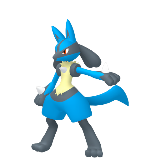 LucarioMystery Houses only
Notable Pokémon
- Pikachu: One of the 16 hero and partner choices, and front and centre in the game’s art and trailers.
- Ninetales: The Pokémon at the heart of the legend that drives the escape from Pokémon Square; a strong-foe Ninetales also roams Northern Range.
- Gengar: Leader of Team Meanies, and one of the Mega Evolutions showcased in official material for DX.
- Celebi: A Shiny Celebi can be recruited from Western Cave’s Mystery Houses once Purity Forest has been cleared for the first time.
- Groudon and Kyogre: The story boss of Magma Cavern and the post-game boss of Stormy Sea; an Empowerment Seed triggers Primal Reversion in both.
- Rayquaza: The final boss at Sky Tower, which can Mega Evolve only if it knows Dragon Ascent.
- Munchlax: Makes a cameo appearance, and giving it an Apple earns unusual held items or Gummis.
Demo & updates
Rescue Team DX was announced in a Pokémon Direct on 9 January 2020, and a free demo went up on the Nintendo eShop the same day. It covers the start of the adventure, and its save data carries straight over to the full game, so nothing has to be replayed. Since launch, the game has had a single patch.
| Date | What happened |
|---|---|
| 9 January 2020 | Revealed in a Pokémon Direct; free demo released on the Nintendo eShop. |
| 21 February 2020 | A five-minute Japanese overview video and two TV commercials released. |
| 6 March 2020 | Worldwide launch on Nintendo Switch (version 1.0.0). |
| 17 March 2020 | Version 1.0.2 released, fixing several issues. |
Regional Variations

Rescue Team DX launched on the same day around the world, so the differences between regions are small:
- The Pokémon Company publishes the game in Japan, and Nintendo in North America, Europe and Australia.
- It came out on 6 March 2020 in Japan, North America, Europe, Australia, Hong Kong and Taiwan alike.
- There is no South Korean release, even though Blue Rescue Team was sold there.
- The text can be set to Japanese, English, French, German, Italian or Spanish; there is no Korean or Chinese option.
- The North American logo uses the same ‘Mystery Dungeon’ lettering as the European logos of earlier games, rather than a separate American design.
- European releases have localised titles: Pokémon Donjon Mystère : Équipe de Secours DX (French), Pokémon Mystery Dungeon: Retterteam DX (German), Pokémon Mystery Dungeon: Squadra di Soccorso DX (Italian) and Pokémon Mundo misterioso: equipo de rescate DX (Spanish).
Left in the data
- A debug menu survives in the files, complete with battery-level indicators and a cutscene viewer.
- The project’s internal name was ‘pegasus’. A leftover revision file records build 1500, dated 6 December 2019, and other debug text carries dates from 2018 and 2019.
- Leftover data for many Pokémon from Gates to Infinity and Super Mystery Dungeon is still in the files, often with incomplete models, along with partial code for Generation IV to VI species that only mods can use.
- Unused text mentions Kyurem’s forms, Meloetta’s Aria Forme and Furfrou, none of which appear in the game.
- A data file from Spike Chunsoft’s Shiren the Wanderer series, also found in Super Mystery Dungeon, sits unused, as do demo leftovers such as a separate demo title logo.
Videos & media
Trailers and promotional videos for Rescue Team DX, from the reveal in January 2020 to the launch in March.
The announcement trailer from the Pokémon Direct of 9 January 2020.
An introduction to the adventure from The Pokémon Company.
A gameplay trailer for the Switch release, from Nintendo UK.
The five-minute Japanese overview video from 21 February 2020.
Nintendo UK’s trailer for the 6 March 2020 launch.
Trivia & facts
- Rescue Team DX was the first remake of a Pokémon game from outside the core series.
- Although it came out during Generation VIII, the game contains nothing that generation introduced, not even a new move or Ability.
-

The box art, here on a UAE copy. The box art merges the covers of Red Rescue Team and Blue Rescue Team, with the same Pokémon and setting repainted in the new style.
- Famitsu gave the 2005 originals and the 2020 remake exactly the same score: 35 out of 40.
- The originals named their highest rescue rank after Lucario, a Pokémon that could not be recruited at the time. DX renames the rank Grand Master and lets Lucario join the team, but only from a Mystery House.
- Western Cave, Mewtwo’s home, shrinks from 99 floors to 20, while Ho-Oh’s Mt. Faraway grows from 40 floors to 60.
- The legendary birds Articuno, Zapdos and Moltres are gigantic Pokémon in DX, each taking up a three-by-three block of tiles.

Mt. Thunder’s summit, home of a gigantic Zapdos. - Shiny Pokémon only appear as strong foes, and a Friend Bow is needed to recruit one. The exception is a Shiny Celebi found in Western Cave’s Mystery Houses.
- The TMs were brought up to date to match Pokémon Sun and Moon and Ultra Sun and Ultra Moon.
- The game’s files contain a debug menu whose default names are Max for the hero, Peyton for the partner and simply Pokémon for the team.

Legacy
What came after
- Worldwide launch – 6 March 2020. Released on Nintendo Switch in Japan, North America, Europe, Australia, Hong Kong and Taiwan, and No. 1 on the Japanese chart in its first week.
- 1.26 million sold – 31 March 2020. Nintendo’s results for the year to March 2020 counted about 360,000 copies in Japan and 890,000 overseas, making it a million-seller in under four weeks.
- 1.99 million sold – 31 December 2022. The lifetime figure in CESA’s 2023 Games White Paper, ahead of the lifetime sales of Gates to Infinity.
- Red Rescue Team on Nintendo Switch Online – 9 August 2024. The Game Boy Advance original joined the Nintendo Switch Online + Expansion Pack library, so both the 2005 game and its remake can now be played on Switch.
- Nintendo Switch 2 compatibility – From June 2025. Nintendo lists Rescue Team DX as compatible with Nintendo Switch 2, which launched on 5 June 2025.
Where to play it today
Rescue Team DX is still on sale as a standard Nintendo Switch game in October 2026, on game cards and as a download from the Nintendo eShop, where the free demo is offered too, and Nintendo lists it as compatible with Nintendo Switch 2. The game has only ever had one patch, version 1.0.2, and nothing in it relies on servers apart from online rescue requests, which need Nintendo Switch Online; password rescues still work offline. The 2005 Red Rescue Team can also be played on Switch through Nintendo Switch Online + Expansion Pack.
How it was made
Rescue Team DX was made by Spike Chunsoft, formed in 2012 when Chunsoft, the studio behind the Mystery Dungeon format and the original Rescue Team games, merged with Spike. Shin-ichiro Tomie and Hironori Ishigami directed, with Tomie also writing the scenario. Akihiro Kaneko led the game planning and Takuya Kanai the programming, while Hiroko Takano and Keisuke Sakurai shared the art direction. Keisuke Ito arranged the score and composed new music around Arata Iiyoshi and Atsuhiro Ishizuna’s original themes. Hitoshi Yamagami, Takato Utsunomiya and Kazunori Sugiura were among the producers, with Tsunekazu Ishihara, Shuntaro Furukawa and Mitsutoshi Sakurai as executive producers.
The remake was built in the Unity engine under the internal project name ‘pegasus’, and debug text left in its files carries dates from 2018 and 2019. It was announced in a Pokémon Direct on 9 January 2020, the same day the free demo arrived, and a five-minute Japanese overview video and two TV commercials followed on 21 February, a fortnight before launch.
The Rescue Team story elsewhere

Sales & reviews
Sales figures
Rescue Team DX sold quickly. It went straight to No. 1 in Japan, where Famitsu counted 138,548 physical copies in its launch week (Media Create’s count was 130,510), and by 31 March 2020, less than four weeks after release, Nintendo had sold 1.26 million copies worldwide: about 360,000 in Japan and 890,000 overseas. The weekly Japanese retail charts had it at 281,908 copies by 3 January 2021. CESA’s 2023 Games White Paper put lifetime sales at 1.99 million by the end of 2022, ahead of Gates to Infinity’s lifetime total, though still well short of the 5.23 million copies that Red and Blue Rescue Team sold between them.
- 1.99msold by the end of 2022 (CESA)
- 1.26msold by 31 March 2020 (Nintendo)
- 138,548Japan launch week, at No. 1 (Famitsu)
- 69Metacritic, from 78 critics
Review scores
Rescue Team DX divided critics. Almost everyone admired the way it looks, but opinions split over whether the remake had done enough to modernise a 15-year-old design. Three verdicts from the English-language reviews:
- GameSpot’s Cian Maher was one of its warmest critics, writing that “Mystery Dungeon on Switch improves upon the originals with some valuable quality-of-life tweaks” and scoring it 8/10.
- Nintendo World Report’s Daan Koopman gave it 7/10: “The improvements are more or less throwaways, but the core adventure is still a solid one.”
- Nintendo Life’s Chris Scullion settled on 6/10, concluding: “It’s still fun in bursts, it just gets samey after a while.”
Aggregate scores settled at 69 on both Metacritic and OpenCritic, where only 39 per cent of critics recommended the game. The new art style was praised almost everywhere, as were the soundtrack, the warmth of the story and conveniences such as recruiting inside dungeons and buying camps freely. The common complaint was that the 2005 design underneath had barely moved on: critics found the dungeons repetitive over long sessions, the deepest ones most of all, missed visible enemy health bars in boss fights and felt the new features did little to modernise the formula. Auto mode split opinion, with Nintendo Life arguing that it undercuts the exploration the game is built on. Famitsu’s panel was far kinder, awarding 35 out of 40.
Media & artwork
Further reading
More Mystery Dungeon and Nintendo Switch links on the site: